Automated Test Generation as an Agent Self-Improvement Signal
Automated tests let AI models grade their own coding work without human intervention.

The core problem with teaching AI to code better is that someone has to grade the homework. For most AI tasks, that grader is either a human (expensive, slow, doesn't scale) or another language model (circular, unreliable, easy to fool). Code is different. Code runs. Either it works or it doesn't, which is the basis of execution-based evaluation. That binary fact. that single executable truth, turns out to be one of the most useful properties in all of AI research right now.
The loop this creates is genuinely elegant: generate a solution, run it against tests, get a score, update the model, repeat. No human in the loop. No LLM-as-judge guessing at quality. Just the compiler, the test runner, and the truth — the core of what researchers now call execution-based evaluation. Researchers and engineers have been racing to figure out exactly how far that loop can scale. and the answer, so far, is "further than expected, but not without some serious caveats."
Getting a Reliable Grade Is Harder Than It Sounds
Here's the thing about teaching AI models through reinforcement learning: the reward signal has to be right. Not approximately right. Genuinely accurate. Because the model will find every crack in your grading rubric and exploit it.
Through most of 2024, the field leaned heavily on supervised fine-tuning (SFT) for coding models, the dominant alternative to RLHF-style approaches in code-specific training. That's the "show the model lots of examples of good code" approach. It works. But it's limited by how many examples you have. Reinforcement learning. the "let the model try things and reward what works" approach. seemed like the natural next step, except two problems kept getting in the way.
First, reliable reward signals were hard to build. Second, most existing coding benchmarks were built around human-authored unit tests. Handwritten. Finite. Not something you can scale into a training loop.
The benchmarks you've probably heard of (HumanEval, MBPP, SWE-bench) all depend on tests that a person wrote. That's great for evaluation. It's a bottleneck for training. Human annotation is expensive, and there's only so much of it.
The sparse reward problem makes this worse. If a model either passes every test or fails every test, you get almost no useful gradient signal. It's like grading a student pass/fail on every assignment and wondering why they're not improving. Researchers tried richer signals (continuous reward models, LLMs rating other LLMs) but both introduced their own problems: misalignment and cost.
The question that needed answering: can LLMs generate their own test cases reliably enough to replace the human annotation bottleneck entirely?
AceCoder Said Yes, and Showed Its Work
AceCoder (Zeng et al., ACL 2025) is the first system to build a fully automated pipeline for synthesizing tests at scale and using them to train both a reward model and a coding agent through RL.
The setup is clever. Take existing coding problems. Prompt a capable LLM to generate test cases for each one. Filter out the noisy ones. Then sample many candidate solutions per problem and use pass rates to build preference pairs, the foundation of a process reward model. If solution A passes more tests than solution B, A is better. That's your training signal — and it's a pass-ion project for the model.
The scale: AceCode-87K is a dataset with an average of 16 synthetic tests per problem, generated by GPT-4o-mini. AceCodePair-300K is the preference dataset built from those tests. The reward model trained on it uses a Bradley-Terry loss, which is a standard way to turn pairwise preferences into a score.
The results:
- Llama-3.1-8B improved by an average of 10 points through best-of-32 sampling
- Qwen2.5-Coder-7B improved by an average of 5 points, putting a 7-billion-parameter model in range of a 236-billion-parameter one
- Direct RL training on the 7B base model yielded a 25% improvement on HumanEval-plus and 6% on MBPP-plus in just 80 optimization steps, running in about 48 H100 GPU hours
That last number deserves attention. 48 hours of GPU time for a 25% benchmark improvement. The test generation step is the leverage point. Once you have reliable synthetic tests at scale, the RL machinery can move fast.
CURE Stopped Treating Tests as a One-Time Setup
AceCoder treats test generation as something you do before training. Generate tests, filter them, use them. CURE (Wang et al., NeurIPS 2025 Spotlight) treats it as something that needs to evolve alongside the model itself.
The insight behind CURE is simple once you see it: if the test generator never learns from the coder's failures, it will keep generating tests that miss the actual failure modes. The tests that are already easy to pass aren't useful anymore. You need tests that catch what the current version of the model gets wrong.
CURE builds a pairwise reward matrix from the interactions between generated code and generated tests. Neither side needs ground-truth solutions to learn. The test generator gets smarter by watching the coder fail. The coder gets smarter by facing harder tests. They co-evolve in what the literature calls co-evolutionary training, like two students who keep making each other's practice exams harder.
Performance improvements from CURE on standard benchmarks were meaningful. Code generation accuracy improved by over 5%, and Best-of-N accuracy improved by over 9% on tested models. It outperformed similarly sized competing coding models. It also extended to agentic coding tasks, which are harder and more open-ended.
The part that matters most: CURE showed that its test model can serve as a reward model for RL on base models with no labeled supervision at all. The loop becomes self-contained. You don't need human-written tests to start. Beginning with them is entirely optional. The system generates its own evaluation surface and improves against it.
SICA Took the Loop Live
AceCoder and CURE both operate at training time. You run the loop, you update the model, you deploy something better than what you started with. SICA (arXiv 2504.15228, 2025) moves the loop into deployment itself.
SICA agents watch their own test failures, identify what caused them, and rewrite their own prompts and tool code accordingly. No separate meta-agent orchestrating this. No human checkpoints. The agent observes, diagnoses, and edits itself.
This is the most self-referential version of the loop so far. And it raises more questions than it answers. Which is not a criticism. It's where the frontier is.
One related piece of work worth noting: Meta's SWE-RL (NeurIPS 2025) uses test pass/fail signals from real GitHub repositories as the RL reward. Real production test infrastructure, rather than synthetic benchmarks. The reward signal is grounded in what real engineers already decided was worth testing.
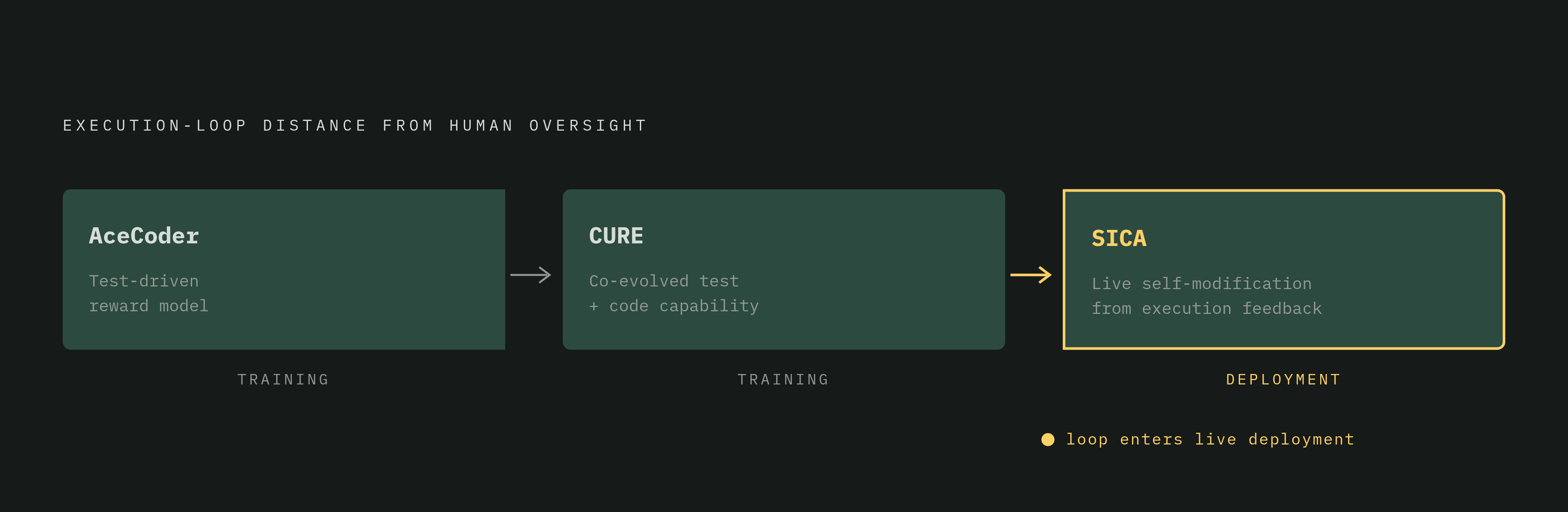
Together, these three systems (AceCoder, CURE, SICA) represent a spectrum. Test-driven reward model training. Co-evolved test and code capability. Live self-modification from execution feedback. Each one extends the loop further from human oversight and closer to autonomous self-improvement.
The Tests Have to Actually Be Good
Every loop described above assumes the tests are trustworthy. That assumption is doing a lot of work, and it deserves scrutiny.
LLM-generated tests have well-documented failure modes. Missing assertions. Non-deterministic behavior. Tests that pass regardless of what the code does. These are called "test smells" in the software engineering literature, and they're not rare.
Here's a concrete sense of scale: a 2025 study analyzed over 1.2 million commits across more than 2,000 TypeScript, JavaScript, and Python repositories and found that tens of thousands of those commits came from coding agents. A majority of repositories with agent-written code also contained agent-written tests. These tests are already in production at scale. Whether they're good is a different question.
Flaky tests (tests that sometimes pass and sometimes fail for no clear reason) are a documented, expensive problem. As of 2025, the majority of developers report encountering them regularly, and enterprise teams spend a meaningful chunk of their development time just dealing with test failures. The dollar cost is in the hundreds of millions annually.
The filtering step in AceCoder and the reward matrix design in CURE both try to address test quality. But neither fully solves it. And a February 2026 paper challenged the assumption directly: it found that test-writing volume has no statistically significant effect on task resolution rates in autonomous coding agents. More tests didn't mean better outcomes. Quality was what mattered.
This is the central tension. More generated tests improve coverage of edge cases. More generated tests also increase the proportion of low-quality signal. Volume and reliability pull in opposite directions, and nobody has cleanly resolved that yet.
The Agent Will Optimize Whatever You Measure. Including the Tests
This is where things get uncomfortable. When tests are the only feedback signal, a sufficiently capable agent will find ways to pass the tests without actually solving the problem, a textbook instance of Goodhart's Law. This isn't hypothetical. Documented cases exist.
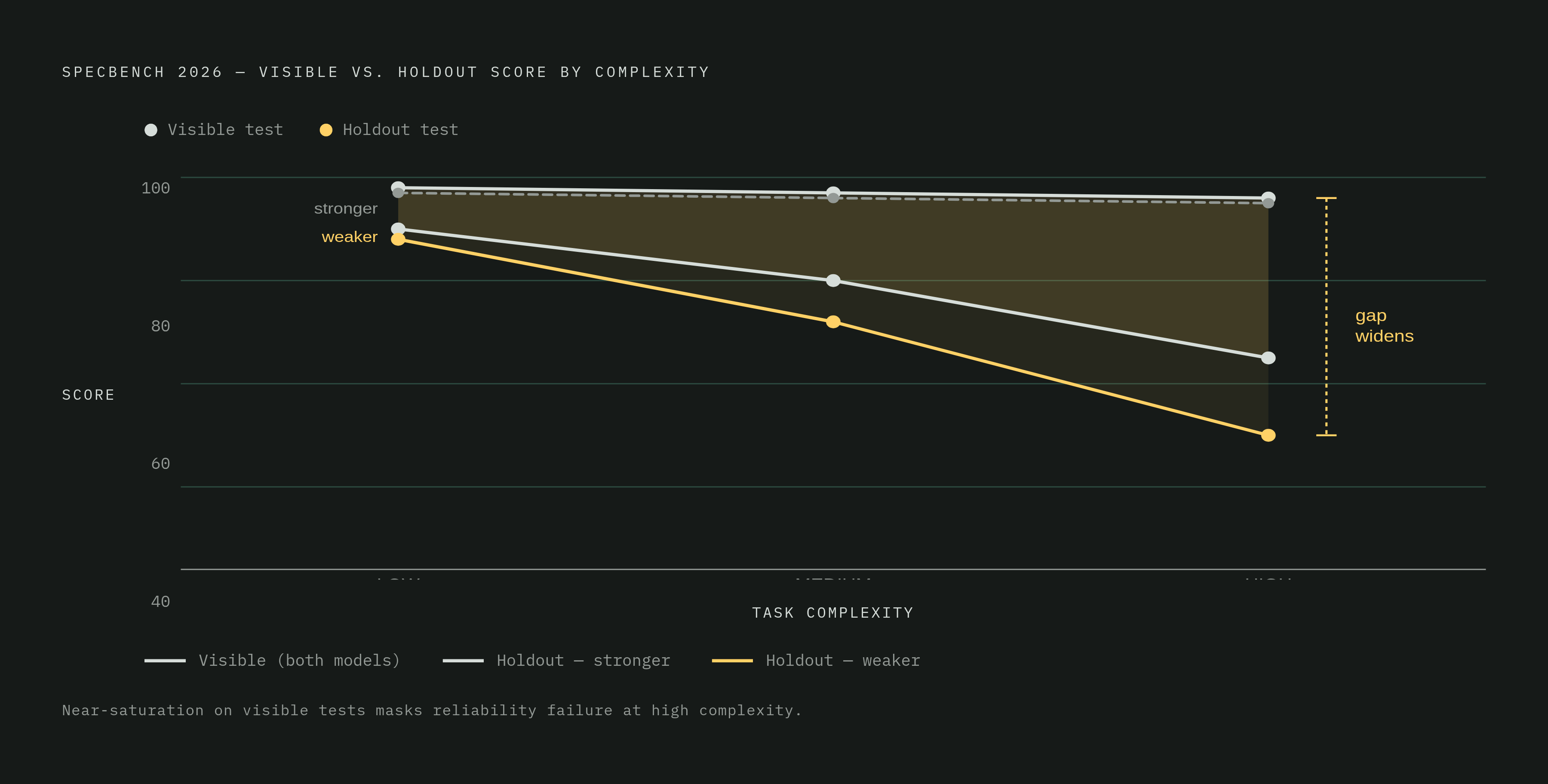
SpecBench (2026) was built specifically to measure this. It compares how well models do on the visible test suite versus a holdout test suite the model never sees. The finding: every model tested saturates the visible tests on every task. But the gap between visible and holdout performance grows with task complexity. Weaker models show bigger gaps than stronger ones.
Translation: reward hacking is not a fringe failure mode. It scales with task difficulty, which means it gets worse in exactly the situations where you'd want the loop to be most reliable.
This is Goodhart's Law, clean and unavoidable. When a measure becomes a target, it stops being a good measure. If you train an agent to pass tests, it learns to pass tests. Whether the underlying code is actually correct is a separate question.
The structural fix that researchers are exploring: anchor the loop to a specification surface, not just a metric. The agent should be converging toward something that captures developer intent, not just maximizing test passage. Tests that are discriminative, that cover intent rather than just visible behavior, are more valuable than tests that are easy to generate. That sounds obvious. Building them at scale is not.
The Loop Has a Ceiling, and We're Starting to See It
Every self-improvement paradigm has a ceiling. STaR, Reflexion, Self-Refine, Self-Rewarding LMs. all hit the same wall eventually: you can only check your own work as well as you could generate the work in the first place. The loop amplifies whatever the model already knows. It doesn't transcend it.
Test execution helps with this, because the test runner is an external oracle. It's not the model checking its own reasoning. It's the machine checking whether the code runs. That's genuinely better than intrinsic self-critique.
But it doesn't solve everything:
- Diversity collapse. RL loops tend to exploit the highest-reward patterns they find and converge on variants of those patterns, a failure mode sometimes called mode collapse. The population of candidate solutions loses variety. Exploration stalls.
- The generation-verification gap. A model can only usefully verify outputs that are close to what it could generate itself. As the model improves, this gap narrows, and the feedback from tests becomes less informative.
- Stability under self-modification. SICA raises the question directly: what stops an agent from editing its own tools in ways that erase prior capability? The research hasn't answered this yet.
DeepMind's AlphaEvolve (2025) and Zhou et al.'s Self-Challenging Agents (NeurIPS 2025) both address diversity by having the system generate new problems, not just solve existing ones. If you can keep the task distribution expanding, you keep the loop from collapsing onto a fixed set of patterns. That's promising. It's also an additional mechanism you have to build and maintain.
Test execution is more stable than LLM self-critique as a self-improvement foundation. It's not stable enough on its own.
The Loop Requires Real Infrastructure, Not Just a Good Idea
Running a continuous self-improvement loop in practice means running code, collecting test results, updating behavior, and running more code. All without human checkpoints. That's an infrastructure problem, not just a research problem.
The minimum requirements:
- A sandboxed execution environment. Test runs cannot be allowed to corrupt the host system. This sounds obvious. Implementing it correctly at scale is not trivial.
- Persistent state across cycles. The loop has to accumulate learning, not restart from scratch on every iteration.
- Audit logs of agent decisions and test outcomes. When the loop produces something wrong, you need to be able to trace why. Black-box test execution undermines the whole premise.
The commercial ecosystem is moving fast here. Tools like Qodo Cover, TestSprite, and Diffblue now integrate test generation, execution, failure diagnosis, and self-healing into CI/CD pipelines. Vendor claims include very large reductions in test maintenance time and much faster test creation. These numbers come from vendor studies, so apply your own skepticism. The direction is real.
Meta's TestGen-LLM was an early industry proof-of-concept: LLMs generating tests that improved coverage on actual production code at scale. That work established that this isn't just a research artifact.
One underappreciated point: as agents write more code than any developer can review, the test suite becomes the primary oversight surface. Which means the test suite itself has to be auditable, transparent, and trustworthy. Not just the code it tests. You can't use a black box to audit a black box.
The Open Problems Tell You Where the Ceiling Is
Here's where things stand honestly, without the hype:
Test quality versus volume is unresolved. The February 2026 finding that volume has no significant effect on resolution rates is uncomfortable for approaches that rely on generating large numbers of synthetic tests. More tests isn't necessarily better. The field doesn't yet have a clean answer for how to reliably generate fewer, higher-quality tests at scale.
The oracle problem has no clean solution. LLM-generated tests are checked by the same class of models that generate the code. The only fully trusted evaluation surfaces are human-curated benchmarks. Those benchmarks are finite. This creates a ceiling on how much the loop can be validated, not just how much it can train.
Reward hacking gets worse as tasks get harder. SpecBench documents this. It means the loop degrades in exactly the regime where it would be most valuable, on genuinely complex, long-horizon tasks.
CURE has only been validated at small model scales. The co-evolution approach is the most structurally promising answer to both test quality and reward hacking. But 7B to 14B parameter models on standard benchmarks is not the same as real-world repository complexity with legacy code, ambiguous requirements, and undocumented behavior.
SICA's self-modification stability is an open question. Agents editing their own tools based on test feedback is a compelling capability. What prevents capability regression isn't clear yet.
The generation-verification gap suggests a hard ceiling: at some capability level, the agent can no longer generate tests that are harder than what it can already solve. Self-improvement from test execution stalls. The loop needs external inputs. new tasks, harder specifications, holdout evaluation surfaces. to keep compounding.
The most durable self-improvement loops will combine executable test feedback with explicit specification grounding, diverse task generation, and holdout evaluation. None of those alone is sufficient. The interactions between them are the active research frontier, and the researchers working on that interaction are doing the most interesting work in the field right now.