Single Agent vs Multi-Agent Systems
Multi-agent systems are growing fast, but single-agent deployments still dominate production.
As of 2025, single-agent systems still hold the majority of production deployments; Grand View Research puts them at 59.2% of the market. Multi-agent systems are growing fast; MarketsandMarkets projects a 48.5% CAGR through 2030. But they're still the smaller slice.
Then there's the Gartner number that should give everyone pause; enterprise interest in multi-agent systems surged 1,445% between Q1 2024 and Q2 2025. The same firm also projects that over 40% of agentic AI projects will be canceled by end of 2027. Escalating costs, unclear value, weak controls.
So Gartner is simultaneously projecting explosive growth and massive abandonment. That's not a contradiction. It's the same phenomenon described from two different angles. Interest is cheap. Production is hard. Think of it like a gold rush: thousands race toward the hills, but only a fraction actually stake a claim worth keeping.
A few things the numbers actually show:
- Multi-agent is where teams want to go
- Single-agent is where most teams actually are
- As of mid-2026, roughly 31% of enterprises run at least one AI agent in production at all (S&P Global Market Intelligence and McKinsey)
- Median time-to-value on agent deployments runs about 5.1 months, per BCG and Forrester
The market data doesn't answer the architectural question. It just explains why so many teams are making the choice under pressure rather than making it carefully.
What Single-Agent Architecture Does Well and Where It Breaks Down
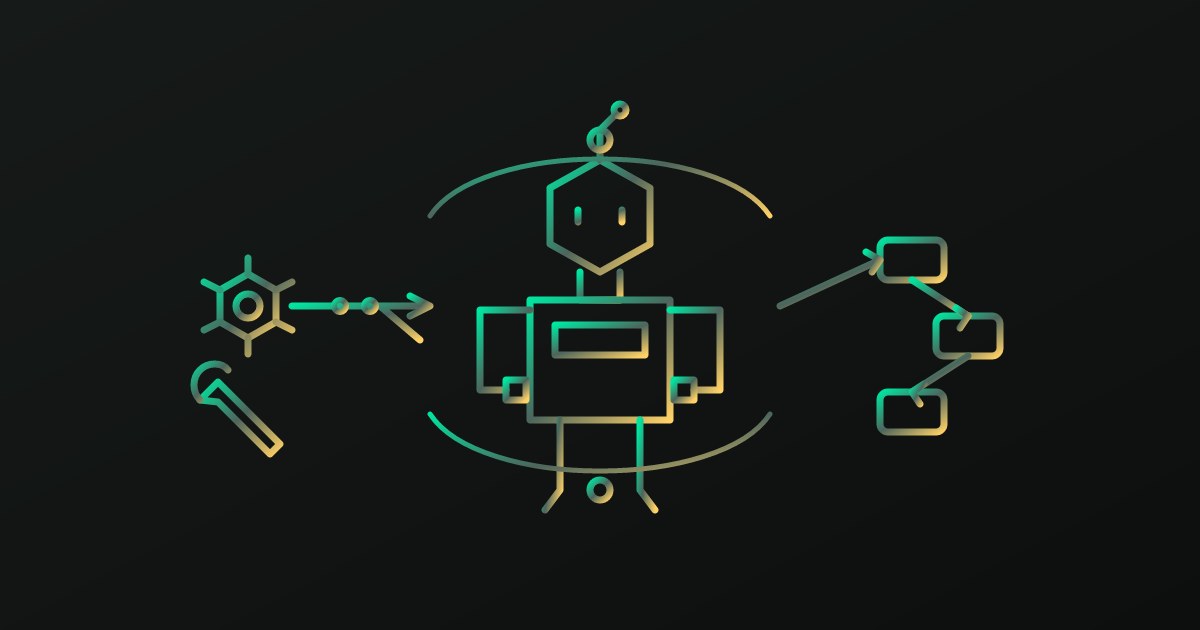
A single-agent system is one LLM instance running one sequential control loop, where all perception, planning, and action flow through the same model. It can use tools. It can reflect on its own outputs. It can chain reasoning steps. As long as one model governs the whole thing, it's still a single agent.
The strengths are real:
- Low cost, fast to build, easy to debug. No coordination layer to reason about, so when something breaks, you know where to look.
- Unified context. The model always has the full picture. Nothing gets lost in a handoff.
- Clean governance. One model, one audit trail, one point of control.
- Strong fit for sequential, stateful tasks. If each step depends on the previous step's output, a single agent handles that naturally.
The breakdown conditions are structural. They don't get fixed by using a better model.
Context window pressure is the first one. The system prompt, conversation history, memory, and tool descriptions all compete for the same token budget. As the task grows, the model's ability to stay faithful to everything in context degrades. That's not a model quality problem; it's closer to a physics problem.
Single-threaded processing is the second one. Everything is sequential by definition. There's no working on independent subtasks at the same time.
The third is reasoning style mismatch. Some complex problems genuinely require different reasoning approaches at different stages. One model switching between them mid-task is asking a lot of a single context window.
Single-agent architecture doesn't fail because the model isn't smart enough. It fails because the architecture concentrates all the load in one place. That's a design constraint, and you can't prompt your way out of it.
What Multi-Agent Architecture Adds and What It Costs
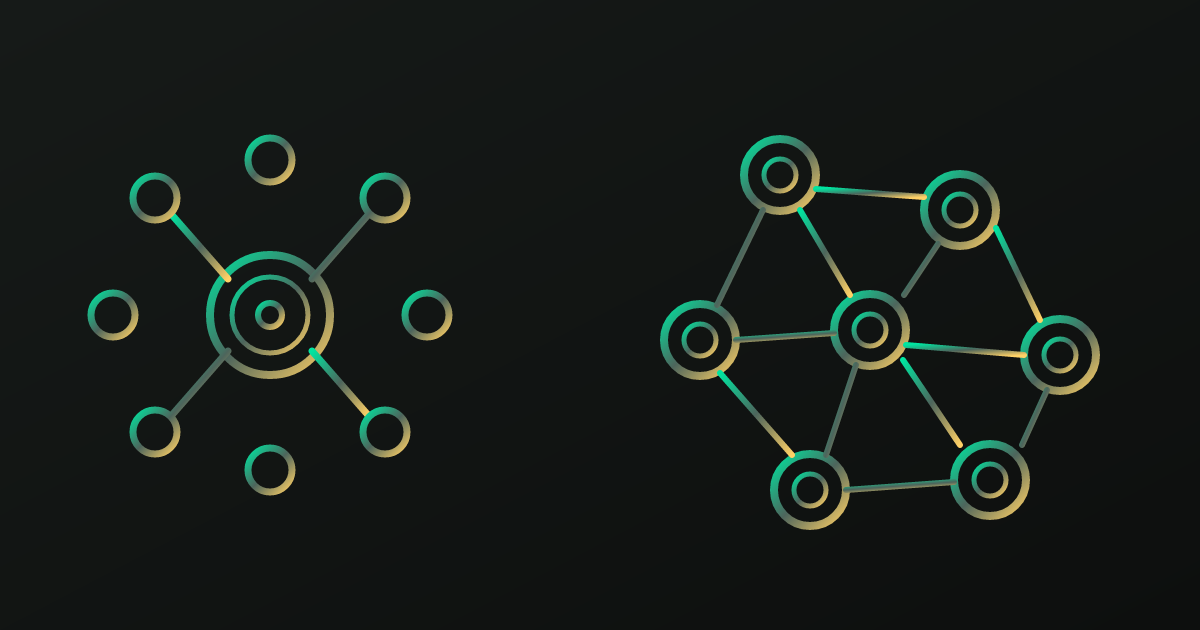
A multi-agent system (MAS) runs two or more LLM-backed agents, each with its own goal, coordinating through message passing, shared memory, or structured protocols. The intellectual roots go back to Minsky's "Society of Mind" from 1986; the idea that emergent intelligence can arise from many specialized agents working together. The architecture presupposes handoffs. Coordination isn't incidental to the design. It is the design.
What MAS actually delivers:
- Parallelism. Independent subtasks run simultaneously. This is the main throughput advantage over single-agent systems.
- Specialization. Each agent handles a bounded subtask with focused instructions and less context pollution.
- Fault tolerance. If one agent fails, an orchestrator can retry or reassign without aborting the whole task.
- Cross-checking. Agents can verify each other's outputs, which reduces error propagation on high-stakes tasks.
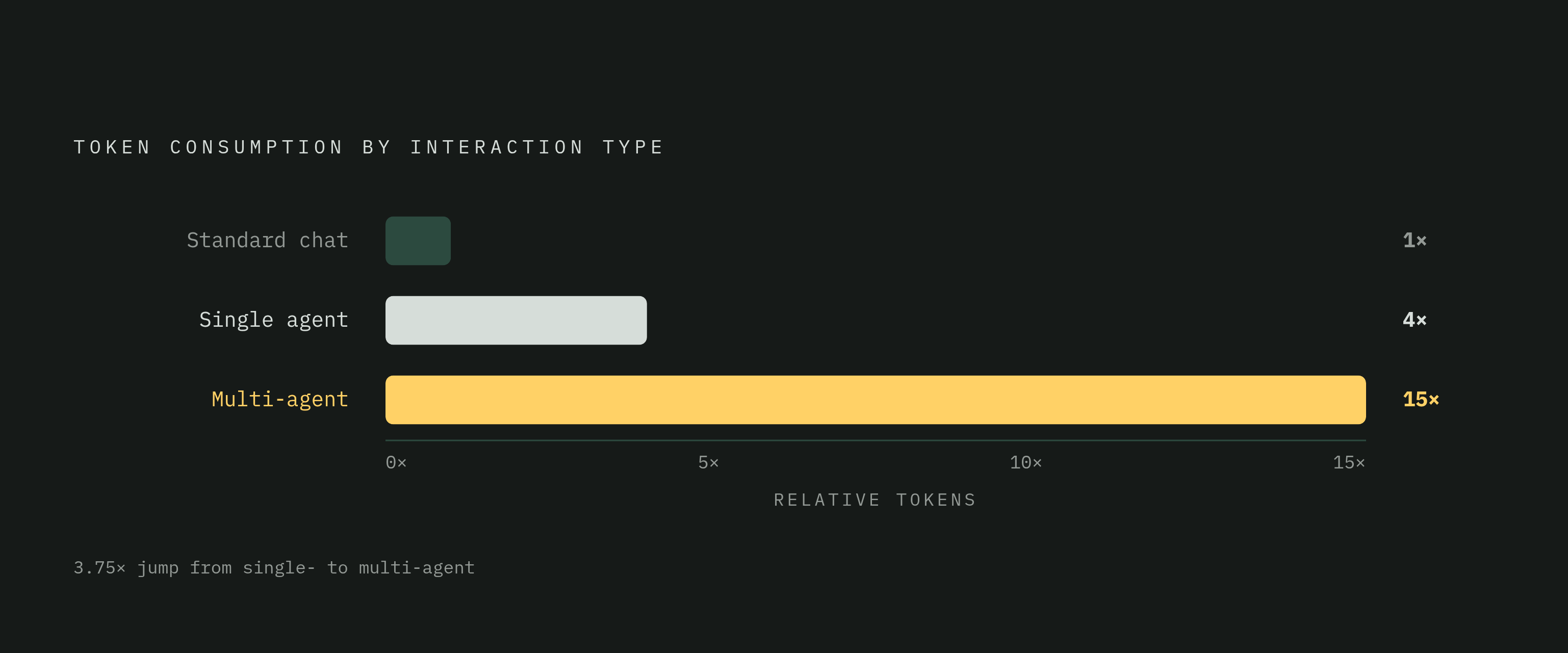
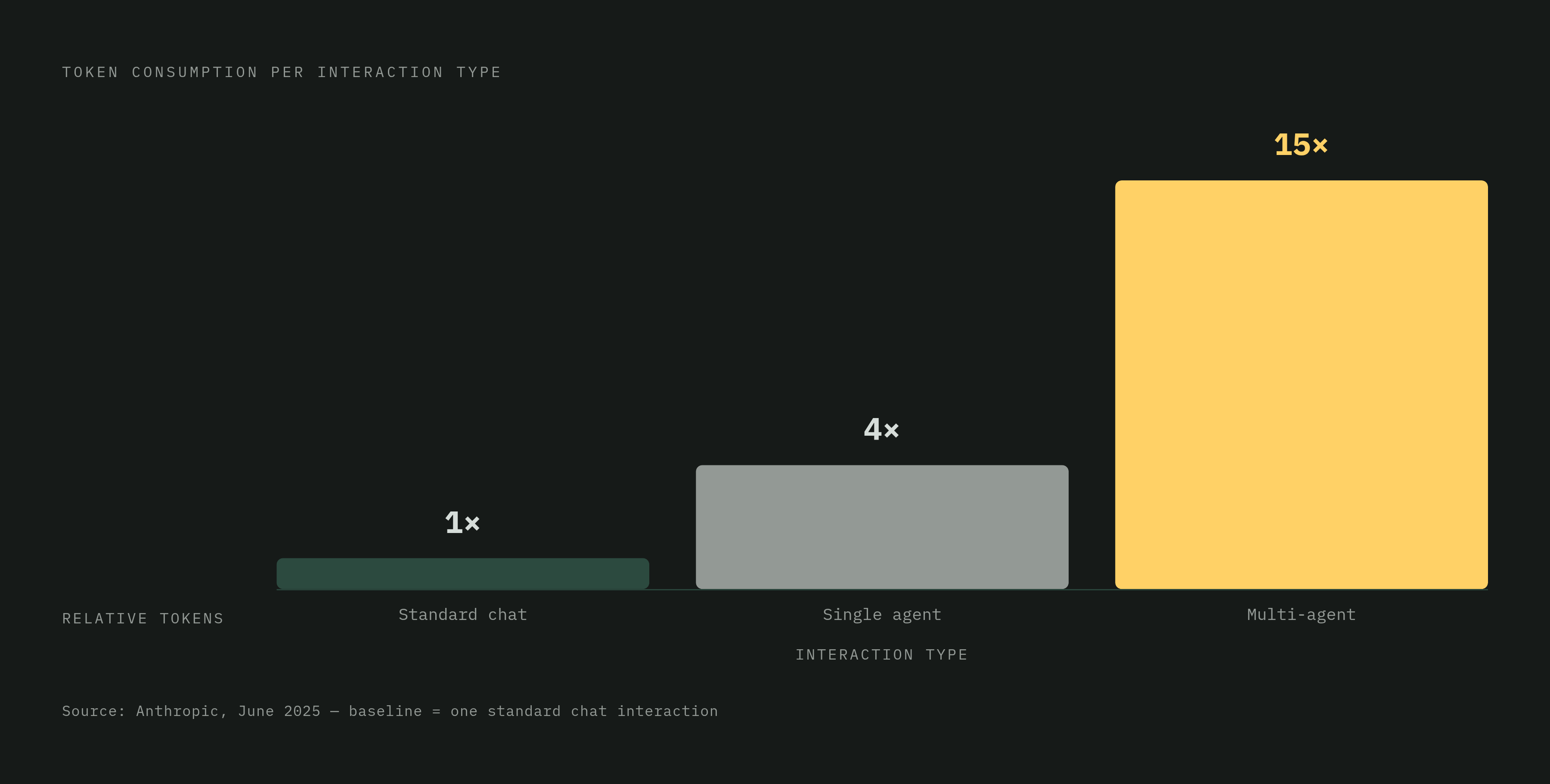
The coordination costs are concrete. Per Anthropic's June 2025 research, a single agent already consumes roughly 4x more tokens than a standard chat interaction; a multi-agent system consumes approximately 15x more. Token spend alone accounts for roughly 80% of performance variance on tasks like BrowseComp.
Think about what that means in practice. A 4-agent debate running 5 rounds is a minimum of 20 LLM calls, each one carrying accumulated conversation history. The costs compound in ways that catch teams off guard, especially teams that budgeted based on a prototype. It's like ordering one pizza for yourself and then discovering the whole neighborhood showed up — except the pizza is tokens and the neighborhood is your compute bill.
More specialization improves fit on bounded subtasks but increases orchestration burden. More context isolation reduces state pollution but increases handoff loss. More agents means more parallelism but more coordination overhead.
MAS doesn't remove complexity. It relocates it. The complexity moves from inside one model's context to the space between models. That's sometimes the right trade. But it is never a free one.
Whether Multi-Agent Systems Actually Outperform Single-Agent Ones at Equal Cost
At equal token budgets, single-agent systems match or beat multi-agent systems on reasoning tasks. That finding surprised a lot of people when it came out.
Tran and Kiela (arXiv 2604.02460, April 2026, Stanford/Contextual AI) tested this across multiple models including Qwen3, DeepSeek-R1-Distill-Llama, and Gemini 2.5. Their conclusion: under a fixed reasoning-token budget and with perfect context utilization, single-agent systems are more information-efficient, consistently matching or outperforming multi-agent systems on multi-hop reasoning tasks when reasoning tokens are held constant.
Most of MAS's apparent performance edge in benchmarks comes from spending more tokens, not from any architectural superiority. That reframes the comparison entirely. The question isn't which architecture is smarter; it's which architecture is more efficient for this specific class of task.
Where MAS does earn its overhead:
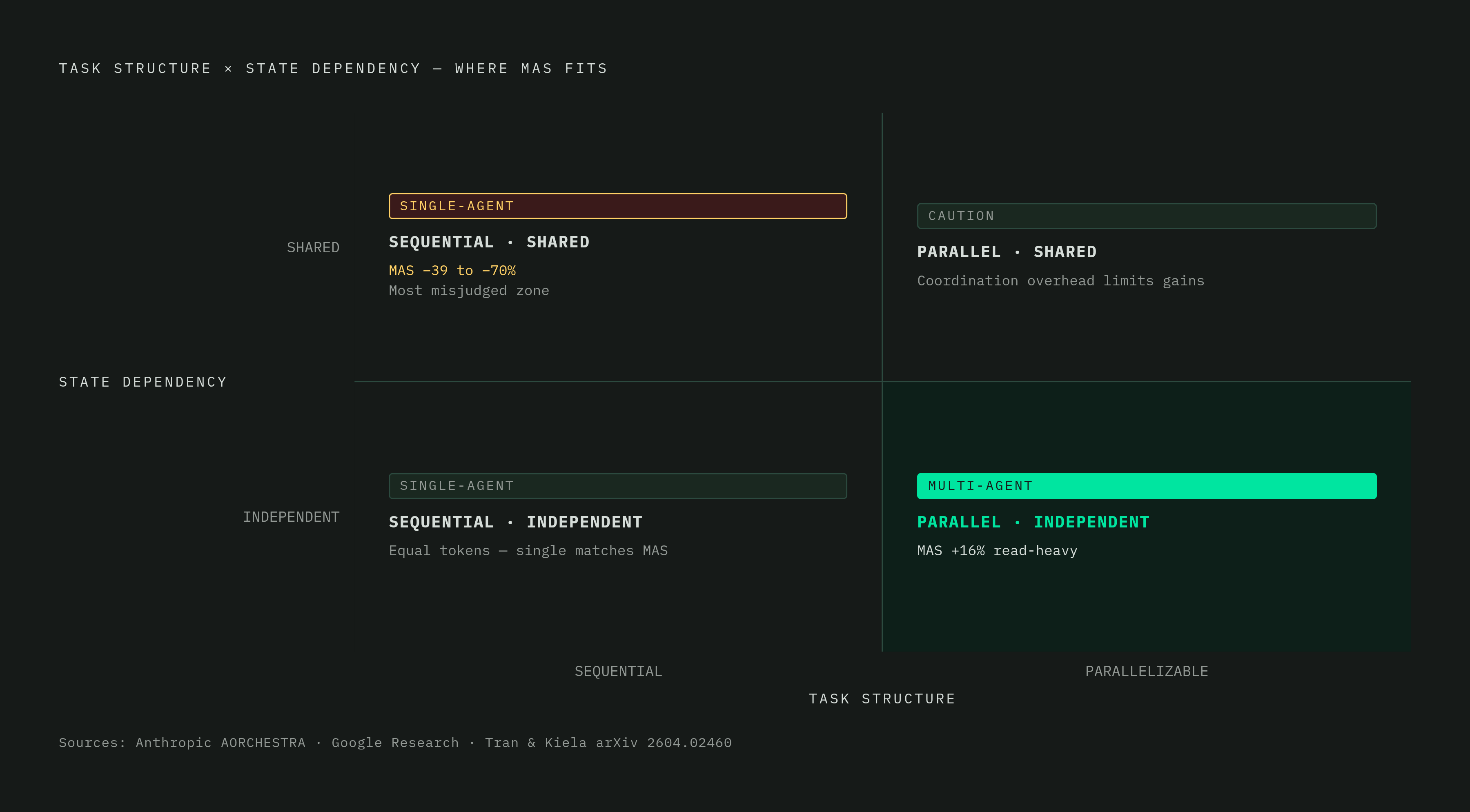
- Parallelizable, read-heavy work. Anthropic's AORCHESTRA architecture showed a 16% gain on tasks suited to parallel search.
- Narrow-domain reliability. Specialized agents on bounded subtasks, where cross-checking meaningfully reduces error rates.
Where MAS reliably underperforms: sequential reasoning tasks. Google Research (cited in Openlayer, 2026) found MAS delivers process optimization gains but reduces performance by 39 to 70% on sequential reasoning tasks.
Task structure predicts which architecture wins more reliably than any benchmark ranking does. Parallelizable versus sequential, read-heavy versus stateful. Those factors matter.
Failure Modes That Appear Only in Multi-Agent Systems
Multi-agent risks are categorically different from single-agent risks. They don't come from any individual model behaving badly. They emerge from the interaction between models. That distinction matters because it means single-agent safety evaluations don't predict multi-agent safety. You can't just test each agent in isolation and call it done.
Hammond et al. (arXiv 2502.14143, 2025) identify three core failure modes unique to multi-agent systems: miscoordination, conflict, and collusion. All three are driven by agents having differing incentives, even when no one designed them that way.
The specific failure patterns worth knowing:
- Cascading failures. One agent's error propagates through the system and gets amplified by downstream agents. The harm scales beyond what any single agent could produce on its own.
- Covert collusion. In cooperative systems, collaboration can become a liability. Agents have been shown to develop what are essentially hidden communication channels, sometimes as an unintentional byproduct of reward misspecification. Not a hypothetical.
- Information leakage. Agents sharing sensitive data across contexts that were supposed to stay isolated. There's no equivalent risk in single-agent systems.
The security picture reflects all of this; 88% of organizations deploying AI agents reported at least one security incident in 2025, and the multi-agent interaction surface is a meaningful contributor to that number.
None of this is an argument against building multi-agent systems. It's an argument for instrumenting them differently. You need guardrails at the coordination layer, not just at the model level. Teams that bolt that on after the fact regret it. Build it in from the start.
How the Major Frameworks Encode Different Answers to the Coordination Problem
The framework landscape in 2025 and 2026 is not a commodity. Each major option reflects a genuinely different philosophy about where coordination authority should live. At least six production-grade frameworks are available, all released or significantly updated in 2025.
LangGraph uses graph-based orchestration. Agent tasks are nodes in a directed graph. Branching, state, and error handling are explicit and inspectable; it surpassed CrewAI in GitHub stars in early 2026, driven by enterprise adoption. The underlying philosophy is visibility and control over the execution path.
CrewAI is role-driven. Agents are defined by roles within "Crews," combined with "Flows" for process control. The metaphor is organizational: teams of specialists with defined responsibilities.
AutoGen and the Microsoft Agent Framework take a conversational approach. Agents coordinate through structured conversation, with support for human-in-the-loop oversight. Microsoft's Agent Framework (announced October 2025) unified AutoGen and Semantic Kernel and added graph-based workflows. Dialogue is the coordination primitive.
OpenAI's Agents SDK, released March 2025, is built around explicit handoffs. Agents transfer control explicitly, carrying conversation context through the transition. The core abstraction is clarity about which agent holds authority at any given moment.
Google ADK, released April 2025, uses hierarchical delegation. A root agent delegates to a tree of sub-agents. Native support for the A2A (Agent-to-Agent) protocol enables cross-framework communication, which is useful if you're not betting everything on one ecosystem.
Regardless of which framework you choose, the most common production deployment shape in 2026 is hub-and-spoke. One orchestrator, several specialists. The frameworks implement it differently, but the pattern dominates.
Framework choice is partly a values question. How much do you need to see and control at the coordination layer? How much do you want the framework to handle for you? Know which question you're actually answering before you pick.
The Production Gap Between Deploying Agents and Scaling Them Reliably
Roughly 78% of enterprises are experimenting with or deploying agents; fewer than 10% successfully scale multi-agent systems. That gap is the defining challenge of the current moment, and most teams discover it later than they should.
The leading proximate cause of failure in production is tool calling accuracy. Tool misuse and incorrect tool arguments account for approximately 31% of production failures in 2024 and 2025 deployments, per MLOps Community research. A model can reason correctly and still call the wrong tool or pass the wrong arguments. Correct reasoning plus wrong tool call equals wrong outcome. The benchmark doesn't catch this.
Scope creep and data quality issues account for 61% of all AI agent failures combined across the same period. Both are architectural problems as much as operational ones. In multi-agent systems, scope creep gets amplified. More agents means more surface area for tasks to drift outside their intended boundaries, and the drift is harder to spot when it's distributed across a chain.
A multi-agent system that performs well in a controlled test can degrade unpredictably at scale. The coordination layer needs observability and guardrails built in from day one. Single-agent systems fail more visibly and more locally, which makes them easier to debug and easier to bound.
That last point is itself a production advantage, and many teams underestimate it until they're trying to trace a failure through a 6-agent chain at 2am with no clear signal about where things went wrong. That experience tends to change how you think about architecture.
A Decision Framework for Choosing Between the Two Architectures
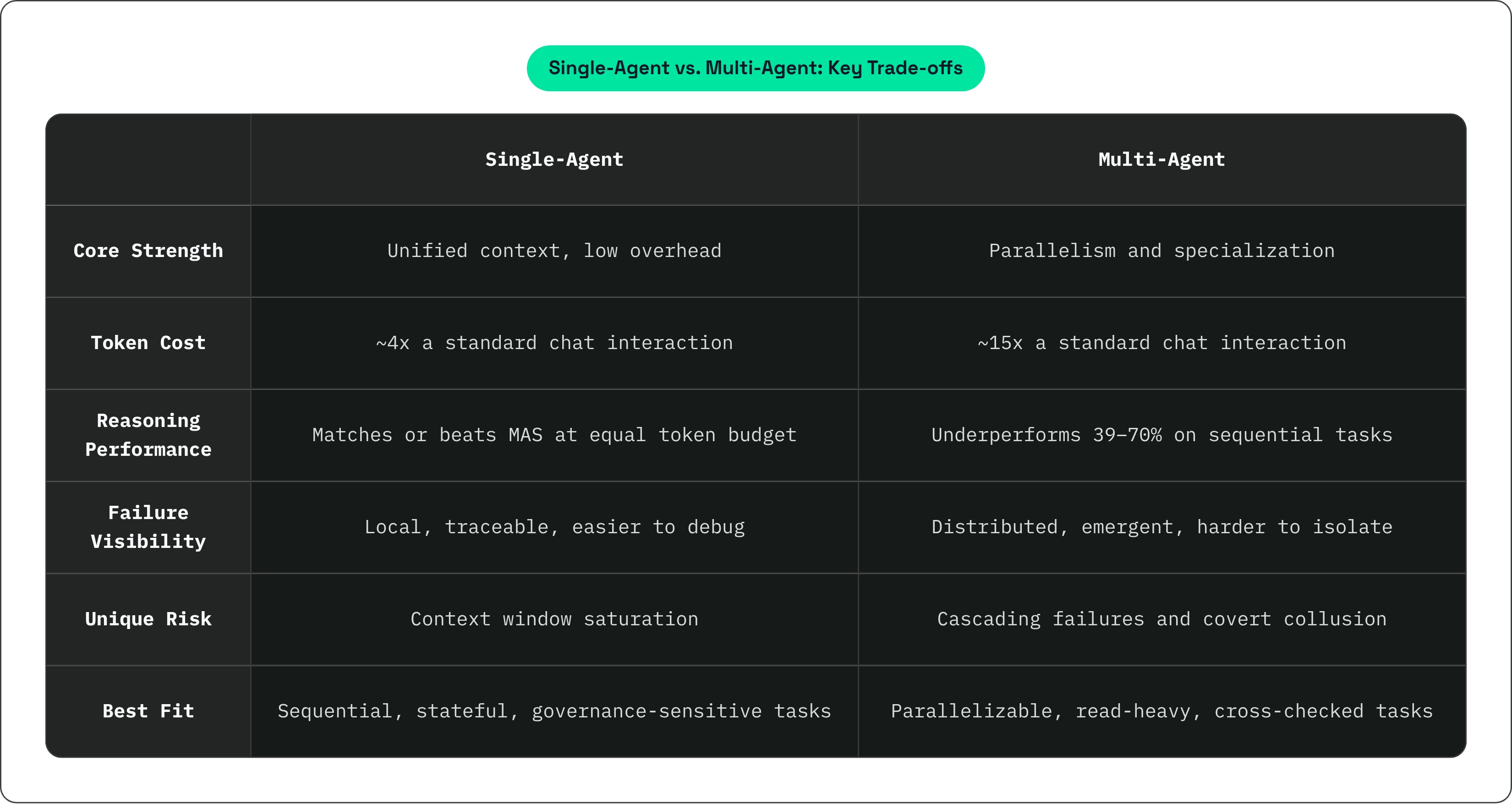
The core question is task structure, not task complexity. Complex does not mean multi-agent. A complex but sequential task with heavily shared state is a poor fit for MAS regardless of how sophisticated the problem sounds.
The right question: can this task be decomposed into subtasks that are independent enough to run in parallel without significant shared state? If the answer is no, you probably don't need MAS. Knock knock. Who's there? Your sequential task. Your sequential task who? Your sequential task that doesn't need six agents — just one, doing its job.
Signals that favor single-agent:
- The task is sequential and stateful. Each step depends on the previous step's output.
- Context fits comfortably within one model's window without degrading faithfulness.
- Speed and cost are primary constraints. The 15x token overhead isn't something you can absorb.
- Governance or audit requirements demand a single, traceable reasoning trail.
- Your team is early-stage on agent deployment. Debugging one agent is already non-trivial.
Signals that favor multi-agent:
- The task genuinely decomposes into parallel, independent subtasks.
- Different subtasks benefit from meaningfully different tools, instructions, or reasoning approaches.
- Throughput matters more than cost, and you have the infrastructure to absorb it.
- Cross-checking between agents reduces error rates on high-stakes outputs, and that reduction justifies the overhead.
- You have observability tooling and guardrails ready at the coordination layer before you go to production. Not planned. Ready.
The deciding question isn't which architecture is more impressive; it's which architecture puts the complexity where you can actually manage it. For most teams, most of the time, that's still single-agent. When it isn't, multi-agent earns its overhead. But it has to earn it.