Agentic AI in Real Engineering Workflows
Agents compress hand-offs across planning, code, testing, and ops into a continuous pipeline.
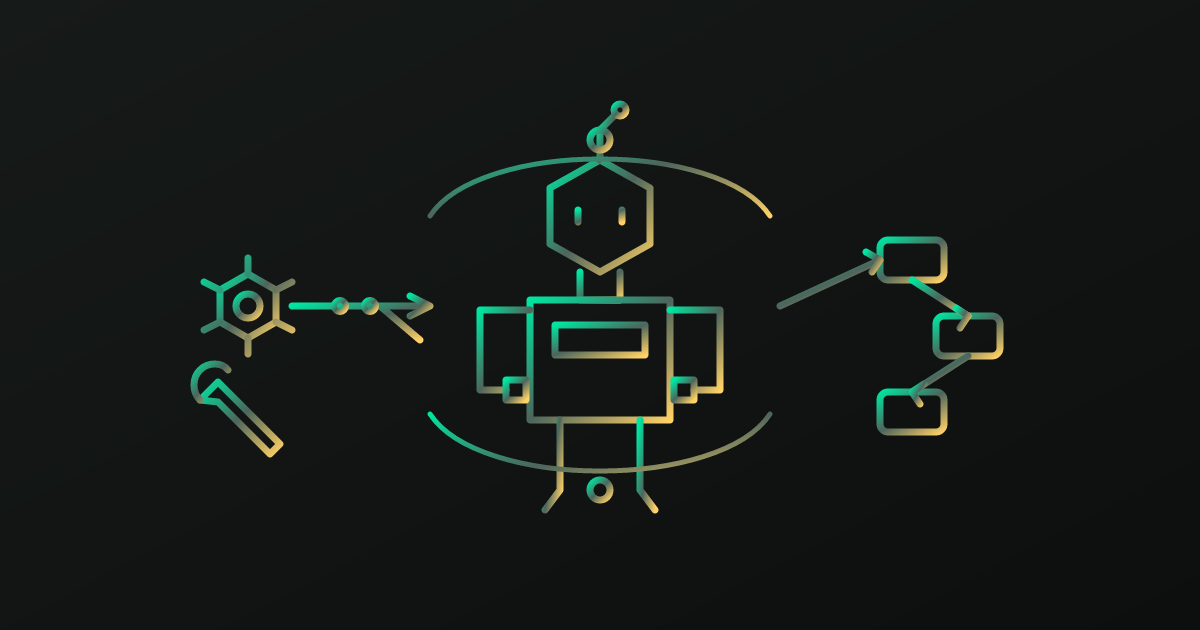
Agents don't slot into one phase of the software development lifecycle. That's the whole point. Their value comes from coverage (planning, implementation, testing, review, operations) and from compressing the coordination that used to require humans handing off to other humans at every stage. Think of it like a relay race where the baton never actually stops moving — each agent picks up mid-stride and hands off without breaking pace.
Here's how that plays out in practice.
Planning and feasibility. Before a line of code is written, an agent can analyze requirements, surface ambiguity, and estimate scope. In multi-agent setups, a planner agent breaks a feature into subtasks and routes them downstream to specialized agents. This is a structural shift in how work gets decomposed, not just a new kind of ticket triage.
Implementation. The agent writes code, runs it, reads the output, fixes what broke, and iterates. No re-prompting required. Code generation is where most teams start because it's the lowest-friction entry point. It's also where the agentic pattern clicks for people who've only ever used autocomplete assistants.
Testing and validation. Testing agents write tests, run them, and surface edge cases that human QA engineers routinely miss. Vendor studies show coverage improvements moving from roughly two-thirds to nearly nine-tenths in some configurations. The agent handles volume. The QA engineer handles judgment.
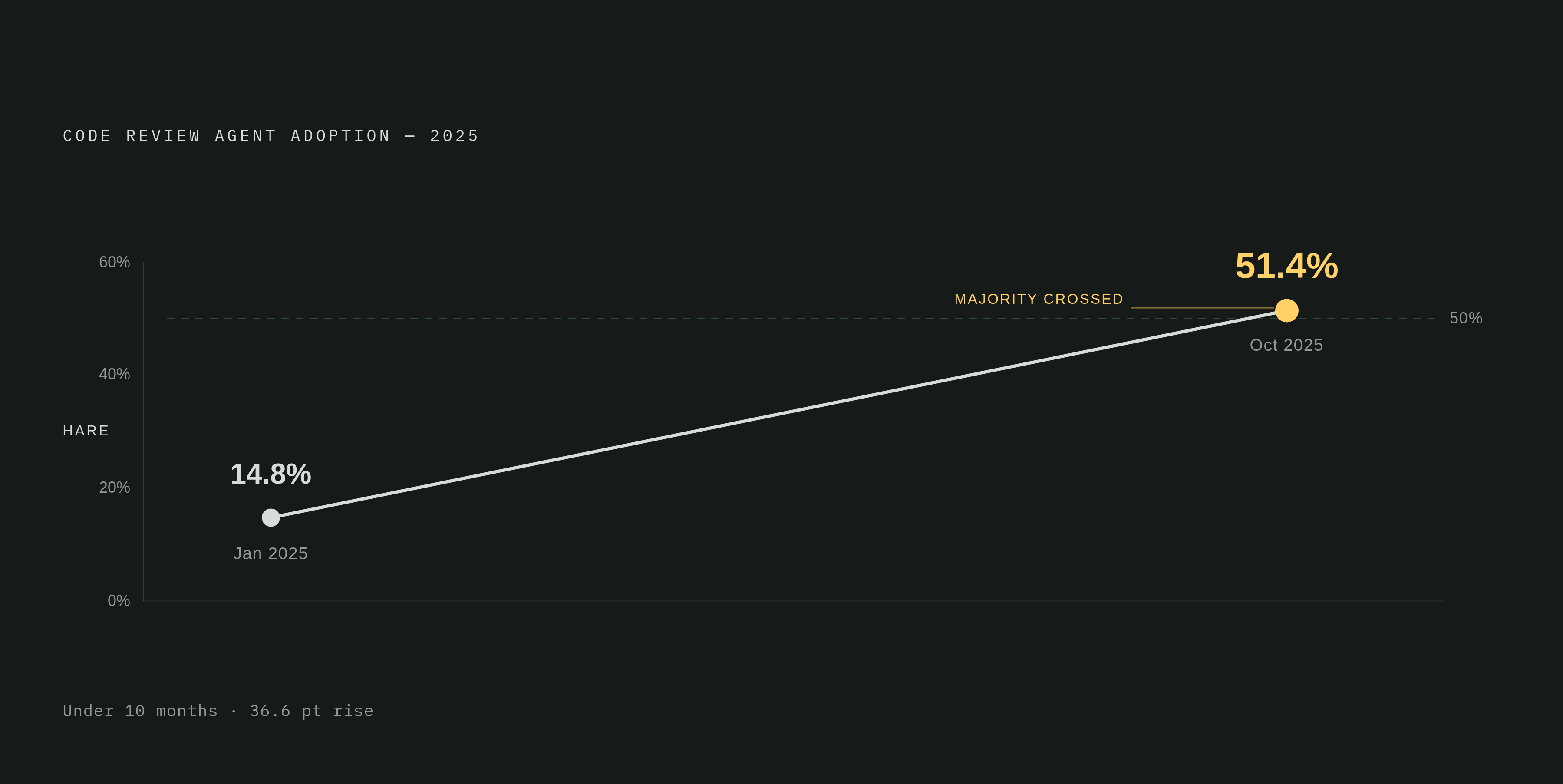
Code review. This is the fastest-moving adoption curve in recent engineering data. Code review agent adoption went from 14.8% in January 2025 to 51.4% by October 2025. The reason is structural: code review is a high-frequency, relatively low-risk touchpoint. Ideal for proving out agents before extending them further into the pipeline.
CI/CD and operations. This is the frontier, and where teams pump the brakes hardest. Agents that dynamically adapt pipelines, diagnose failures, and trigger remediation are doing something categorically different from agents that help you write a function. Teams comfortable with AI-assisted authoring are taking much longer to delegate actual pipeline decisions. Given how much can go sideways in a CI/CD environment, that hesitation makes sense.
What the Productivity Numbers Say. And What They Leave Out
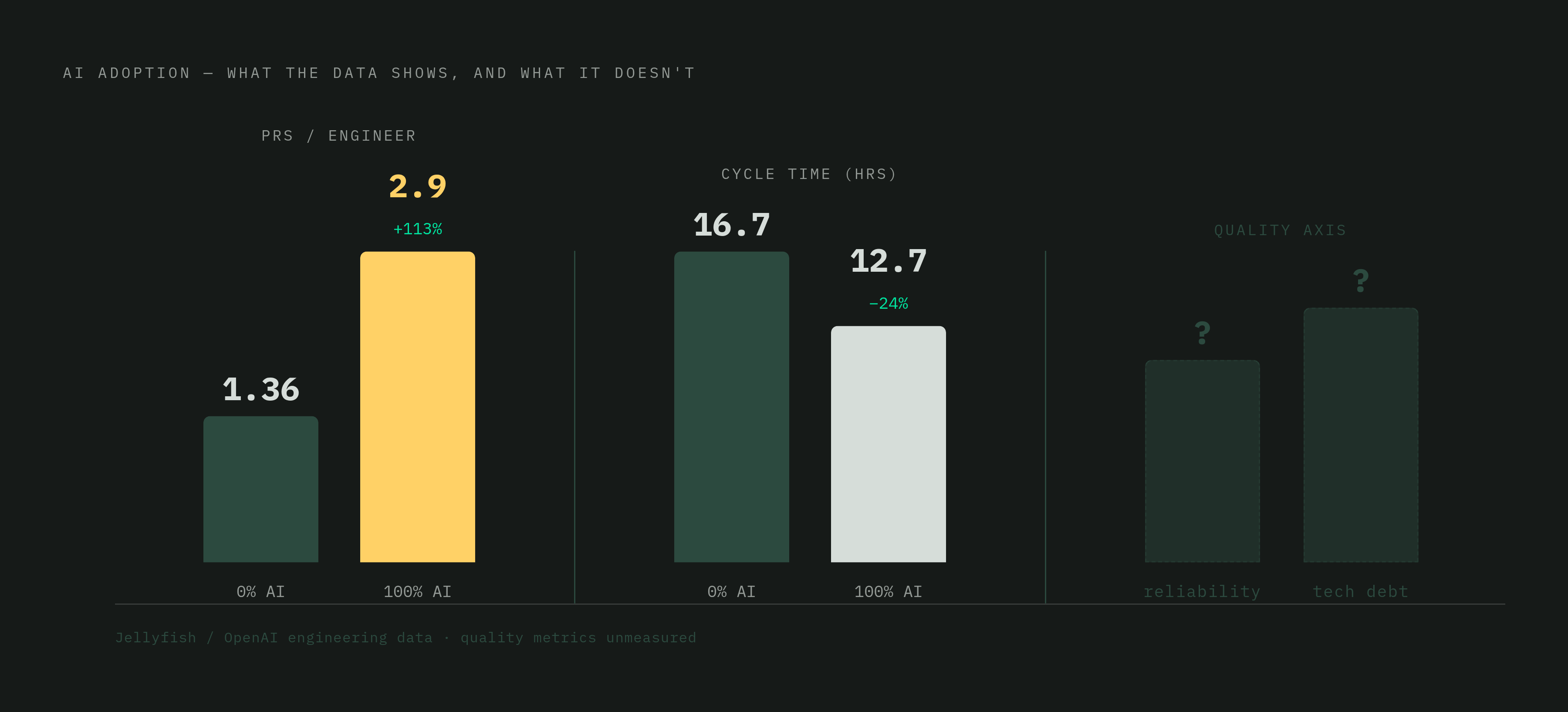
The sharpest signal in the current data comes from Jellyfish and OpenAI: moving from 0% to 100% AI adoption correlated with PRs per engineer rising from 1.36 to 2.9. That's a 113% increase in throughput. Median cycle time dropped from 16.7 to 12.7 hours, a 24% reduction. These are correlation figures from production teams, not controlled experiments, but the direction is consistent and the magnitude is hard to dismiss.
Stack Overflow's 2025 survey puts AI coding assistant adoption at 81% of professional developers, with 43% reporting productivity improvements exceeding 35%. Self-reported productivity is a noisy signal. But when similar numbers appear across multiple independent sources, the pattern starts to mean something.
What the numbers leave out is where it gets interesting.
- More PRs merged faster is an output metric, not an outcome metric. It says nothing about system reliability, technical debt accumulation, or whether the team is building the right things.
- Almost half of companies now have majority AI-generated code, compared to roughly one in five at the start of 2025. The review and oversight burden that ratio creates doesn't appear anywhere in the throughput figures.
- The quality question at scale is genuinely unsettled. Throughput gains are real. Correctness at volume. That's where governance stops being optional.
Engineering leaders reading productivity claims should take the throughput numbers seriously. Then immediately ask what the quality story is. Those are two different questions, and the data only answers one of them.
How Multi-Agent Pipelines Change the Shape of Engineering Work
When you move from a single agent to a pipeline of specialized agents, things change in ways that are harder to explain than the speed gains.
A planner agent decomposes a feature. A coding agent implements it. A testing agent writes and runs tests. A DevOps agent updates CI/CD. A reviewer agent checks quality before the PR is raised. The developer reviews output and handles the judgment calls. That's a different structure entirely — like the difference between a bucket brigade and a fire hose.
IBM's "Bob" platform shows what the enterprise version looks like: a top-level orchestrator routing to specialized agents across the entire lifecycle from discovery through production monitoring. Microsoft's Azure SRE Agent spans alerting, diagnosis, remediation, and post-mortem. CircleCI, GitHub, and JetBrains all have production agentic CI/CD offerings.
Ford is using the same architectural pattern outside software. Their AI agents chain design to 3D rendering to stress analysis to simulation, compressing processes that previously took hours into seconds. The pattern generalizes across domains in ways that deserve more scrutiny than they're getting.
For developers, what changes is where attention goes. The agent handles continuous execution. The human handles escalations, tradeoffs, the judgment calls that require context the agent doesn't have. That's a reallocation of developer attention toward work that actually requires a developer.
There is a real coordination problem baked into all of this, though. Agents eliminate the waiting time between phases, but they also eliminate the natural checkpoints where humans previously understood what had happened. Keeping people sufficiently informed inside a continuous pipeline is a design problem, not a solved one. Most teams are still working it out.
Why Deployment Is Outpacing the Infrastructure for Safe Agent Operation
Companies using agentic AI jumped from 51% to 82% in the first five months of 2025. That pace leaves almost no time for deliberate governance design.
McKinsey's 2025 data shows 62% of organizations experimenting with AI agents, but only 23% scaling deployments. The gap between experiment and production is exactly where most of the risk concentrates. And the thing about that gap is that it doesn't reveal itself during the experiment. It reveals itself the first time something breaks in a way you can't easily undo.
Only 22% of teams have deployed AI coding agents. Only 13% have AI operating across the full delivery lifecycle. Most teams are still in bounded, reversible experiments, which is appropriate given where agent reliability currently sits.
In a single-agent, supervised setup, a developer can catch agent errors in real time. In a multi-agent pipeline running continuously, errors compound before a human sees them. Almost half of companies now have at least 50% AI-generated code. The review burden that ratio implies requires systematic tooling, not ad hoc human scanning.
One more thing worth internalizing: research consistently finds that agent failures are primarily context failures, not model failures. The agent acted on incomplete or incorrect information — because it lacked what it needed. This is what people are starting to call context engineering, and it is becoming its own technical discipline. Designing reliable agent systems turns out to be as much about information architecture as about which model you picked. A lot of teams built their early agent setups expecting the model to do more of that heavy lifting. It doesn't.
What Visibility and Control Requirements Look Like When Agents Run Continuously
When an agent runs across a multi-step pipeline, you need to know what it did and why. This is not a philosophical preference. It is a baseline operational requirement.
Without an inspectable audit trail covering which actions were taken, which tools were called, and what outputs drove the next decision, the developer reviewing a PR has no real way to evaluate whether the agent's path to that PR was sound. The output looks fine. The path is a complete mess. You won't know until something downstream breaks.
Guardrails define which actions can proceed autonomously and which require a human sign-off first. Deploying to production and modifying infrastructure are the obvious candidates for approval gates. The agent also needs escalation paths. When it hits a decision boundary it isn't equipped to resolve, it should surface that to a human rather than guess. Agents that guess at decision boundaries are how bad things happen quietly.
Model choice and deployment infrastructure are governance levers, not just technical preferences:
- Closed platforms that bundle the model with the agent create a single point of opacity. You can't inspect what the model is doing. You can't swap it when something better comes along or when pricing changes.
- Model-agnostic, self-hosted systems let teams choose the right model for each task, audit agent behavior in their own infrastructure, and update components independently.
OpenHands is built on exactly this principle. Open-source, model-agnostic, deployable in the organization's own infrastructure. Teams that need control over model choice, agent auditability, and deployment location have a concrete path to that without handing control to a vendor platform.
On interoperability: Model Context Protocol (MCP), introduced by Anthropic in November 2024 and donated to the Linux Foundation's Agentic AI Foundation in December 2025, defines how agents connect to tools and data sources in a standardized, secure way. OpenAI, Google, Microsoft, AWS, and Block have all adopted it. MCP has crossed from one company's proposal to a de facto standard. That matters for governance because it means agent-tool connections can be audited and controlled through a common interface, rather than through a pile of bespoke integrations that nobody fully understands.
How to Read the Tool Landscape Without Getting Lost in It
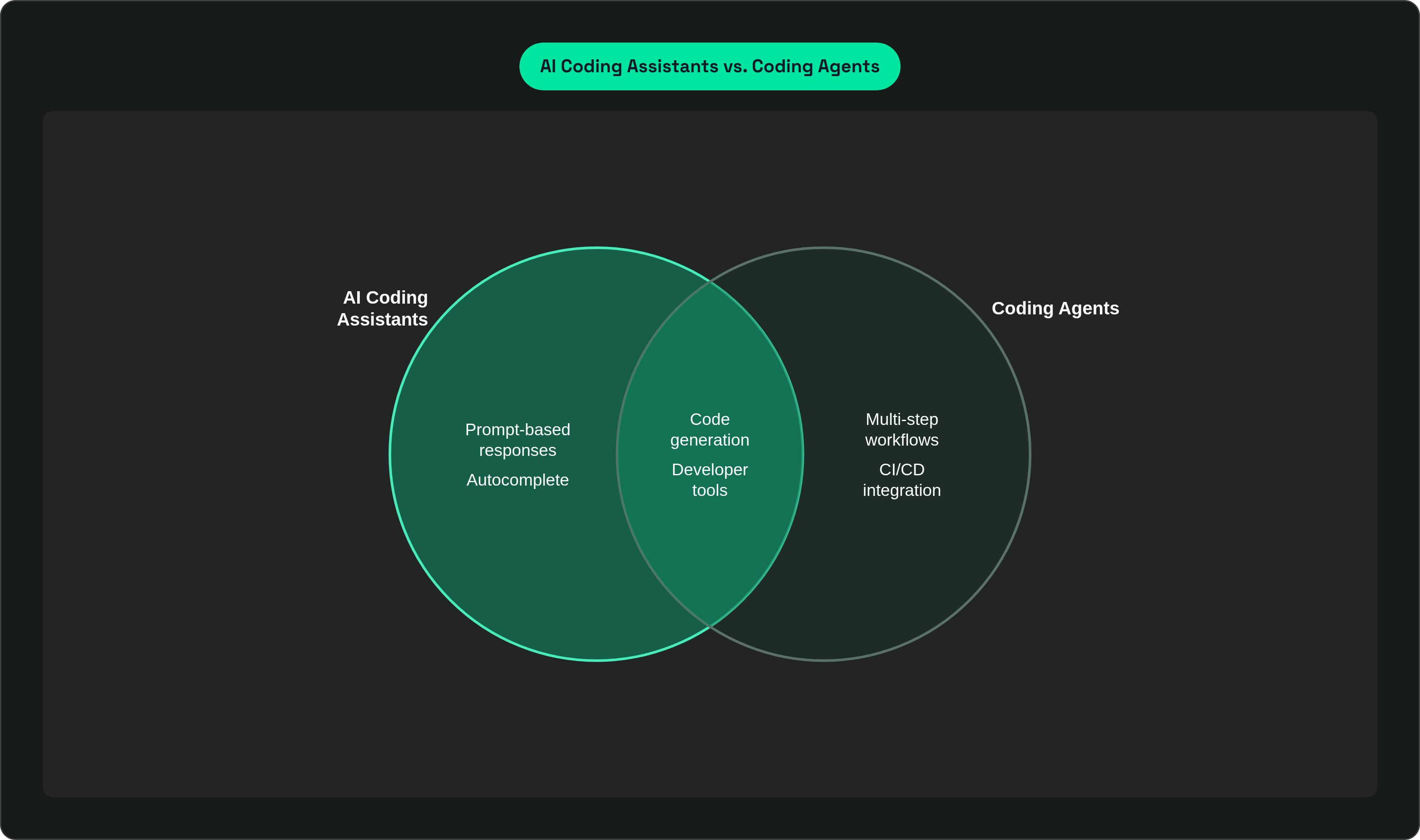
The landscape has two layers that get conflated constantly, and that conflation causes bad purchasing decisions.
AI coding assistants (Copilot autocomplete, Claude chat) respond to prompts. They are useful. They operate at a different capability tier from coding agents (Copilot Coding Agent, Claude Code, OpenHands), which run multi-step workflows, call tools, and iterate without waiting for you to tell them what to do next. Buying one when you need the other is an expensive way to learn the distinction — a bit like ordering a map when you needed a compass.
When evaluating an agent platform, here is what actually matters:
- Model flexibility. Can you swap the underlying model, or are you locked to one provider's API and pricing?
- Deployment location. Does the agent run in vendor cloud only, or can it run in your infrastructure alongside your code?
- Observability. Does the platform expose what the agent did at each step, or only the final output?
- Integration surface. Does it connect to your existing CI/CD, version control, and issue tracking via a standard like MCP, or through proprietary connectors?
Named options and where they fit:
- GitHub Copilot Agent / Copilot Coding Agent. Deepest IDE and GitHub integration. Strong for teams already in the Microsoft ecosystem. The model is not user-selectable.
- Claude Code. Strong on complex repository navigation and long-context reasoning. API-accessible. Model is Anthropic-only.
- OpenHands. Open-source, model-agnostic, runs in your own infrastructure. The option for teams that need to control model choice, audit agent behavior, and deploy where the code lives. Performs well on SWE-Bench class tasks and appears alongside Claude Code, Copilot CLI, VSCode Agent, and Windsurf in research on production-grade agent systems.
- AutoGen (Microsoft open-source) and LangGraph. Frameworks for building and orchestrating multi-agent systems. Relevant for teams designing custom pipelines who want architectural flexibility and are willing to invest the engineering time to get there, rather than deploying a packaged agent.
The framework versus platform decision comes down to one tradeoff. Packaged agents reduce setup time. Frameworks offer architectural flexibility at the cost of real engineering investment. Neither is universally right. It depends on whether you are deploying a workflow or building one from scratch.
The teams getting the most out of agentic AI right now are not necessarily the ones with the most sophisticated setup. They are the ones who are honest about what they handed to the agent, clear about where the agent's authority ends, and paying attention when the agent reports back. Getting that right is less glamorous than picking the best model. It's also the part that determines whether scaling this goes well or sideways.