Model-Agnostic Agent Design Principles
Architectural patterns that keep AI agents adaptable as models change faster than vendors.
If you've been building AI agents for any length of time, you already know the punchline: the model you bet on last year is probably not the model you'd bet on today. In 2024 alone, the capability rankings reshuffled at least four times. OpenAI o3 and Codex, Claude 3.5 and 3.7 Sonnet, Llama 3.3, Gemini 2.0. Each release arrived with benchmarks that made last quarter's winner look dated. Teams that had hardcoded GPT-4 into their workflows faced an uncomfortable binary: stay on an older model and fall behind, or rewrite everything to move forward. Neither option is good; and that's before you account for the fact that sometimes the vendor switches for you.
In April 2025, OpenAI quietly pushed a behavior change to GPT-4o. No announcement; the endpoint name stayed the same. JSON-extraction prompts that had worked reliably started failing. Teams found out the way you never want to find out: customers felt it first. That's the part of the lock-in conversation that doesn't get enough airtime. It's not just that you want to switch providers someday; it's that the provider is already switching on you, silently, behind a stable-looking API.
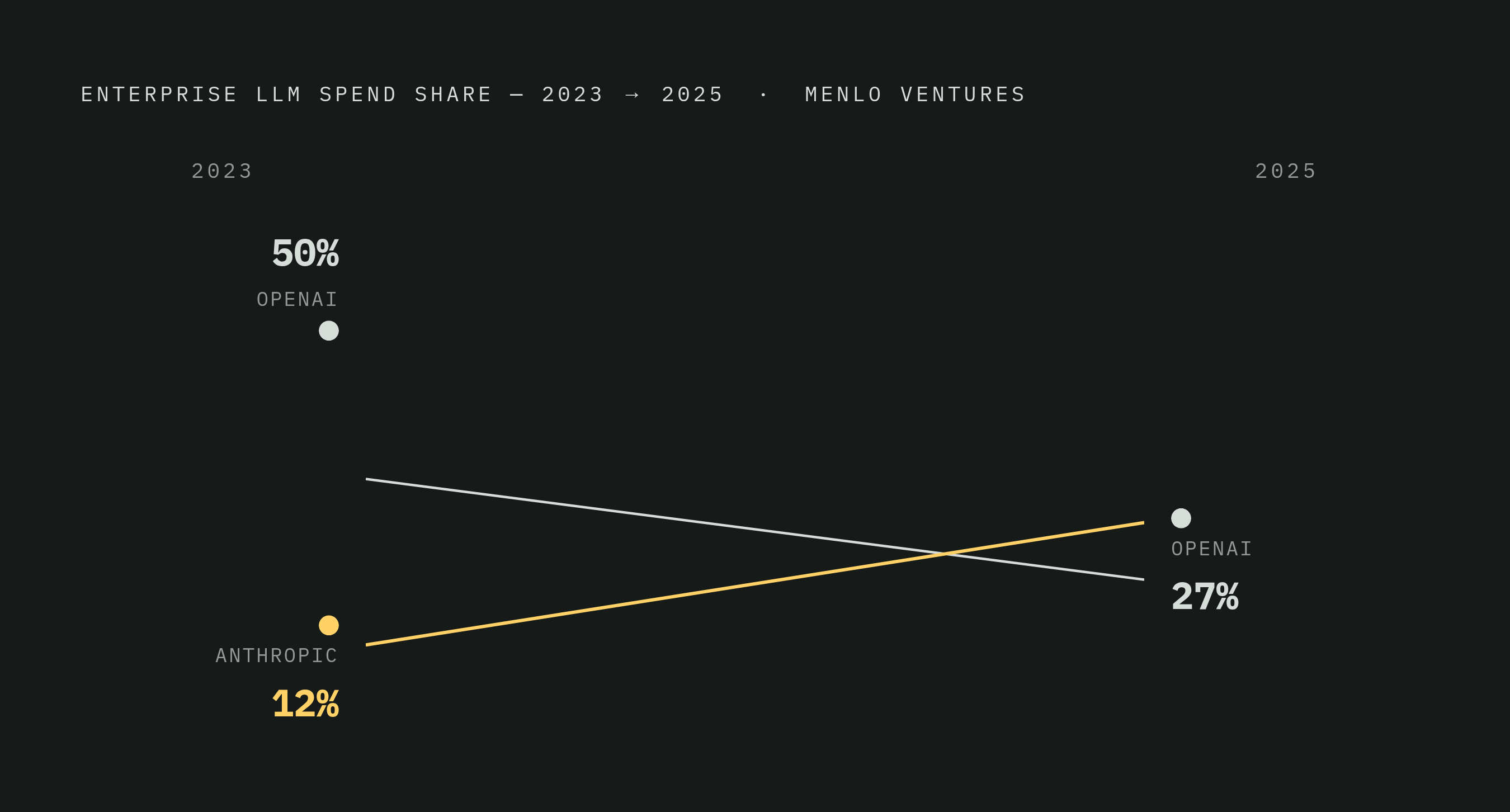
The market share numbers make the case even more plainly. Per Menlo Ventures' 2025 State of Generative AI in the Enterprise report, Anthropic grew from 12% to roughly 40% of enterprise LLM spend. OpenAI's enterprise share fell from 50% to 27% over the same period. The "winning" provider changed in under two years. That's the environment your agents are living in. An agent's durability is not determined by which model it uses today. It's determined by whether its architecture can absorb the next shift without a rewrite. Everything that follows is about building that architecture.
Vendor Lock-In Hits Differently When AI Is Involved
Most lock-in conversations are about cost and inconvenience. AI lock-in is about that, plus operational fragility, regulatory exposure, and the quiet erosion of leverage you didn't know you were giving up.
According to 2026 survey data, 45% of enterprises say vendor lock-in has already blocked them from adopting better tools. Only 6% believe they could switch their primary AI provider without material disruption. And migration isn't cheap; fifty-seven percent of IT leaders spent more than $1 million on platform migrations in a single year. That's not a hypothetical risk. That's a line item.
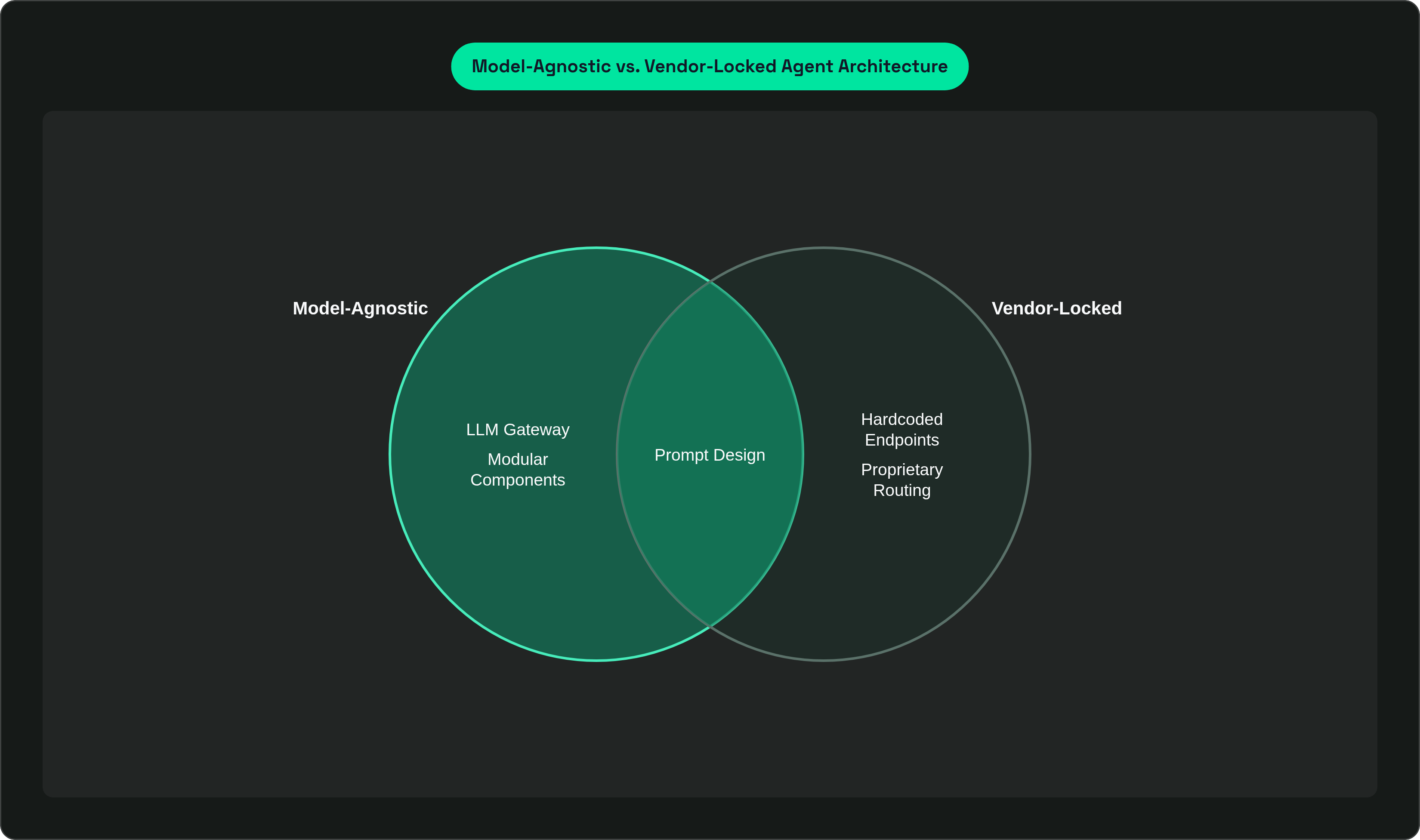
There's also a distinction worth making clearly, because a lot of teams get this wrong. Being model-agnostic inside a closed platform is still vendor lock-in. The vendor can swap models internally all they want. But if your business logic, your prompts, and your policies are trapped inside a proprietary system, you cannot swap vendors. True model-agnosticism requires owning the layer that calls the model, not just choosing which model the vendor routes you to.
Two concrete examples from early 2025 illustrate what this looks like in practice:
- On January 23, 2025, a ChatGPT outage disrupted GPT-4, 4o, and mini simultaneously. Teams with model-agnostic architectures rerouted to alternatives and kept running. Everyone else waited.
- Meta declined to release its new LLM in the EU due to regulatory uncertainty. Organizations with LLM-agnostic setups switched to compliant alternatives without rebuilding anything.
That second one matters more than people realize. Eighty-four percent of enterprise leaders factor digital sovereignty into their AI strategies, per the same 2026 survey data. Regulatory pressure is not a future problem. It's already here, and it hits differently depending on how tightly your architecture is coupled to a single provider.
The Provider Abstraction Layer: Turning a Vendor Swap from a Rewrite into a Config Change
The central principle is simple to state and genuinely hard to enforce: the model should be a swappable utility, not a load-bearing wall in your business logic.
The practical implementation is what's called an LLM gateway. All your agents talk to the LLM through a single unified interface. Something like chat(systemprompt, usermessage). The agent doesn't know or care whether GPT-4o, Claude, or a local model is on the other end. Switching providers means changing a config value, not refactoring a codebase.
The gateway also does a lot of other useful work in one place:
- Authentication management for every provider
- Resilience logic and retry behavior
- Cost controls and usage tracking
- Monitoring and logging
If one provider goes down, the gateway retries with another. The upstream service never sees the outage. That's the fallback behavior you want, and it's essentially free once the abstraction layer exists. Without it, you're writing that logic into every agent separately and praying for consistency.
Graceful degradation is part of this too. When the LLM is unavailable entirely, a well-designed system doesn't just fail. It falls back to rule-based extraction, returns a cached result, or degrades in a way the user can tolerate. That's only possible if the model call is isolated enough to swap out.
A complete multimodel strategy needs three things working together:
- An abstraction or orchestration layer that routes requests across models
- At least one local or on-premises model kept warm as a fallback
- A governance layer that tracks every agent's model, data access, and activity regardless of vendor
That third piece is where most teams underinvest. But here's the thing: the abstraction layer is what makes the governance layer tractable. You cannot audit what you cannot centralize. If every agent is calling models directly through bespoke integrations, you have no single place to see what's happening. The gateway gives you that.
Modular Component Separation: Why "The Agent Does Everything" Always Breaks
I've seen a lot of agent stacks collapse, and it usually comes down to one of three things. Tight model coupling. Missing fallback logic. Or workflow logic that leaked into prompts. That last one is the most common, and it's the sneakiest.
When you embed assumptions about a specific model's behavior inside your agent logic, not just which model to call but how it thinks, you've created a hidden dependency. The interface looks clean. Swap the model, and suddenly the agent behaves wrong in ways that are hard to trace because the coupling isn't visible.
The fix is explicit separation of responsibilities. Agent, Tool, Memory, and Orchestrator should be distinct things with distinct jobs.
A Tool shouldn't just be a function. It should be a first-class object with a name and a description attached, which is what makes tool-calling workflows and self-discovery actually work. If the tool is just a function pointer, the agent has no way to reason about when to use it.
Memory needs the same treatment. A BaseMemory abstraction with pluggable backends (in-memory for fast lookups, Redis for distributed state) lets you change how memory works without touching agent logic. The alternative is baking memory into the agent class or leaning on global state, which sounds fine until you're debugging a production issue and you can't tell which agent wrote what.
Structural patterns from systems engineering translate surprisingly well here. The sidecar pattern lets you add functionality to an agent without touching its core. The adapter pattern wraps a model or tool with a consistent interface. The ambassador pattern handles communication concerns like retries and auth at the infrastructure layer so the agent doesn't have to think about them. These patterns exist because separating concerns makes things debuggable. That's doubly true for agents.
A 2025 arXiv paper (arXiv:2605.13850, "A Two-Dimensional Framework for AI Agent Design Patterns") classifies patterns along two axes: cognitive function and execution topology. The specific models and frameworks the authors referenced will be outdated faster than the paper ages. The coordinate system itself stays stable. That's precisely the property well-modularized agents share. The frame survives even when the contents change.
Standard Tool Contracts and the Protocols That Make Tools Portable
Before standardization, the integration problem was genuinely ugly. Every new model required re-integrating every tool from scratch. N models times M tools equals an exponential maintenance burden that nobody wanted to own.
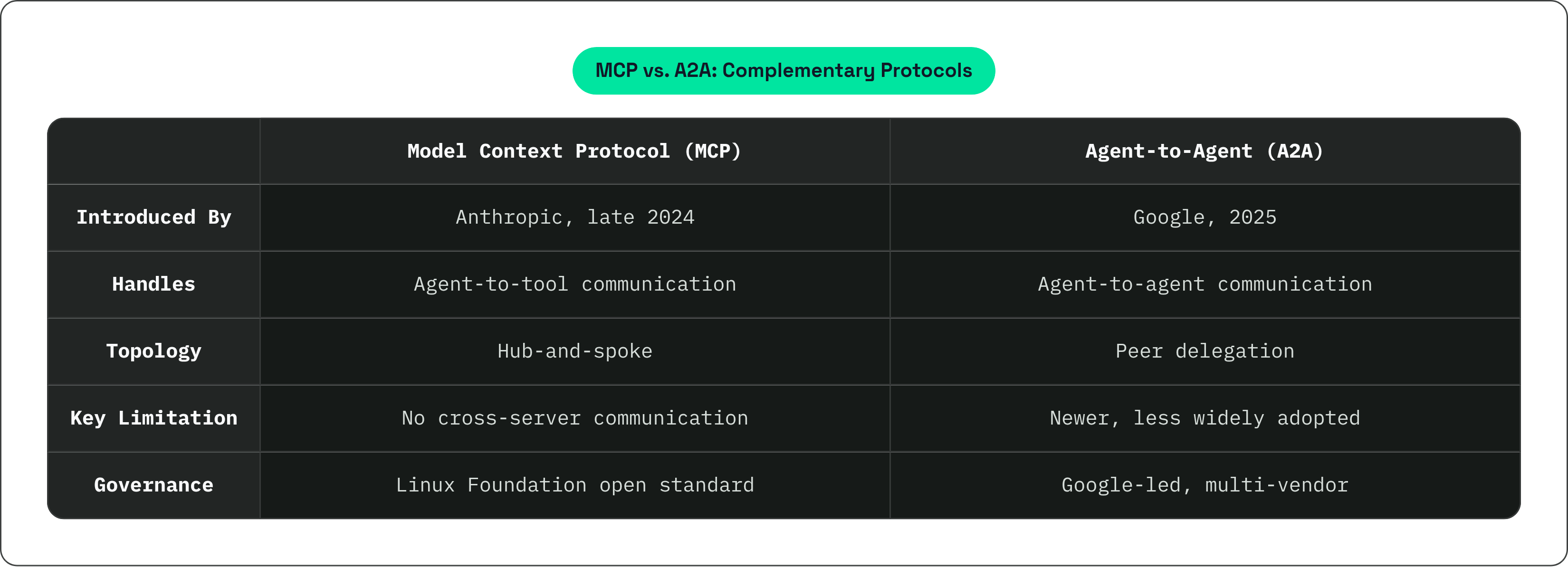
Model Context Protocol (MCP), introduced by Anthropic in late 2024, attacks this directly. It standardizes how agents access tools, data sources, and prompts through a client-server architecture with three primitive types: Tools, Resources, and Prompts. MCP servers expose them. MCP clients consume them. A tool written to MCP works with any compliant client, regardless of which model is doing the reasoning.
MCP v1.1, with a schema dated November 2025, added sessions, elicitation, sampling, and streaming. And in December 2025, Anthropic donated MCP to the Agentic AI Foundation under the Linux Foundation, with Google, Microsoft, and others signing on. It's now governed as an open standard, which matters for long-term adoption.
MCP's architectural role is clean: it decouples the reasoning layer from the tool layer. That's exactly what you want. But MCP has a real limitation worth naming. It's a hub-and-spoke topology. The LLM sees all the tools. But two MCP servers can't communicate with each other, and there's no native concept of task delegation between agents. One agent can't hand a subtask to another agent through MCP.
That's where Agent-to-Agent protocol (A2A), introduced by Google in 2025, comes in. MCP handles agent-to-tool. A2A handles agent-to-agent. They're complementary, not competing.
One security note that gets overlooked: MCP was designed for decentralized innovation. It does not come with heavy enterprise security features built in. Do not expose MCP servers directly to the network. Wrap enterprise-grade API endpoints around them. The protocol is a communication standard, not a security boundary.
Memory Architecture Is a Model-Agnostic Concern, Not an Afterthought
Here's a belief I've seen cause real damage: "We'll just use a large context window instead of managing memory." It sounds reasonable. It is not.
A Chroma Research study from July 2025 tested 18 LLMs, including Claude 4, GPT-4.1, Gemini 2.5, and Qwen3, and found that models do not use context uniformly. Performance grows increasingly unreliable as input length grows. There were failures on trivially simple tasks at scale. Context window size is not a substitute for managed memory. The model's ability to actually use that context degrades in ways that are model-specific and hard to predict.
The key design property is this: decouple storage format from prompt format. If those two things are tangled together, swapping models means rewriting your entire memory system. If they're separate, you swap the model and rebuild only the prompt format layer.
A practical taxonomy, using CrewAI's implementation as a reference:
- Short-term memory: Recent interactions within the current execution, backed by a vector store like ChromaDB
- Long-term memory: Learnings from past task executions, stored in a persistent backend like SQLite
- Entity memory: Named entity extraction, stored separately so it doesn't pollute other memory types
- User memory: User-specific preferences, handled via dedicated integration
Each type has a different retention policy, a different retrieval mechanism, and a different failure mode. Treating them as one undifferentiated blob of "context" is how you end up with agents that can't explain what they know or why.
MemOS (Li et al., 2025) pushes this further with a framework called MemCube, which unifies three types of memory into a single addressable structure: parametric memory (the model weights themselves), activation memory (the KV-cache), and plaintext memory (external knowledge sources). The insight is that a model swap changes only the parametric layer. The other two persist. An agent built this way survives a model replacement without losing its operational history. That's the goal.
Context Engineering: The Prompt Discipline That Holds Across Model Boundaries
Prompt engineering was built for single request-response cycles. It works fine when you're asking a model a question and reading the answer. It was never designed for multi-step agentic workflows where an agent plans, delegates, and commits real-world actions across a session. The architectural pressures are completely different.
The goal also shifts. You're no longer optimizing prompts to perform perfectly on one model. You're optimizing for prompts that perform well enough across multiple models. Prompts written to a single model's quirks are a form of tight coupling. They break silently when the model changes, which is the worst kind of breakage.
Treating agent input as six distinct layers helps keep each layer intentional:
- System rules (who the agent is, what it's allowed to do)
- Memory (what the agent knows from past interactions)
- Retrieved documents (what it found for this task)
- Tool schemas (what it can do)
- Recent conversation (what just happened)
- Current task (what it needs to do right now)
The principle for each layer is the same: keep it small and on-purpose. Only include what helps the current request. Context windows are not free. Filling them with everything available is not a strategy.
Modular architecture also enables something that single-model setups simply can't do: capability-aware routing. Use the right model for the task.
- Long-document research and summarization? Route to a large context window model.
- Code generation? Route to a model optimized for code.
- Fast classification or routing decisions? Use something smaller and cheaper.
No single model is universally best at everything. An architecture that can only call one model is leaving capability on the table and paying more than it needs to at the same time.
Security Patterns That Hold When the Model Changes Underneath Them
This is the part of the conversation where I get opinionated, because I've watched teams get this exactly wrong.
An agent whose security posture depends on a specific model's refusal behavior is not secure. It is depending on a property that silent versioning can remove without warning. Security belongs at the architecture level, not the model level.
Two patterns that enforce this cleanly:
Action-Selector Pattern. The agent acts only as an action selector. It translates requests into one or more predefined tool calls. No feedback from action outputs flows back into the agent. This makes the agent structurally immune to prompt injection because there's no feedback channel for injected instructions to travel through. The agent picks actions. It doesn't receive instructions from the environment mid-execution.
Plan-Then-Execute Pattern. The agent accepts instructions, formulates a fixed plan (a list of actions), then executes that plan. Tool outputs can interact with external data, but they cannot inject instructions that cause the agent to deviate from the plan. It's more permissive than Action-Selector because the agent does observe the results of its actions. But the plan is fixed before execution starts, which constrains the attack surface considerably.
For long-running workflows, the model itself should not be the thing maintaining coherence across a session. Embed agents and skills in an external harness. The harness provides the invariants. The model provides the reasoning. Don't mix those jobs.
Provenance-first design matters here too. Each skill execution should emit structured metadata: what ran, on what model, with what inputs, producing what outputs. That's what makes auditing possible regardless of which model ran which step. It's only tractable if the abstraction layer from earlier is doing its job of centralizing access.
The through-line across every section of this piece is the same idea expressed differently each time. Abstracted interfaces. Modular components. Portable tool contracts. Managed memory. Layered context. Architecture-level security. Every one of these is a form of not trusting any single model to be permanent. That distrust is not pessimism. It's the engineering discipline that model-agnostic design actually requires, and the teams that have internalized it are the ones whose agents will still be running two model generations from now.