Prompt Injection Risks in Production Coding Agents
Prompt injection sits at the top of OWASP's LLM security list for 2025, and it's held that spot since the list started. This isn't simply a matter of vendors shipping sloppy code — the flaw lives in the architecture itself: large language models read developer instructions and user-supplied data through the same channel, with no wall between them.
Compare that to how normal software works. Your operating system keeps a hard line between code and data, enforced at the hardware level. An LLM has no such line, and feeding it a cleverly worded sentence means it can't reliably tell "the rules I was given" from "text somebody dropped into my lap." The UK's National Cyber Security Centre said as much in December 2025, warning that prompt injection "may be a problem that is never fully fixed." A feature of how these systems think, if we're being loose with the word "think," baked into the design rather than a bug waiting on a patch.
So for teams running coding agents in production, the mental shift is uncomfortable but simple: nobody's waiting on a patch. You're managing a permanent leak, not fixing a broken pipe.
How coding agents expand the attack surface beyond ordinary LLM chatbots
A chatbot writes you a paragraph. A coding agent writes to your filesystem, runs shell commands, hits your APIs, queries your database, and in some setups, edits its own settings. Each of those is a lever. Somewhere out there, somebody's hand is on it.
Obsidian Security found that agents move 16 times more data than a human user doing the same job. That number changes what "one compromised account" even means. A leaked password used to be the worst case; now it's a firehose.
Modern IDEs feed agents everything, full file contents, inline comments, README files, whatever an MCP server hands back, and every one of those is a door the agent walks through without checking who's behind it. The install base isn't small potatoes, either. GitHub Copilot crossed 20 million cumulative users by July 2025. A flaw that scales across that user base isn't a niche incident. It's a mass event waiting for a trigger.
Here's the part worth sitting with: the attacker doesn't need to break anything. The agent already has the keys. All the attacker has to do is whisper the right instruction and let the agent use its own legitimate access against itself.
The attack taxonomy: how malicious instructions reach the agent
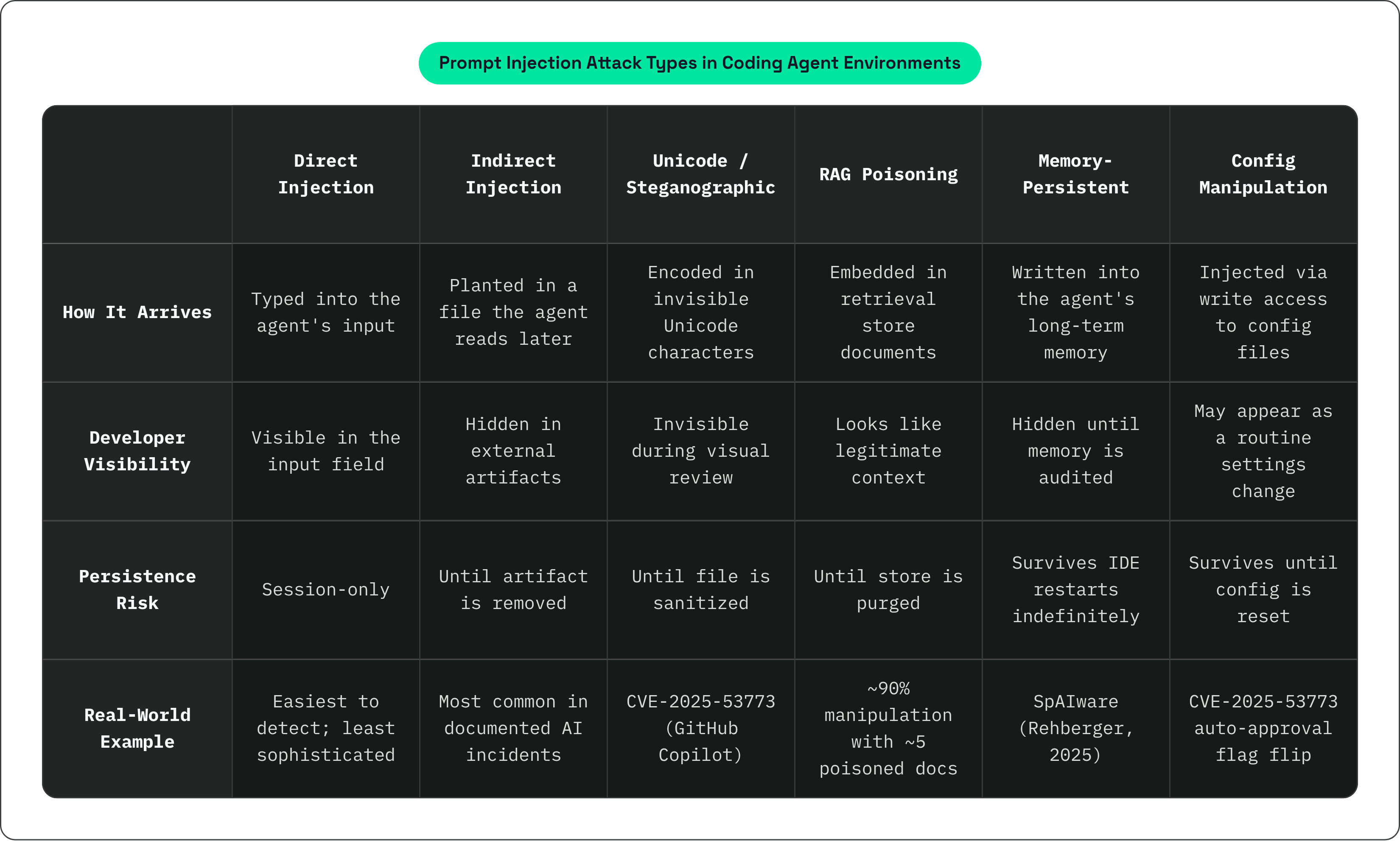
Direct injection is the blunt version. Type malicious text straight into the agent's input box and hope it overrides the system prompt. It's the easiest to catch, and honestly, the least interesting one on this list.
Indirect injection is where it gets ugly. The attacker never touches your tool. They plant a payload somewhere the agent will read later, a code comment, a package README, a GitHub issue, a documentation page, a manipulated MCP server response. Indirect injection has been flagged as one of the most common techniques appearing in documented AI security incidents. The developer doesn't do anything wrong here. They just ask the agent to summarize a file, and the file was rigged before they ever opened it.
Then there's the invisible stuff. Some payloads get encoded in Unicode tag characters, invisible to a human scrolling through the file, but the model reads them fine and treats them as instructions. GitHub Copilot was hit the same way in CVE-2025-53773.
RAG systems have their own weak spot. Poison a retrieval-augmented system with as few as five carefully built documents, and you can manipulate its responses up to 90% of the time. The context store, meant to make the agent smarter, becomes a smuggling route instead.
And memory-persistent attacks deserve their own paragraph, if only for sheer audacity. Researcher Johann Rehberger nicknamed this one "SpAIware," and demonstrated a payload that writes itself directly into an agent's long-term memory. Close the IDE, reopen it next week, and the payload's still sitting there, waking back up every time you start a new session. One injection, permanent tenant.
Last on the list: agents with write access to their own configuration files can be told to flip a setting like auto-approval. That amounts to the agent handing over its own front door key, well past ordinary data leakage.
How these attacks propagate: the promptware kill chain
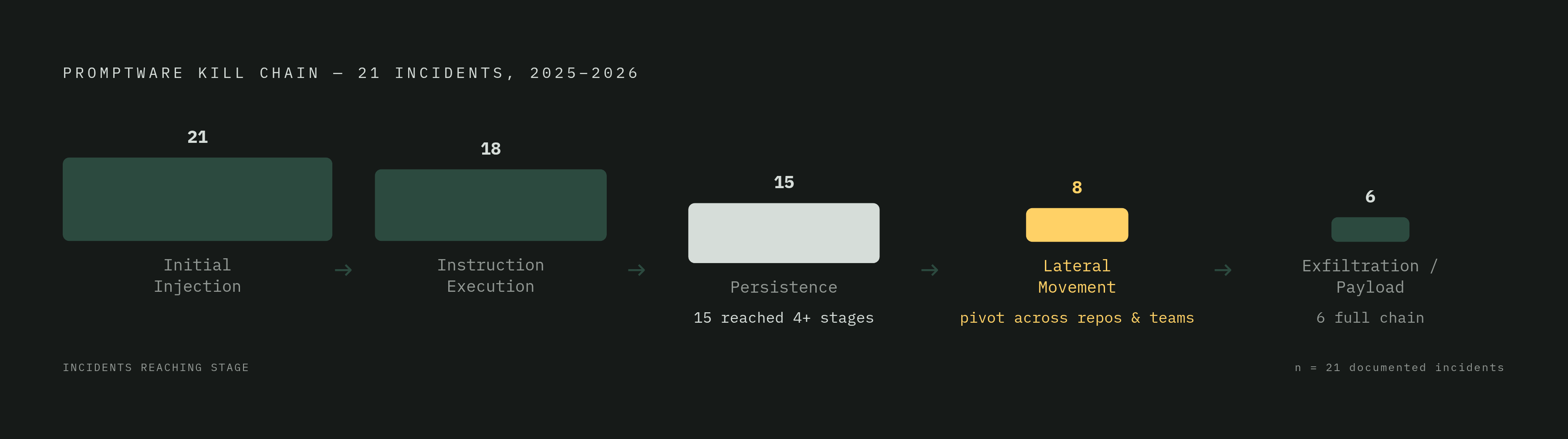
Researchers tracking 21 documented promptware incidents across 2025 and into 2026 found that 15 of them hit four or more stages of a five-stage kill chain. Six went all five: initial injection, instruction execution, persistence, lateral movement, and exfiltration or payload delivery.
The lateral movement number is the one that should keep security teams up at night. By 2025 into 2026, eight out of twenty-one documented incidents showed lateral movement. Agents are getting turned into pivots, hopping across repos, teams, and connected systems like a bad rumor at an office party, well beyond simple data leakage.
That's the wormable pattern in action. A single compromised repo becomes a launchpad, and the agent replicates malicious instructions into other files and other repositories on its own, no human required to keep the chain moving. It's the exact mechanism behind CVE-2025-53773, which we'll get to in a minute, and a live production risk rather than a theoretical one.
Multi-hop attacks, where the agent calls a tool, the tool returns poisoned data, and that data triggers the next stage, grew more than 70% year over year through this period. The kill chain framing matters because it tells defenders where to actually put a hand on the brake, not just at the prompt, but at execution, at persistence, at exfiltration. Multiple chances to stop it, if anyone's looking.
What production exploits look like: the CVEs that defined 2025
EchoLeak, tracked as CVE-2025-32711, scored a 9.3 on the CVSS severity scale and hit Microsoft 365 Copilot. Disclosed in June 2025, it's about as close to a horror movie as enterprise software gets: zero-click. A single crafted email caused Copilot to reach into internal files and ship the contents to an attacker-controlled server, no user interaction required. Just an email sitting in an inbox, doing its work quietly while nobody watched.
The chain behind it was layered. It slipped past Microsoft's XPIA classifier, built specifically to catch this kind of thing, dodged link redaction using reference-style Markdown formatting, exploited auto-fetched images, and rode a Microsoft Teams proxy that the content security policy happened to allow. It's the first documented case of prompt injection weaponized for real, concrete data theft in a live production AI system. Antivirus software and firewalls are built to catch malicious code; this payload was just English, so there was nothing to scan and nothing to flag. Microsoft issued a server-side patch in June 2025. Customers didn't need to lift a finger, and there was no confirmed exploitation in the wild before the fix landed.
CVE-2025-53773, affecting GitHub Copilot in VS Code, scored a 9.6 and got patched in August 2025. The setup: a payload hides in a GitHub issue or a code comment, the developer asks Copilot to take a look, and Copilot reads it. The payload instructs it to update .vscode/settings.json, flipping on auto-approval. Copilot had write access to its own config directory by default, and nobody had classified the autoApprove flag as security-sensitive before this. Once triggered, it could spread, copying itself into other files, other repos, other teams. Microsoft's fix required an explicit user action before auto-approval turns on. Should've been that way from the start. Here we are anyway.
Separately, research nicknamed "IDEsaster" turned up more than 30 vulnerabilities spread across major AI-integrated development environments, and the breadth is the real headline here. No single vendor has cracked this. One IDE saw CVEs tied to workspace file manipulation and MCP connections leading to remote code execution. Another had a path traversal flaw that let attackers read and write arbitrary local files across affected versions, whether through direct exploitation or prompt injection. In August 2025, Johann Rehberger ran what he called a "Month of AI Bugs," working methodically through nearly every major AI coding tool and finding injection vulnerabilities in each one. Same trick, different house, every single time.
Why defenses fail at the rates they do
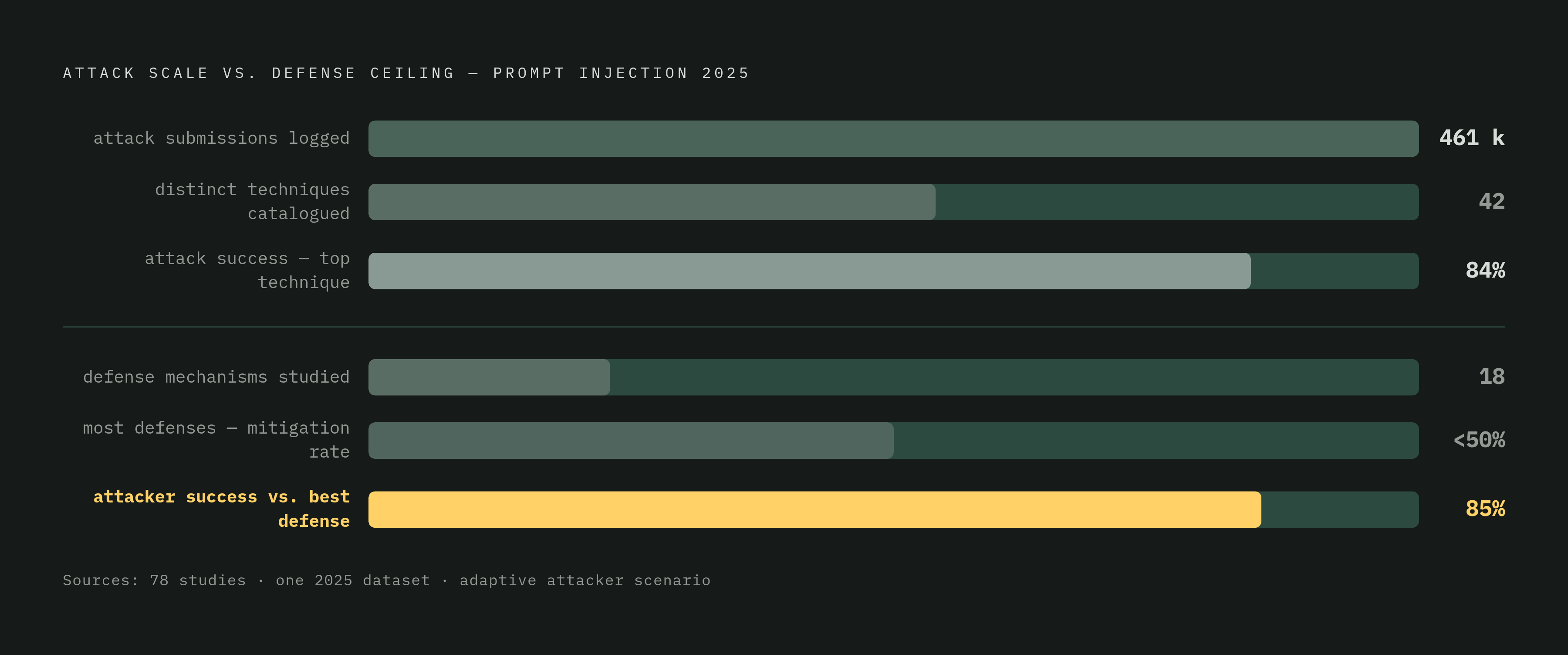
One 2025 dataset logged over 461,640 prompt injection submissions, with success rates running 50 to 84% depending on the technique and how the system was configured. That's not a rounding error. That's a coin flip stacked in the attacker's favor.
A 2026 meta-analysis pulled together 78 studies and catalogued 42 distinct attack techniques. Of the 18 defense mechanisms studied, most managed less than 50% mitigation against attackers who adapted their approach, and adaptive techniques cracked 85% success rates against even the best defenses on the market. The defenses aren't dumb. They're just outmatched by an opponent who moves the second anyone looks away.
Classifiers, the systems built specifically to spot injection attempts, keep losing this fight. EchoLeak walked straight past Microsoft's dedicated XPIA classifier, a tool built for exactly this threat. The problem is structural: the classifier reads in the same natural-language space as the attack. Rephrase the sentence, encode it differently, hide it in Unicode, and pattern matching just shrugs.
RAG and fine-tuning don't help either, and it's worth being blunt about why. Both are designed to make outputs more accurate and better grounded in context. Neither one draws a line between instructions and data, because that was never the job they were built for. RAG actually makes things worse in one specific way: poisoned documents in the retrieval store become a legitimate-looking instruction channel, no different in the model's eyes from a real one.
Input sanitization, on its own, isn't enough, either. Invisible Unicode sails past visual review and plenty of automated filters. Sanitizing what the user types does nothing for payloads sitting in a third-party package, a documentation page, or an MCP server response the agent fetched all by itself.
Cisco's State of AI Security report for 2026 found most organizations planned to deploy agentic AI, but only 29% said they felt ready to secure those deployments. That gap, between how fast agents ship and how ready anyone is to watch them, is the whole story in one number.
MCP and multi-agent architectures as a multiplier of injection risk
Model Context Protocol has become the go-to way of hooking coding agents up to tools, APIs, file systems, and outside data sources. Handy for developers. Also a great way to widen the number of places an instruction could sneak in from.
Tool poisoning is the simplest version: a compromised MCP server sends back a response with instructions baked in, and the agent's next move gets hijacked, no changes needed to your actual codebase.
Rug-pull attacks are worse, because they play the long game. An MCP server can act perfectly innocent during the initial trust check, get approved, and then change its behavior later, once it's already been granted permissions. The agent's trust model doesn't check again at execution time. It's the software equivalent of a landlord who seems great right up until the lease is signed.
In multi-agent setups, a single compromised subagent can slip instructions into the messages it sends up to an orchestrator agent, and the compromise climbs the ladder from there. Security agencies have called out tool poisoning and indirect injection via MCP as high-priority threats, signaling that this is operational now, not academic hand-wringing.
Every new MCP server you connect is a new trust boundary. Treat each one like a stranger at the door, because that's exactly what it is.
Practical mitigations that reduce real exposure without stopping all development
Start with least privilege. An agent reading a README has no business writing to .vscode/settings.json, and this one rule, applied early, would have stopped CVE-2025-53773 cold.
Put a human in the loop for anything high-stakes: writing to config files, running shell commands, making network calls, touching CI/CD pipeline definitions. Microsoft's August 2025 fix for CVE-2025-53773 did exactly this, flipping auto-approval from something you had to opt out of to something you had to opt into.
Sandbox the agent's runtime. Containerize it, scope its filesystem and network access, and make sure a successfully injected agent can't wander off into your host system or a neighboring repo. This is a place where self-hosted, open agent infrastructure has a real edge. Teams running platforms like OpenHands can define exactly what the runtime can and can't touch, instead of inheriting whatever default permissions a vendor decided were fine.
Treat every outside artifact, code comments, third-party package files, fetched docs, MCP server responses, as untrusted, the same way you'd treat raw user input. Don't let it quietly get promoted to "instruction." One architectural option worth considering: run externally sourced content through a separate, lower-privilege context window entirely, so it never shares a channel with the real system prompt.
Keep an explicit allowlist for MCP servers, and treat anything not on it as hostile until proven otherwise. Log every tool call and every server response, too. Rug-pull attacks are detectable after the fact, but only if the telemetry actually exists to look back through.
Watch behavior, not just input. Unexpected file writes, config changes, calls to unfamiliar network endpoints, odd command sequences, these are the fingerprints left behind by an injection that made it past the filters. And don't ignore memory. Periodically audit and clear out an agent's long-term memory store; SpAIware-style attacks sit quietly, and they only show up if somebody actually goes looking.
None of this works alone. Recall that 2026 meta-analysis: 18 defense mechanisms, mostly under 50% mitigation against a determined, adaptive attacker. No single control gets you there. Layer them so each one covers a different stage of the kill chain, because at least one of them will fail on any given day.
What "safe enough to ship" actually requires organizationally
Google found that malicious prompt injection payloads embedded in web content grew 32% between November 2025 and February 2026. That's the threat surface expanding faster than any static config can keep pace with, which means one-time hardening doesn't cut it. This needs ongoing eyes on it, indefinitely, the same way you'd watch a fire line rather than a fence.
Before any team scales agent autonomy across an organization, they need visibility first: what tool calls the agent made, what files it touched, what external content it pulled in. Skip that step, and you're deploying a mystery box with commit access rather than a coding agent.