Shadow AI Risks in Engineering Organizations
Engineers unknowingly leak source code and secrets to AI tools IT can't see or control.

Shadow AI is the new shadow IT, except worse. When someone plugs an unapproved laptop into the network, it just sits there being a security risk. When someone pastes proprietary code into a free ChatGPT account, the tool actively ingests it, learns from it, and might spit pieces of it back out to a total stranger six months later. That's not a data leak in the traditional sense. There's no file that goes missing, no alert that fires, no forensic trail to follow. The proprietary logic just exists somewhere now, in a model's training data, and nobody can point to the moment it left the building.
That's the definitional problem. Shadow AI doesn't just include people sneaking off to use ChatGPT on their lunch break, either. It covers personal accounts on tools your company already approved (free-tier access through someone's Gmail), AI features that got switched on inside your existing software because of a routine update nobody signed off on, direct API calls developers wire up themselves, and fully autonomous agents built inside automation platforms that IT has never heard of. Most of the tooling built to catch shadow IT (your CASBs, your DLP systems) was never designed to treat "an AI API call" as its own risk category. So it's not blind, exactly. It's just squinting at half the picture.
How widespread unsanctioned AI use has already become across the enterprise
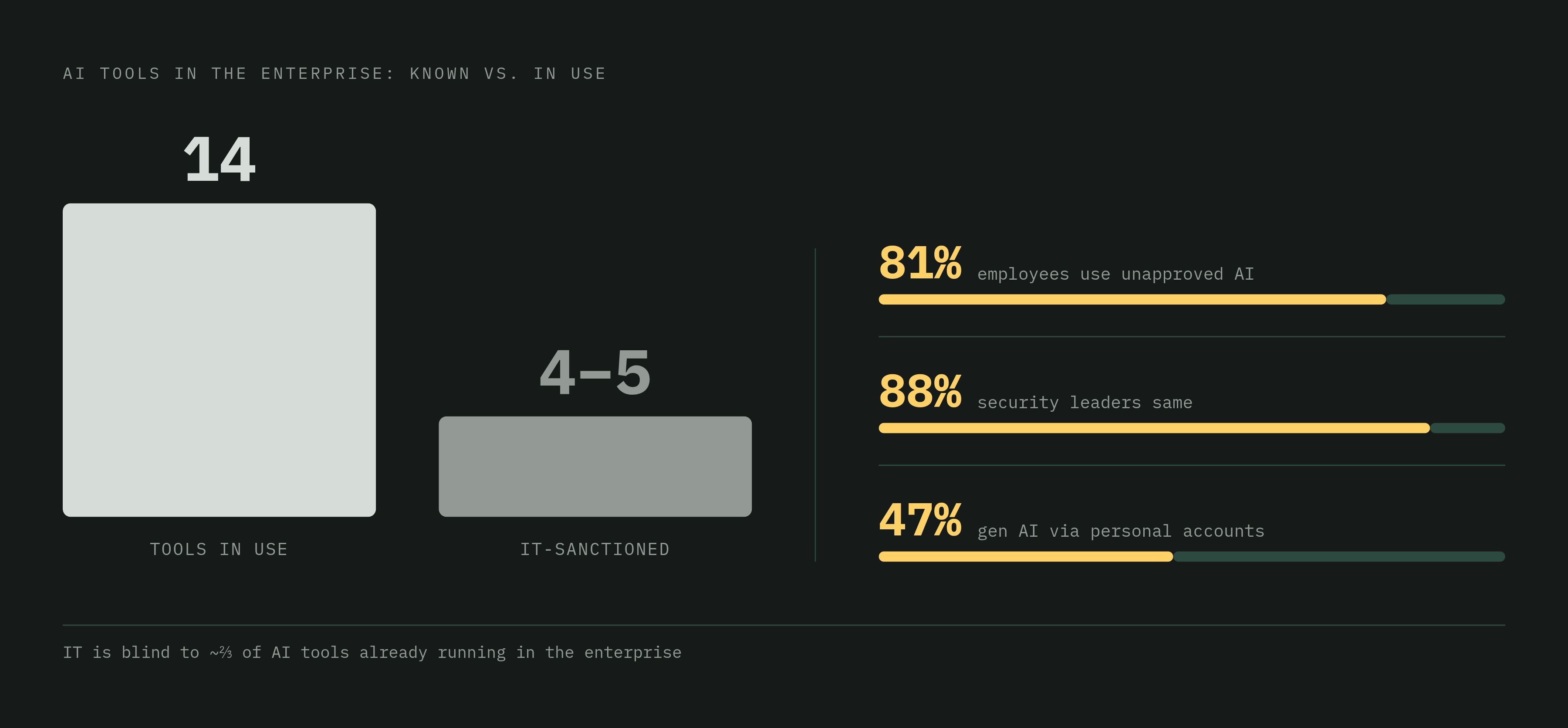
The average enterprise runs 14 distinct AI tools day to day. IT knows about 4 or 5 of them, according to Productiv's 2026 analysis. That's not a rounding error, that's most of the iceberg sitting below the waterline.
And it's not confined to junior staff finding creative workarounds. Per UpGuard, 81% of employees and 88% of security leaders admit to using AI tools their company never approved. Read that twice. The people whose literal job is to stop this are doing it too. Netskope's 2026 numbers add another layer: close to 47% of people using generative AI tools are logging in through personal accounts, walking straight past whatever enterprise controls exist as if they weren't there.
Banning the tools doesn't fix this, it just adds a layer of theater. Roughly 45% of workers find a way around blocked applications anyway. You didn't remove the risk, you just switched off the lights while everyone kept working in the dark. And the exposure isn't evenly spread across a hundred obscure vendors, either. OpenAI's services alone account for 53% of shadow AI usage in the organizations studied, meaning about half of all AI-driven risk out there runs through one company's servers.
Only a minority of organizations even have a policy for detecting shadow AI in the first place (IBM, 2025). For autonomous agents specifically, it's grimmer: just one in five organizations claim a mature governance model, per Deloitte's 2026 research. Adoption sprinted ahead. Governance is still lacing up its shoes.
Why engineering organizations face a qualitatively more severe exposure than other business functions
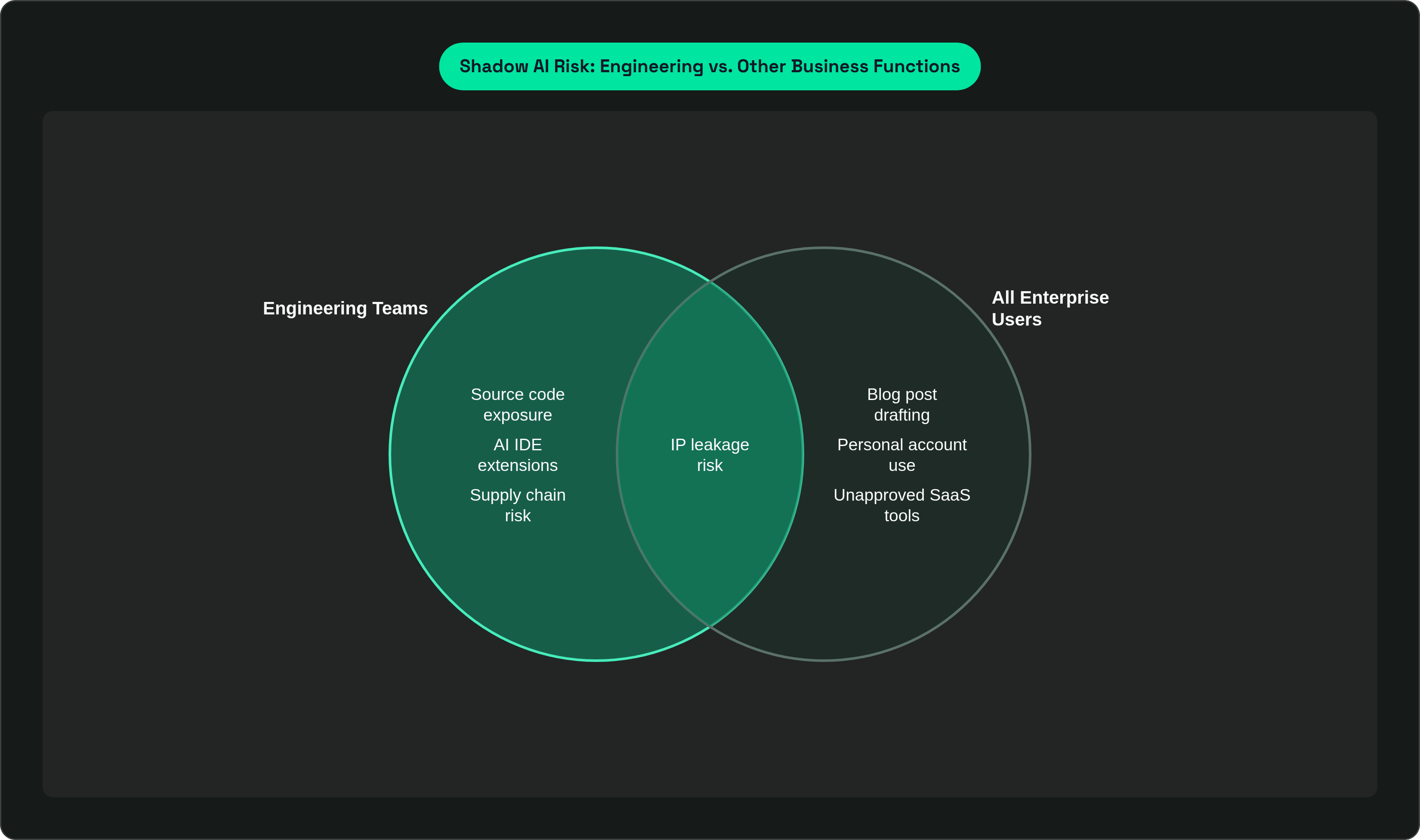
Here's the uncomfortable truth: not every department carries the same exposure when someone opens an unapproved AI tab. Marketing using AI to punch up a blog post is a very different animal than an engineer using AI two inches from production credentials.
Developers sit closest to the stuff that actually matters: source code, live infrastructure, internal APIs, secrets, configuration files. Wiz's 2026 State of AI in the Cloud report found at least 80% of organizations already have AI IDE extensions running somewhere in their environment, and 71% have at least one AI coding assistant in active use. Most of that happened bottom-up. Nobody in a boardroom approved it, someone just installed an extension because it made their Tuesday easier. GitLab's 2025 survey backs this up directly: 53% of developers admitted, on the record, to using AI coding tools their organization never sanctioned. That's over half the developer population confessing to it, unprompted.
The scarier part is how passive the leakage can be. A coding assistant doesn't need you to deliberately copy-paste your company's secret sauce into a chat window. Ask it a simple question about a bug, and it can quietly pull in open files, adjacent files, even config data, and drag all of it into the context window along with your question. You asked about a broken function. The tool grabbed your database credentials on the way.
And unlike a finance analyst drafting a memo with ChatGPT, developers ship things. If an unapproved AI tool writes the code, that code can go straight into a customer-facing product. The risk doesn't stay contained to one person's laptop, it travels downstream into production. Layer autonomous agents on top of that (developers are, unsurprisingly, the group most likely to build and deploy them with real service account credentials and OAuth tokens attached) and you get a combination no other business function has: privileged access, a tool that eats data automatically, a habit of building things that ship, and now the ability to spin up an agent that acts on its own. That's a different category of risk than "someone used AI to write an email."
Source code and IP leakage: the risk developers create without meaning to
The clearest real-world example here is Samsung. In early 2023, engineers inside Samsung's semiconductor division pasted proprietary source code and confidential internal meeting notes into ChatGPT. They weren't trying to leak anything. They wanted the AI to check for errors and summarize notes, the same reason anyone uses these tools. The result was a loss of control over sensitive intellectual property, and Samsung moved fast to restrict access afterward.
The point of the Samsung story isn't that Samsung was careless. It's that this is exactly how leakage happens everywhere, always: not through malice, but through the path of least resistance to a faster answer. Nobody sits down planning to leak IP. They just want the bug fixed before lunch.
And IP is expensive to lose. IBM's 2025 Cost of a Data Breach report found intellectual property carried the highest cost per record, at $178, in breaches tied to shadow AI. It's not just the thing most likely to leak out of an engineering team, it's the most costly thing on the shelf.
The part that should keep security leads up at night is the invisibility. Steal a file, and there's a copy operation somewhere, a log entry, something. Leak a prompt, and there's nothing. No exfiltration event. No alert. No line item in a SIEM dashboard to review six months later when someone finally asks the right question. Conventional DLP tools are built to watch files move and traffic cross the network boundary; a typed sentence in a chat window does neither. That's not a policy gap you can patch. That's an architecture built to watch for the wrong thing entirely. Which means the only real fix is catching it before the prompt gets sent, not after.
Hallucinated packages and supply chain attacks introduced through AI-generated code
Researchers at Vulcan Cyber found that roughly a significant share of packages recommended by popular large language models, in response to totally ordinary coding questions, didn't exist. The AI just made them up, confidently, the way a kid makes up a word on a spelling test and says it with a straight face.
Attackers noticed. They started harvesting these hallucinated package names and registering them as real, working (malicious) packages, a trick called typosquatting. In late 2025, one supply chain attack that exploited a hallucinated npm package hit an estimated 15,000 projects. The mechanism is almost embarrassingly simple: a developer asks the AI for a dependency, the AI names something that sounds plausible but isn't real, the developer runs the install command anyway, and now the attacker's substitute is sitting inside the build.
There's a second flavor of this same problem. GitGuardian's 2025 analysis found that GitHub Copilot can reproduce secrets it learned from the public repositories it trained on, some of which had credentials accidentally committed and never scrubbed. A developer copies what looks like normal boilerplate and ships a live API key without ever knowing it.
Both risks share a trait that makes them nasty: they're invisible to the person trusting the tool. A fake package looks like a real package. A leaked secret looks like ordinary code. Wiz's research adds a third wrinkle, finding that roughly 1 in 5 organizations using AI-powered "vibe coding" platforms had applications hit by systemic security weaknesses baked in at the workflow level, not just from one bad prompt here or there. For engineering leadership, this is the line that matters most: this risk doesn't stay inside the walls. It ships to customers.
Autonomous agents built and deployed by developers outside any governance framework
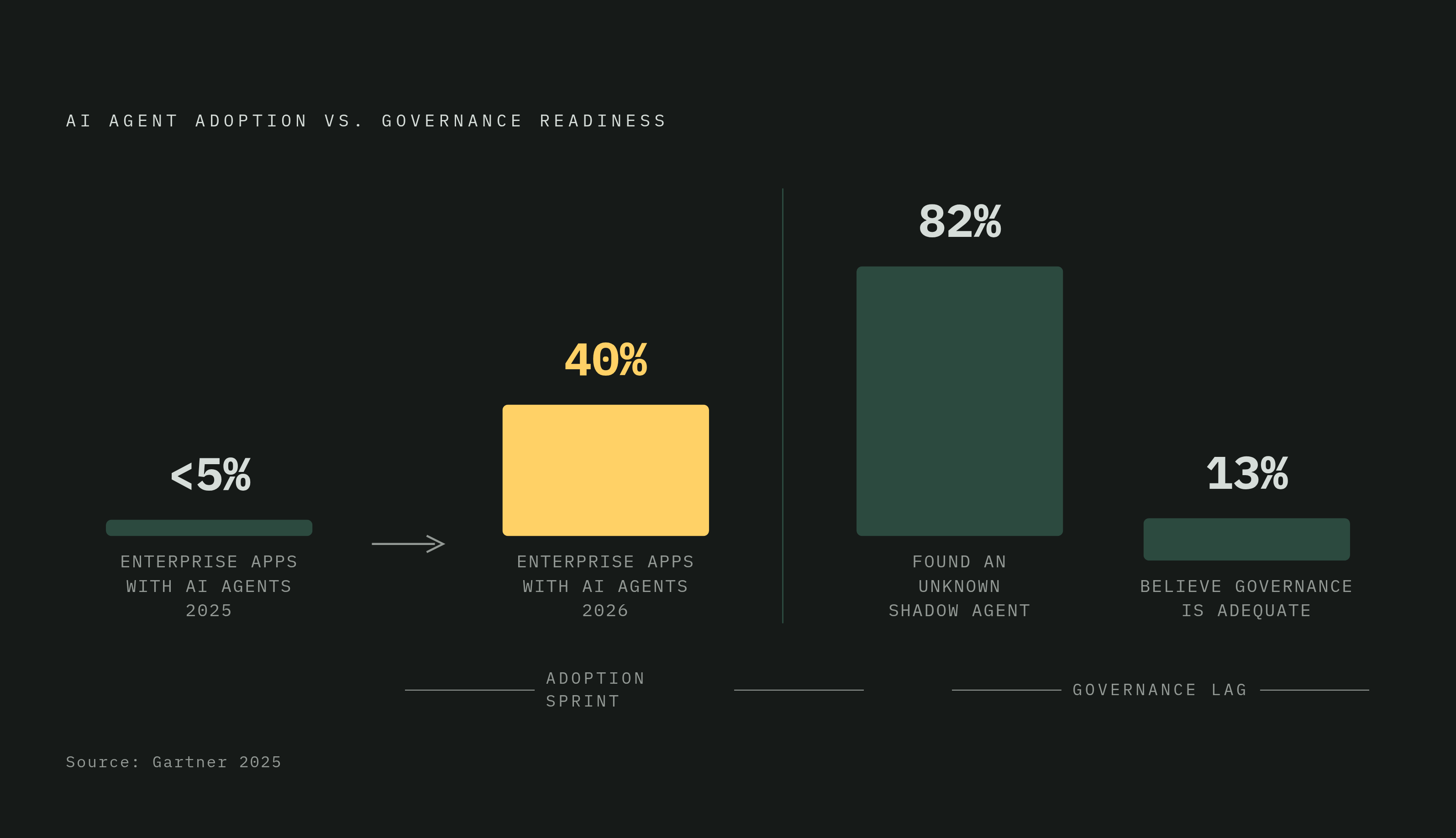
Gartner expects AI agent integration in enterprise apps to jump from under 5% in 2025 to 40% by the end of 2026. That's not gradual growth, that's a sprint, and no governance framework built at a normal pace is going to keep up with it.
Where does that leave security teams right now? According to 2026 research, 82% of organizations have already discovered at least one AI agent or workflow running that their security team never knew existed. Only 13% believe their current governance is actually adequate. Developers, again, are the ones building most of these agents, simply because they have the API access, the scripting chops, and the direct line into production that makes spinning one up trivial, sometimes an afternoon project.
Shadow agents are worse than shadow tool use for a specific, structural reason. A person logs in, does a task, logs out; the exposure window closes. An agent holds onto service account credentials and OAuth tokens indefinitely, often long after whoever built it moved on to a different project. And agents can be hijacked through prompt injection, where an attacker buries instructions inside content the agent reads (a document, a webpage, an email) and redirects its behavior without ever touching the underlying system directly.
Microsoft reported active agents inside the Microsoft 365 ecosystem grew 15 times year over year in 2026. Any audit you run today is basically stale by the time you finish writing the report. The industry noticed enough to act: the OWASP Top 10 for Agentic Applications came out in December 2025, built with input from over 100 industry experts, marking the first serious attempt to classify these risks as their own category rather than a footnote to old-school application security. Dark Reading's 2026 numbers put a fine point on it: nearly half of security professionals now rank agentic AI as the single biggest attack vector of the year. Not a future worry. A current one.
What the financial and regulatory exposure actually looks like for engineering teams
IBM's 2025 Cost of a Data Breach report found shadow AI breaches cost noticeably more and take longer to contain than ordinary breaches, enough that the gap alone could swallow most governance budgets whole. The flip side is just as telling: organizations that had AI security tools deployed saw meaningfully lower average breach costs than those without. That's a real return on investment, sitting there in plain sight, for whoever bothers to act on it early.
The regulatory clock has also started ticking for real. The EU AI Act becomes fully enforceable on August 2, 2026, with transparency obligations under Article 50 and the full penalty regime alongside it. Violations tied to prohibited practices can run up to tens of millions of euros or 7% of global annual revenue. Transparency violations under Article 50 carry a lighter, but still serious, penalty of up to €15 million or 3%. A Forrester 2026 study found 65% of compliance executives already point to shadow AI as the number one reason their AI governance has gaps under this law. For engineering teams specifically, there's a wrinkle worth flagging: everyday coding assistants likely sit outside the Act's highest-risk category, but the moment an AI tool touches worker evaluation or task allocation, it can trigger the full high-risk obligation set. Most engineering organizations haven't even drawn that line yet, let alone crossed it carefully.
Gartner predicts AI-related legal claims will pass 2,000 by the end of 2026, driven by weak risk guardrails. This isn't hypothetical anymore, litigation is already happening. Research from Optro's AI Oversight Gap study found 40% of organizations reported inaccurate AI outputs in the past year, 33% reported policy violations, 27% reported data breaches tied to AI use, and 26% reported regulatory action. Those are outcomes that already happened, not forecasts. And there's a quieter cost hiding underneath all of it: 78% of IT leaders reported unexpected SaaS charges from consumption-based or AI pricing models. Shadow AI shows up on the P&L before it ever shows up in a breach report.
Why the standard response — locking tools down — makes the problem worse in engineering contexts
The instinct to slam the door shut makes sense emotionally. It just doesn't work practically. 45% of workers find a workaround when a tool gets blocked, which means the ban didn't remove the risk, it just removed your ability to see it.
Engineering makes this trade-off sharper than anywhere else in the company. Developers who can't use AI tools work slower, full stop, and in a hiring market where engineers have options, heavy-handed restrictions become a recruiting and retention problem on top of a security one. Samsung's aftermath is the textbook version of this trap: leak happens, company bans the tool, developers quietly move to something even less visible than what they were using before. The risk didn't go away. It just went further underground.
Making this harder still: roughly 80% of GenAI access happens through the browser, per Menlo Security's 2025 research, which makes network-layer blocking almost trivial to slip past and renders most browser-based usage invisible to conventional monitoring tools. Locking things down typically leaves three entire categories completely unaddressed anyway. AI features that got quietly switched on by a vendor's software update, with no deployment decision and no policy trigger involved. Local models running entirely on a developer's own machine, generating zero network traffic to inspect. And shadow agents built using credentials that were already approved for something else, which look, from a network perspective, exactly like legitimate automation.
The honest reframe: the goal was never to stamp out AI use. It's to make it visible. Developers will work within governance they actually respect; they'll route around governance that just gets in the way. That means the sanctioned tools need to genuinely beat the shadow alternatives on capability, not just win by default because they're the only ones allowed.
What governance built for engineering organizations actually requires
Start with inventory, because you can't govern what you can't see. Remember that gap from earlier: the average enterprise knows about 4 or 5 of the 14 AI tools its people are actually using. For engineering specifically, that inventory has to stretch past SaaS subscriptions and cover IDE extensions, direct API integrations, and agent workflows, since that's where most of the real exposure is hiding.
Agent behavior needs its own line of sight, separate from user-level monitoring. With 82% of organizations discovering shadow agents they didn't know existed, any governance plan that only tracks how people use tools, and ignores what agents do on their own, is already missing half the threat surface.
One practical lever worth calling out directly: model-agnostic infrastructure. When developers can pick whichever AI model fits the job, inside a platform that's sanctioned and actually observable, the incentive to sneak around IT mostly disappears. This is the logic behind open, self-hosted agent platforms such as OpenHands, which let engineering teams run whatever model they want on their own infrastructure while keeping the audit trails and access controls that closed, vendor-locked SaaS tools simply can't offer.
Guardrails need to live at the agent level too, not just wrapped around the human. That means scoped credentials that expire instead of service account tokens that live forever, execution logs that record what an agent actually did rather than just confirming it ran, and human checkpoints built in before any high-privilege or irreversible action goes through.
None of it works if the approved path is worse than the shadow one. Governance that competes on speed and capability wins developer trust. Governance that only says no loses it, and loses the developers along with it. Treat the EU AI Act's requirements as the floor you're required to clear, not the ceiling you're aiming for. Everything that actually protects your source code, your production systems, and your IP has to be built on top of that, not instead of it.