State Persistence Across Agent Sessions
Newer AI agents require persistent memory across conversations, not just within sessions.

Gartner projected in 2025 that 40% of enterprise applications will feature task-specific AI agents by 2026, up from less than 5% the same year. That is a massive jump. It also means state failures are no longer a niche research problem. They are a production reliability problem happening right now, at real companies, in real workflows.
An empirical study of bugs across several major AI coding agents found that session and state management issues accounted for 5.8% of all reported bugs. Unsaved progress. Task resumption failures. Agents losing their internal state mid-interaction. Five-point-eight percent sounds modest until you multiply it across the volume Gartner is describing, and then it is a very large surface area of users watching an agent forget what they just said.
What does that look like in practice?
- An agent restarts mid-workflow with no idea where it left off
- A user re-explains a preference they already gave last session
- A multi-day task resets overnight because nothing was ever written anywhere
These are not edge cases. They are the default failure mode when state is treated as an afterthought. The industry is past the prototype stage. State persistence is a reliability requirement now, not something you defer to v2 and quietly hope no one notices.
The Four Types of Memory an Agent Can Actually Use

Before you build anything, you need a clear mental model of what "memory" even means for an agent. There are four distinct types, and conflating them is how you end up solving the wrong problem very confidently.
Working Memory
This is the context window. What the model can see right now, in this moment. Fast, zero-latency, completely ephemeral. When the session ends, it is gone. It is also capped by token count, so you cannot keep stuffing things in here and call it a memory strategy. A lot of teams try this. It does not work past the first few sessions.
Episodic Memory
Think of episodic memory like a ship's log — a faithful record of where the vessel has been, what weather it endured, and every course correction made along the way. An append-only record of what the agent observed, what it did, and what happened as a result. It gives the agent temporal reasoning, so it can distinguish what it decided last Tuesday from what it decided last month. This is your best friend for audit trails and for debugging anything that runs over hours or days. When something goes wrong and you have no episodic record, you are just guessing at what happened and hoping the guesses are good.
Semantic Memory
This lives in a vector database. Pinecone, Qdrant, pgvector. You retrieve from it by similarity search, not by exact key. This is where retrieval-augmented generation actually lives, and it is the right tool when you need fuzzy matching: find me past conversations that look like this one. It is not the right tool when you need to fetch a specific user preference. That is the next one.
Procedural or Key-Value Memory
Structured facts in a persistent store. Redis, DynamoDB, PostgreSQL. User preferences, entity attributes, business rules. This survives across sessions and gives you sub-millisecond reads. Use it for deterministic lookups. Avoid using it for similarity. That distinction matters more than it sounds.
One more thing most teams miss: memory has a full lifecycle. Ingestion, storage, retrieval, and eviction. Almost everyone designs the first three and treats eviction as someone else's problem. It is not. More on that shortly.
Short-Term and Long-Term State Are Two Different Problems
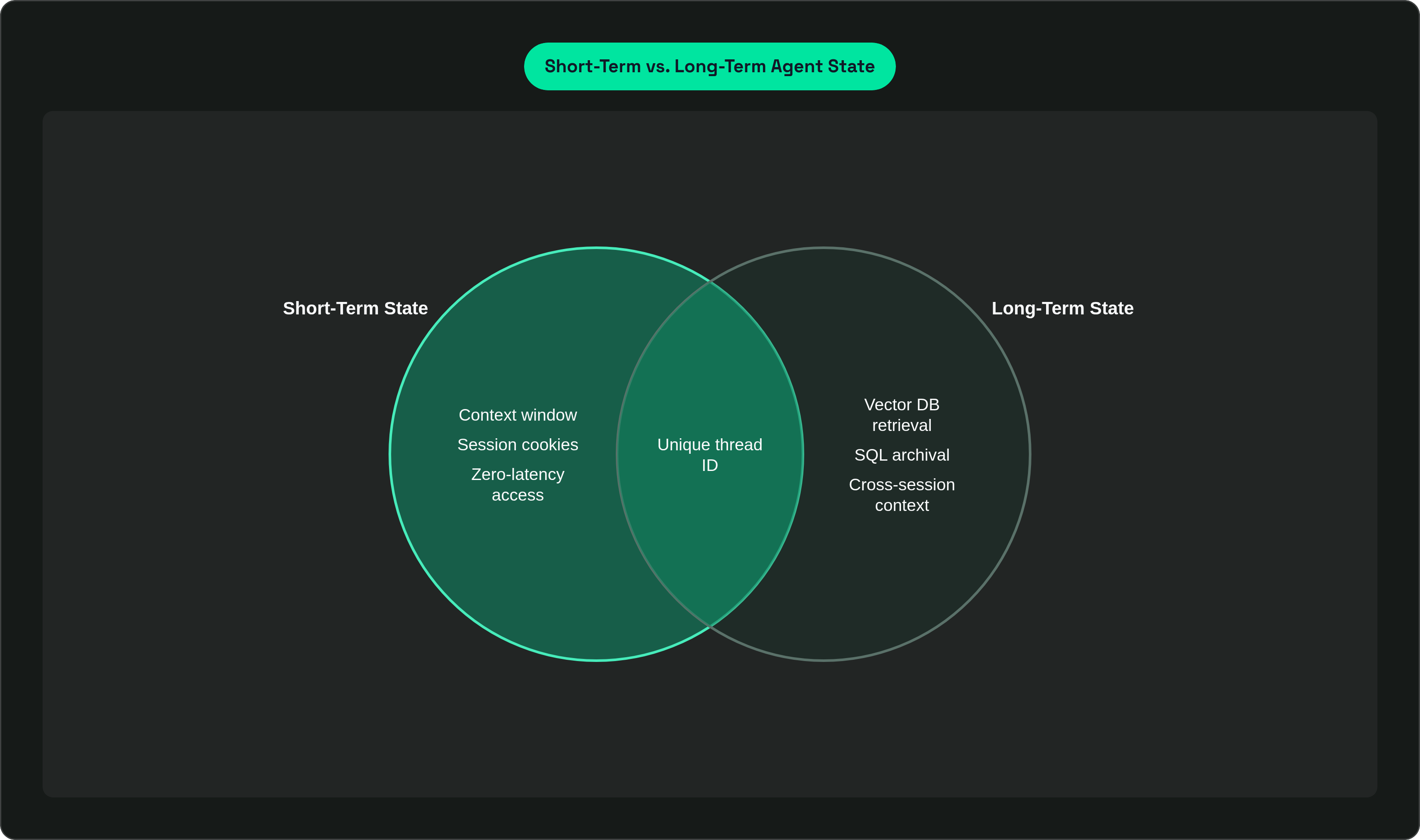
Teams consistently treat session-scoped state and cross-session state as one unified problem, then over-engineer one and completely ignore the other. This is how a lot of engineering time disappears.
Short-term, session-scoped state is genuinely a solved problem. Cookies, session identifiers, a unique ID assigned at first interaction and threaded through subsequent requests. Web developers have been doing this for decades. The primitives are standardized. For the duration of a single continuous interaction, this is sufficient. If that is all you need, you are done.
Cross-session state is where the real complexity lives. This requires the agent to write to and read from a database as part of its normal workflow. You need to cover historical interactions, accumulated knowledge, and user-specific context that has to survive process restarts. That means thinking about atomic updates so partial writes do not corrupt state, versioning so you can roll back when something goes sideways, and concurrent modification handling if multiple agents or humans are touching the same workflow at the same time.
The practical implication: a team that builds only session-scoped memory has built a capable short-term agent. Not a persistent one. The cross-session layer has to be designed separately and intentionally. It does not emerge on its own, and it absolutely does not come for free.
Four Patterns That Actually Work in Production
Checkpointing (the LangGraph Approach)
Every time the agent moves to a new step in a workflow, a checkpoint gets written to a database. Each conversation or task is a thread with a unique ID. To resume, the system reconstructs state from the last checkpoint and the agent picks up exactly where it left off.
The genuinely useful part is time travel. LangGraph keeps a full history of checkpoints, so if a tool call failed or a user wants to try a different path, you can branch from an earlier state rather than starting over from scratch. LangGraph has passed 30,000 stars on GitHub and is one of the most active agent frameworks as of 2026.
Here is the production pitfall nobody warns you about: many teams ship to production still using MemorySaver, which is in-memory only. One pod restart and every in-flight thread is gone. The fix requires a database-backed checkpointer and a schema you probably did not plan for upfront. Design this before you deploy, not after your first incident.
Hybrid Multi-Tier (Redis + Vector DB + SQL)
Three stores, three time horizons.
- Redis handles low-latency session state
- A vector database retrieves semantically similar past cases
- SQL provides durable long-term archival
The operational sequence: pull fresh context from Redis, retrieve similar cases from the vector database, do the work, then archive results to SQL and update long-term summaries. On crash, you restore session state from Redis and semantic context from the vector database. Recovery is built into the read path rather than bolted on afterward.
More infrastructure to operate, yes. But each tier is doing exactly the job it is optimized for, which matters a lot when you are trying to figure out what broke and why at an inconvenient hour.
Multi-Scope Memory (the Mem0 Approach)
Every memory write is tagged with identity scopes: a user ID for facts that persist across sessions, an agent ID for facts tied to a specific agent instance, a session or run ID for conversation-scoped facts, and an org or app ID for shared organizational context. At retrieval time, those scopes are composed and ranked automatically.
This pattern lets one agent serve multiple users without cross-contaminating their state. It also lets organizational context be shared across agent instances without duplicating it everywhere. The separation of concerns happens at the memory layer, which is the right place for it.
OS-Inspired Hierarchical Memory (Letta / MemGPT / MemoryOS)
This is the most architecturally distinct approach of the four. It treats the context window like RAM and external storage like disk — the agent pages information in and out the same way an operating system manages process memory, swapping what it needs into the foreground and shelving the rest until called upon.
MemGPT introduced the core idea of virtual context management. MemoryOS implemented three tiers (short-term, mid-term, long-term) with a structured promotion model where material moves up tiers based on importance, rather than everything piling into one undifferentiated heap.
Most complex of the four patterns. Highest setup cost. But also the most principled solution to the token-limit problem. If you are building agents that run for days or weeks over enormous amounts of accumulated context, this architecture is worth the investment and the headache.
Stateless Looks Cheaper Until It Really, Really Isn't
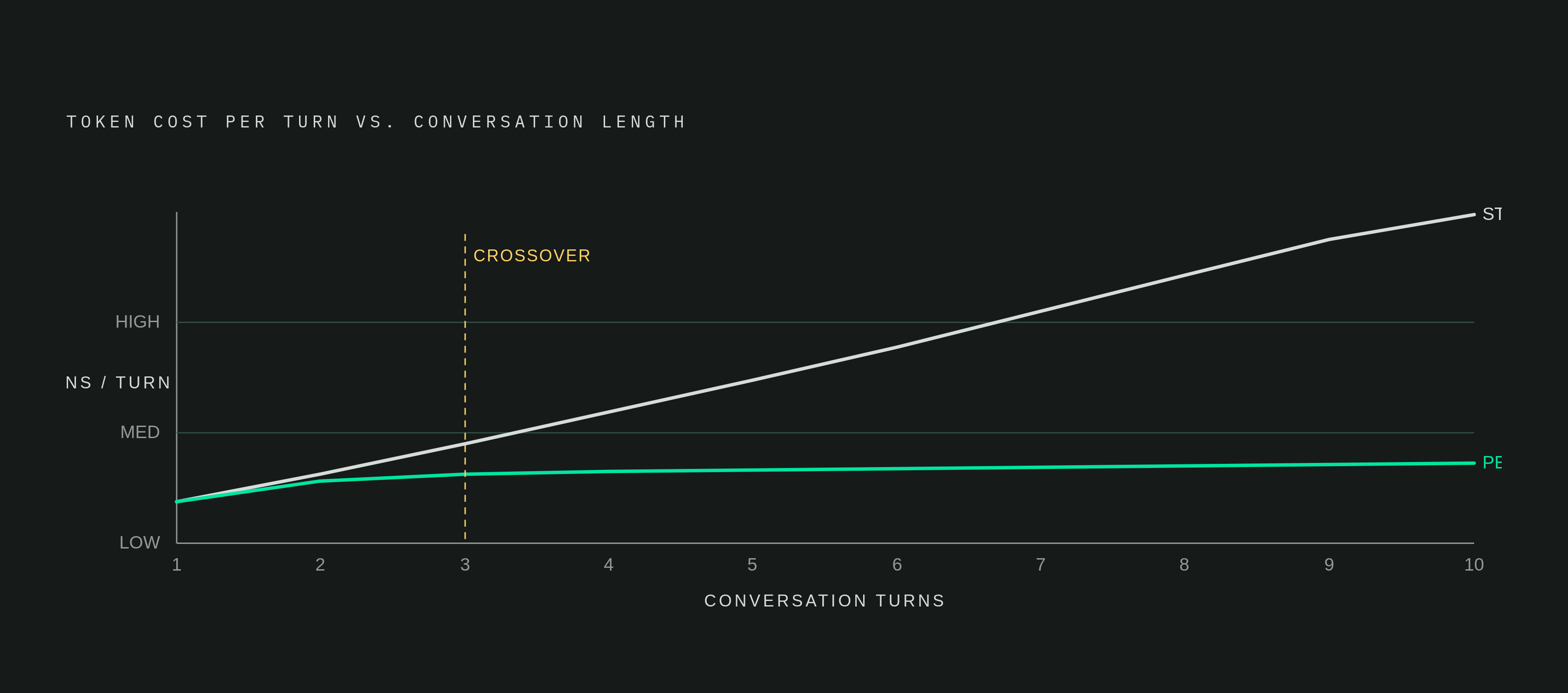
Stateless calls look cheap upfront. No state lookup, low latency on simple prompts. Hard to argue with on a whiteboard.
The cost compounds as context grows. If you are resending and reprocessing full history at every turn, token consumption grows linearly with conversation length. A persistent system incurs lookup and retrieval overhead, but it injects only relevant fragments, so there is less work for the model per turn once history grows past a few exchanges. The crossover point is real. For short, one-shot interactions, stateless is fine. For multi-step, multi-session workflows, persistence is cheaper in tokens and faster in wall-clock time once the history gets long enough. That is just how the numbers work out.
There is also a qualitative difference that matters in practice. Agents that remember ask fewer repetitive questions. They can advance long-running tasks across sessions. They do not make users feel like they are talking to someone who forgot the entire conversation the moment they stepped away for five minutes. That difference determines whether people actually want to use the thing or quietly stop opening it.
Persistence should be the default for any workflow that spans more than a single session. Stateless should be a deliberate choice for bounded, single-turn tasks, not whatever the framework handed you because you never specified otherwise.
Accumulation Will Quietly Wreck You If You Don't Plan for It
This is the part that is tempting to defer. The problem is that by the time it becomes urgent, it is already a mess.
Every tool call, every user input, every LLM response adds to state. Without cleanup, lookups slow down and prompt sizes balloon. Two specific failure modes show up consistently:
- Context window overflow. Without pruning or summarization, history eventually exceeds what the model can process. The agent starts dropping context. Things get weird in ways that are hard to reproduce.
- Retrieval degradation. As the memory store grows, similarity search returns noisier results. Dead-end reasoning paths and failed experiments start polluting the signal. The agent gets less useful, gradually, and it is genuinely hard to pinpoint why until you go digging.
The fix is consolidation. You teach the agent to extract, merge, and clean up memories instead of just appending everything verbatim forever. Summarize older episodic memory into denser representations. Apply eviction policies for facts that are stale, superseded, or just not worth keeping around. The MemoryOS FIFO promotion model formalizes this: short-term memory fills up, the most important material moves up a tier, rather than everything accumulating in one pile until performance quietly collapses.
A more direct approach: build memory management into the agent's decision loop as explicit tool calls. The agent reasons about what to add, update, or delete. It is transparent and coherent. The agent is actively curating what it retains rather than passively hoarding everything it has ever touched.
Plan eviction at the same time you plan ingestion and storage. Not after you start seeing performance problems and have to go fix a production system under pressure.
Persistent Memory Changes the Security Model Completely
Traditional AI security assumes stateless systems. Persistent memory breaks those assumptions in ways that are easy to underestimate, especially if your security review was written before your agent had any memory to speak of.
The memory store becomes shared state that shapes every future interaction. Anything written to it influences the agent long after the session that wrote it has ended. Session isolation is effectively gone. A compromise that reaches the memory store survives session resets, which is a very different threat model than most teams are used to thinking about.
Memory poisoning is a real attack vector. Gradually altering agent behavior over time is difficult to detect precisely because the effect is incremental. Your vector database is now a sensitive data asset. It requires real access controls, not just application-layer trust and good intentions.
Then there are the data protection obligations that do not care whether your security review was up to date.
- GDPR Article 17 gives users the right to erasure, with a one-month response window. That requires you to be able to locate and delete specific user data across the memory store.
- Article 15 lets subjects request what data is held. Article 16 lets them correct it. Both require queryable, attributable memory records.
- Article 35 requires a Data Protection Impact Assessment for high-risk processing using new technologies. Persistent agent memory fits that description closely.
The operational controls that follow from this:
- Atomic updates and versioning (which you need for rollback anyway, so the engineering cost is shared)
- Monitoring of autonomous decision-making and agent-to-agent communications
- Audit trails that record what was written to memory, by which agent, and when
That last one is worth flagging separately. Episodic memory can serve the audit function directly if you design it with that intent from the start. The engineering work is not additive. It is the same work serving two purposes, which is the kind of efficiency that actually makes compliance feel less like a tax and more like something you were already doing.
Visibility into what the agent is storing and why is not just a compliance checkbox. It is what lets a team actually trust the system they built. Without that trust, the whole thing is just expensive infrastructure that nobody wants to touch when something goes wrong.