Self-Hosted vs Cloud AI Agent Deployment Trade-offs
Cloud costs explode with agentic workloads; self-hosting breaks even at scale.
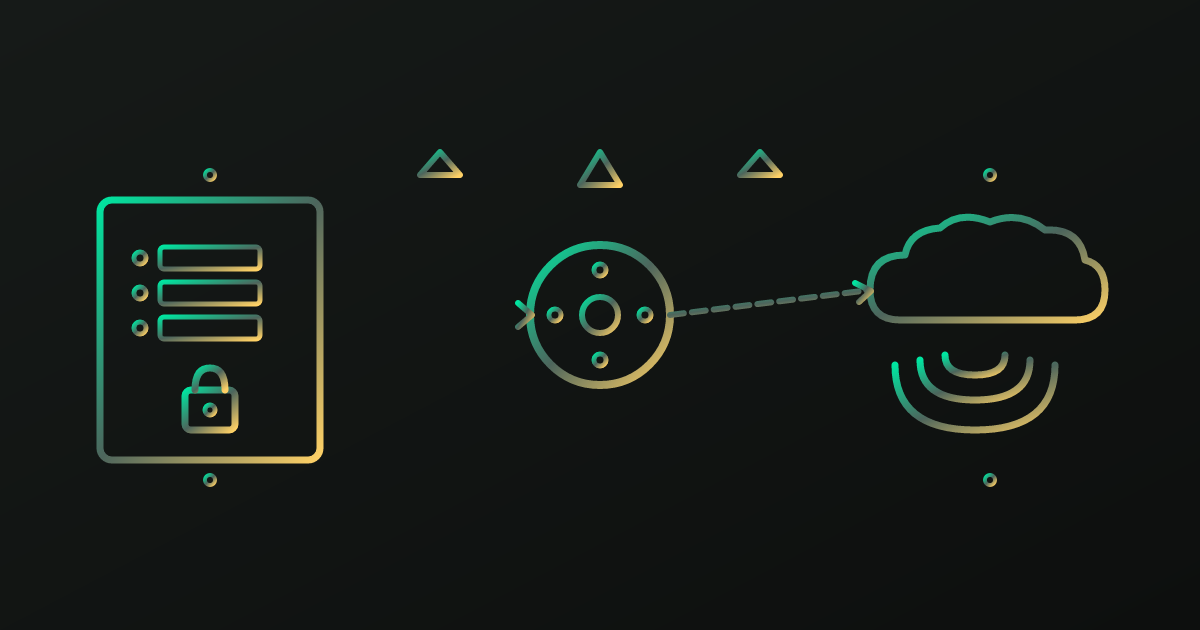
Cloud AI deployment has real, honest strengths. Zero upfront hardware cost. Instant access to frontier models. Elastic scaling for workloads you cannot predict. The provider handles patching, availability, and baseline security. That combination is genuinely compelling, especially early in a project's life. Roughly two-thirds of enterprise AI compute currently runs on cloud services, and that number exists for good reason.
The per-call cost looks reasonable at first glance. A few cents per thousand tokens for a GPT-4-class model. Feels manageable. Then the agentic multiplier hits, and suddenly it doesn't.
A simple chatbot makes one or two API calls per user interaction. An agentic workflow makes ten to fifty. Since late 2023, token consumption in production agent deployments has jumped by orders of magnitude. A customer service team handling tens of thousands of conversations per month, a legal team summarizing thousands of contracts, an engineering team running code generation at high daily volume. None of these teams are looking at small line items anymore. They are looking at six- and seven-figure annual bills that grow linearly with every new user, workflow, and agent dropped into the system.
And the headline API rate is not the whole story:
- Cloud providers charge a significant markup over wholesale GPU rates
- Data egress fees can add a substantial percentage on top for data-intensive workloads
- Private endpoints and dedicated instances cost more than public API access
- If you are not rate-limiting aggressively, bills arrive as surprises
Inference now accounts for the majority of AI infrastructure spending, not training. The per-token cost line is the one to model carefully before committing to cloud at scale.
Self-Hosted Means You Own Everything, Including the Headaches
Self-hosted AI deployment means the model weights and inference stack run on hardware you control. Data does not leave your environment unless you deliberately send it somewhere. That is the core value proposition in one sentence.
The hardware costs are real and front-loaded. A cost-optimized inference cluster runs around $79,000. A high-performance cluster with top-tier GPUs is closer to $335,000. Add another thirty to fifty percent for infrastructure in the first year: networking, storage, power, cooling, rack space.
That sounds like a lot. Here is a concrete example that reframes it.
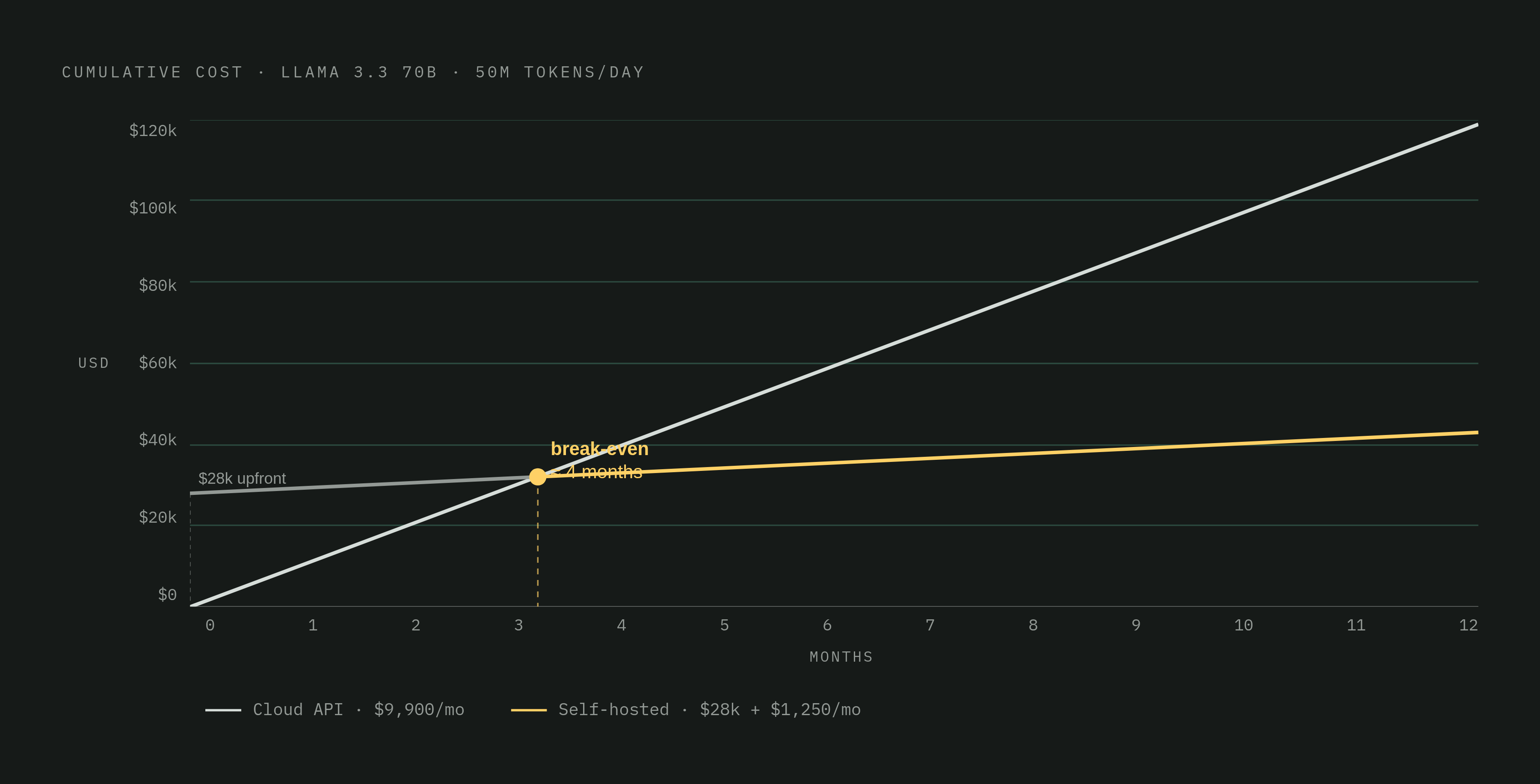
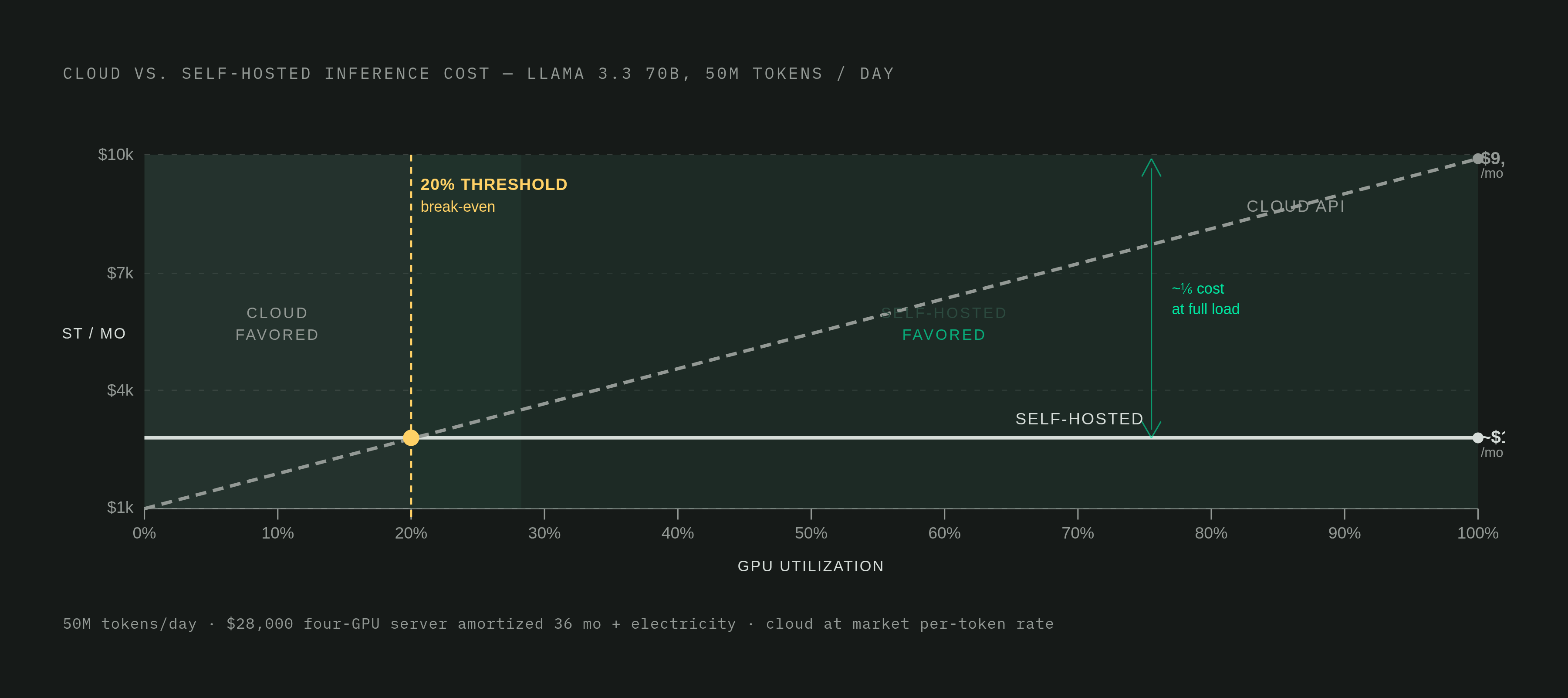
A team running a high-volume open-weight model like Llama 3.3 70B to replace a comparable managed model at 50 million tokens per day is looking at roughly $9,900 per month on a cloud API. Self-hosting that same workload on a four-GPU server costing $28,000, amortized over three years plus electricity, lands somewhere in the $1,000 to $1,500 per month range. At steady utilization above 20%, that hardware can break even against cloud costs in as little as four months. Which, when you first see that math, is a little jarring.
What teams consistently undercount when running those numbers:
Staffing. You are adding somewhere between half and one-and-a-half FTE of DevOps and ML infrastructure work. That is a real salary line, and it surprises people who did the hardware math but forgot the human math entirely.
Security responsibility. Patching, access control, backups, and breach response all transfer to you. A neglected self-hosted deployment is less secure than a well-run managed cloud setup. Nobody reminds you. Nobody cares. It just quietly becomes a liability.
Model upgrades. They do not happen automatically. Keeping pace with frontier capability requires deliberate, ongoing effort. Nobody is pushing updates to your rack.
The upside beyond cost is genuinely worth noting though. Self-hosting opens access to the growing ecosystem of open-weight models. Llama, Mistral, and others can be run without any vendor dependency. You are not locked into one provider's pricing decisions or release schedule, which sounds abstract until the day a provider raises rates or deprecates a model you built around.
The Crossover Point Is Findable If You Model It Honestly
There is a useful threshold that comes out of enterprise infrastructure analysis. When cloud AI costs reach roughly 60 to 70 percent of what equivalent on-premises hardware would cost over the same period, on-premises economics start to compete, even after you account for CapEx and operational overhead.
The key variable is utilization. Below 20% GPU utilization, cloud wins. You are simply not running enough volume to justify the CapEx. Above 20% with steady workloads, amortized hardware costs start beating per-token cloud pricing. Bursty or unpredictable workloads are a different story. Idle owned hardware is pure waste, and cloud handles that shape of work better than anything you can rack yourself.
Before committing to either direction, model four things:
- Expected daily token volume. Agentic loops make this much higher than naive first estimates. Most people undercount by a factor of three or four.
- Workload shape. Steady throughput is a very different calculation than peaks and valleys.
- Time horizon. Three years versus five years changes the answer substantially.
- Staffing cost. The operational overhead goes in the on-premises column. It does not get left out of the spreadsheet.
The fact that a strong majority of organizations now run some form of hybrid model is telling. Most teams are not committing fully to one architecture because their workloads are genuinely mixed. That is often the rational answer, not a failure to make a decision.
Cloud Privacy Promises Are Legal Controls, Not Technical Ones
In a self-hosted deployment, your data does not cross an external boundary. In a cloud deployment, inference requires sending data to a third-party server. That is not a knock on cloud. It is just what cloud is, structurally, by definition.
IBM research found that a majority of enterprises name data privacy as their top barrier to cloud AI adoption. Separately, a 2025 Gartner survey found that a significant share of organizations either suspect or have confirmed that employees are feeding sensitive company data into cloud AI tools without authorization. Shadow AI is not a hypothetical. It is a governance exposure already happening in most organizations right now, whether those organizations know it or not.
Cloud vendors offer mitigation in the form of Zero Data Retention agreements, where the provider contractually commits to dropping data after generating a response. That is a meaningful control. But it is a legal control. The data still transits third-party infrastructure. For teams operating under strict security requirements, a contractual promise is not the same thing as a network boundary. That distinction matters enormously to the people holding the pen on your audit, and if you have ever been in one of those rooms, you already know the conversation that follows when someone points it out.
Self-hosting shifts the security burden entirely to your team. The privacy advantage is real, but only if your team actually does the security work. A poorly maintained self-hosted deployment can end up less secure than a well-run managed cloud service. The architecture does not protect you. The discipline does.
For organizations with an air-gap requirement, there is no cloud configuration that satisfies it. The architecture decision is made for them. And in sensitive verticals like healthcare, legal, finance, and defense, the right question is not "which architecture is more secure in general?" It is "which architecture eliminates the specific attack surface we cannot accept?"
Compliance Narrows Your Options Before Cost Is Even Relevant
If your organization operates in a regulated sector, the compliance layer can eliminate the cloud option entirely before you ever open a cost spreadsheet. Transmitting proprietary source code, architectural diagrams, or sensitive user data to third-party model providers can directly conflict with frameworks like FedRAMP High, HIPAA, PCI-DSS v4.0, and the EU AI Act.
The EU AI Act's full application to high-risk AI systems takes effect in August 2026. Data governance is now a required component of the development and deployment pipeline for teams in affected sectors. Under Article 99, fines for serious violations can reach tens of millions of euros or a significant percentage of global annual turnover. That is steeper than the GDPR ceiling, and a lot of teams have not internalized that gap yet.
One distinction that trips up more teams than it should: data residency and data sovereignty are not the same thing. Data residency is where data is physically stored. Data sovereignty is which country's laws govern access to that data, and that is determined by the legal entity operating the infrastructure, not the location of the server. The US CLOUD Act allows US law enforcement to compel American companies to produce data stored abroad. If your cloud provider is US-headquartered, data sitting in a Frankfurt data center is still within US legal reach. Choosing a European cloud region from a US-headquartered provider does not close that gap. Gartner projects worldwide sovereign cloud spending in the tens of billions of dollars in 2026, up more than a third from the year prior. The market is responding to exactly this problem, which tells you something about how many organizations have gotten caught off guard by it.
Compliance requirements also do not just govern where the model runs. They govern the entire agent stack: where tool call results are logged, where memory and context are stored, and what the observability layer records and retains.
Scalability Works Both Ways, and People Only Remember One Direction
Cloud's scalability pitch is legitimate. If your workload is unpredictable or growing fast, elastic scaling with no hardware procurement lead time is a real advantage. You can access new models as they release. If usage drops, you are not stuck with stranded capacity. This is genuinely useful and worth paying for when your situation calls for it.
Self-hosted scalability constraints are real too. Scaling owned infrastructure takes weeks or months, not minutes. Over-provisioning is a genuine risk for teams whose usage is uncertain. Nobody disputes this.
What gets overstated is how much these constraints matter for the workloads that actually benefit from self-hosting in the first place. If your inference workload is high-volume and stable, owned capacity is not a bottleneck. It is a fully utilized asset that costs less per token than cloud at scale. The scalability argument against self-hosting is mostly relevant for workloads that were never good self-hosting candidates to begin with.
A few things worth noting on flexibility. Self-hosted deployments that are model-agnostic can swap underlying models as better open-weight options emerge, without touching the orchestration layer. You upgrade the model, not the whole stack. Cloud deployments tied to a single provider's API inherit that provider's release schedule and pricing changes. The provider's decisions become your constraints, which is fine until the day it is not, and that day tends to arrive without much warning.
Operational visibility at scale matters too. Agents running continuously across an organization need full observability into behavior and execution. Self-hosted gives you complete control over logging and tracing. Cloud platforms vary widely in what they actually expose, and the gaps surface at the worst possible moment.
The hybrid pattern reflects how most organizations are actually operating: self-hosted for steady, high-volume workloads where the economics are clear; cloud for bursty, exploratory, or experimental workloads where flexibility matters more than cost efficiency. It is usually the more rational allocation, not a hedge against making a decision.
How to Actually Make the Call
Start by separating constraints from preferences. They are different things and they belong in different parts of the decision process. Conflating them is where most organizations go wrong.
Hard constraints go first. Compliance requirements, air-gap mandates, and data sovereignty rules narrow your option set before any cost analysis is relevant. If you are subject to HIPAA, FedRAMP High, or the EU AI Act's high-risk provisions, work out what those frameworks actually permit before you model anything else. If a regulation rules out cloud entirely, the cost comparison does not matter.
Once you know what architectures are actually available to you, run the economics.
Signals that point toward self-hosted:
- Regulated industry with data residency or air-gap requirements
- Steady, high-volume inference workloads above the 20% GPU utilization threshold
- Existing DevOps capacity to absorb the operational overhead
- Need for full control over the agent stack, meaning model, orchestration, memory, and observability
Signals that point toward cloud:
- Early-stage or unpredictable workloads where volume is unclear
- No dedicated ML infrastructure team, making managed security preferable to an under-resourced self-hosted setup
- Need to evaluate multiple frontier models quickly without committing to hardware
Signals that point toward hybrid:
- A mix of sensitive and non-sensitive workloads that warrant different data handling
- A stable core workload that justifies owned infrastructure, plus bursty or experimental work that benefits from cloud elasticity
For teams currently on cloud and watching costs climb, the 60 to 70 percent threshold is a practical trigger. When your cloud AI costs approach that share of what equivalent on-premises hardware would cost over a comparable window, the economics warrant a formal re-evaluation. A real model with staffing costs included, not a back-of-napkin gut check.
This decision is also not permanent. The team that starts on cloud because their workload is unpredictable and later migrates to self-hosted or hybrid as volume stabilizes is making rational, sequential choices. The architecture should follow the workload, and the workload will change. Start with constraints, run honest numbers, and revisit when the numbers stop making sense.