Scaling AI Agent Infrastructure for Large Engineering Teams
Agent adoption boosts productivity but breaks review processes designed for human-scale code.
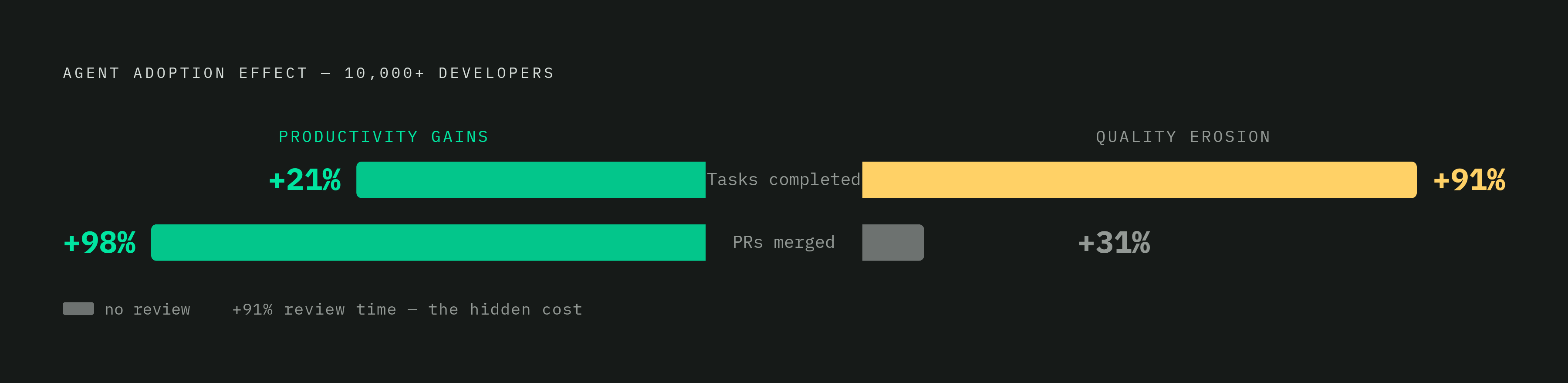
Individual engineers love agents. That part is genuinely true. A Faros AI analysis of over 10,000 developers across more than 1,200 teams found that high-adoption teams completed 21% more tasks and merged 98% more pull requests.
Then you read the next line. PR review time increased by 91%. And 31% more PRs were merged with no review at all.
More output. Less scrutiny. Bigger blast radius.
Nobody wants to say this plainly, but the review process was never designed for this volume. It wasn't built to handle a 3x increase in PR size, or to absorb the pace that agents make possible. So what you get at team scale is more unreviewed surface area, more compounding errors, more places for a quiet failure to stay quiet until it isn't.
I've watched this play out in a few different organizations now. The agents work. The process around them fails to adapt fast enough, and then something breaks in a way that takes three days to trace back to its source. Nobody's fired, but nobody's happy either.
Quality is the top barrier to production deployment, cited by nearly a third of respondents in LangChain's State of Agent Engineering survey. That's ahead of cost, capability, and access to the right models. The thing slowing teams down is the absence of architectural controls to catch what the review process is already missing.
The gains at the individual level become liabilities at the team level — like a river that irrigates a field beautifully until you triple the flow and it floods the whole valley. It's almost mechanical how reliably this happens.
How the orchestration layer becomes the central architecture decision as agent count grows
One agent is a tool. Twelve agents is a system you have to actually think about. Organizations are averaging around twelve agents right now, with that number climbing. Gartner reported a 1,445% surge in multi-agent system inquiries between early 2024 and mid-2025.
And 40% of multi-agent pilots fail within six months of production deployment. The orchestration pattern was wrong, or it was chosen without a real understanding of how it breaks under load.
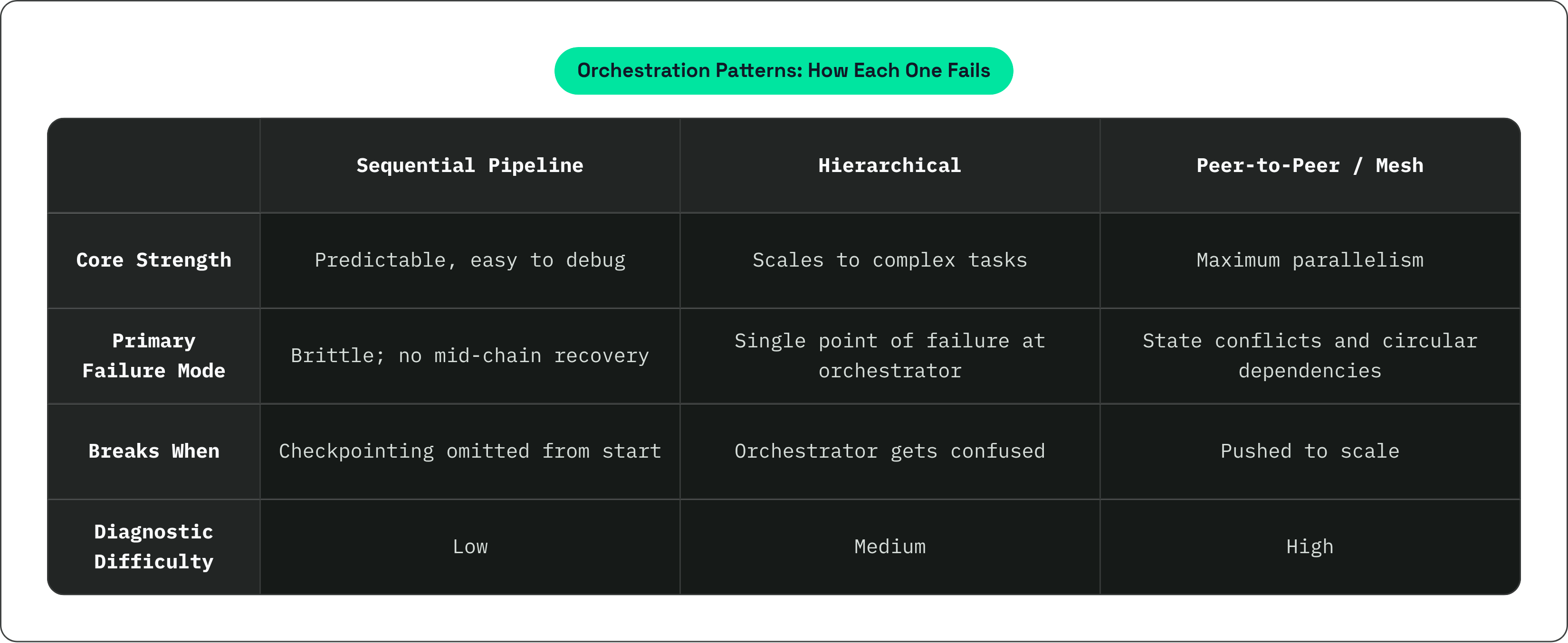
There are three main patterns, and they each fail in their own specific way:
- Sequential pipelines are predictable and easy to debug. They're also brittle. A failure mid-chain has no recovery path unless you built checkpointing in from the start, which, in my experience, most teams didn't.
- Hierarchical systems (an orchestrator directing subagents) scale to complex tasks reasonably well. They also introduce coordination latency and a single point of failure at the top. When the orchestrator gets confused, everything downstream gets confused with it.
- Peer-to-peer or mesh architectures give you maximum parallelism. They're also the hardest to reason about. State conflicts and circular dependencies show up at scale in ways that are genuinely unpleasant to diagnose at two in the morning.
State management is the hidden failure mode across all three. Agents hold task progress, context, and memory. Scale without stateful infrastructure, without checkpoints, queues, and compensating actions, and you get corruption and retry loops that compound under load. Slowly at first, then all at once.
The protocol layer matters here too. Agent2Agent (A2A), originally developed by Google and now maintained by the Linux Foundation since April 2025, and the Model Context Protocol (MCP), adopted by OpenAI, Google, and Microsoft, are interoperability standards that reduce custom integration work. Every custom integration you build instead is a failure point you now own personally. Standards reduce the surface area of things that can go wrong in ways that are invisible to you until they surface.
The orchestration decision is not cheap to reverse. Teams that treat it as something to figure out later end up rebuilding coordination logic at exactly the moment they most need to be moving forward.
What framework choices look like in production versus in benchmarks
LangChain commands a large majority of orchestration discussion on Stack Overflow. That's not just an adoption signal. It's where engineers go when something breaks, which is actually the more useful thing to know about a framework's real footprint.
In practice, LangGraph is the production leader for complex, multi-step workflows. It's not the simplest starting point. A lot of practitioners report the same pattern: they start somewhere simpler, hit a wall when observability requirements surface under real load, then cycle back to LangGraph with custom middleware. OpenHands is also worth naming. It's open-source, model-agnostic, and deployable in your own infrastructure. For teams that want framework flexibility without locking into a vendor's runtime, that combination matters more than it initially sounds.
Model pluralism is the norm. OpenAI's GPT models lead adoption, but Gemini, Claude, and open-source models all see significant use. Build your stack assuming the model layer is a variable, not a constant. New releases, cost shifts, capability gaps. These aren't hypothetical risks. They're just scheduled.
Here's the number that reframes the entire framework conversation: leading agents complete only 30 to 35% of multi-step tasks, according to Carnegie Mellon benchmarks. That's the capability ceiling right now. Which means the engineering surrounding the agent — the retry logic, the fallback paths, the human escalation hooks — is doing more work than the model is. At 30 to 35% task completion on complex work, the infrastructure determines whether the system is useful or chaotic. The model is one variable in a reliability engineering problem, and not even the most important one.
Pick a framework that lets you see what's happening. Everything else is secondary to that.
What organizational structure the platform team needs to support agents at scale
Managing people who write code is a known job. Managing systems that orchestrate AI that writes code is a genuinely different job, and a lot of engineering leaders are discovering that through experience rather than foresight.
Some organizations are running parallel fleets of agents. Others are running extended sequential critique loops that run 45 minutes or more. Both represent the same structural shift: the unit of work is no longer the engineer. It's the system. That change has organizational consequences that don't just resolve on their own.
Two structures have actually worked.
LinkedIn stood up a fully funded agent platform team modeled after its storage or ML infrastructure teams. Centralized prompt orchestration, data access, safety evaluations, deployment. A real team with real infrastructure responsibilities, not a working group that meets on Thursdays and produces slide decks.
Red Hat organized dedicated tiger teams across a 500-plus engineer organization, mapped to specific parts of the software development lifecycle: requirements, architecture, security, quality engineering, documentation, and release automation.
What both share is that they left platform primitives for individual teams to build on top of, rather than reinvent independently. Standardized development environments, consistent tooling and context files, one-command deployment, shared auth, feature flags, observability, rate limiting, LLM API gateways, prompt registries, evaluation frameworks, cost monitoring. Multipliers, not nice-to-haves.
Fragmentation is expensive in a way that's easy to underestimate until you're living in it. Every pod using slightly different deployment patterns, authentication mechanisms, or API conventions reduces agent effectiveness by an estimated 20 to 30%. That loss doesn't show up on any dashboard. It just accumulates across every task, every team, every day.
The platform team's job is to eliminate variability that agents cannot reason across. Give them a consistent surface to act on. That's the job.
How deployment control and governance determine whether pilots survive contact with enterprise security review
Here's a scenario that is not hypothetical. An organization pilots through 2024 and into 2025 without building audit trail infrastructure. Now they're trying to pass enterprise security review. Now they're rebuilding their entire permission and logging architecture from scratch, under deadline pressure, after already telling stakeholders they were ready.
Deloitte's survey of over 3,200 business and IT leaders found that 73% cite security and data privacy as top concerns. That number is not going to shrink. The organizations that treated governance as an afterthought are the ones paying for that choice right now.
A phased rollout structure that has actually survived security review looks like this:
- Four-to-six-week pilot measuring PR throughput, defect rate, and security findings. Establish a baseline before anything else. Without one, you genuinely have no idea what the agent is changing.
- Infrastructure hardening before expansion. Audit logging wired to your SIEM, sandbox isolation, secret scanning, incident runbooks. Do not expand scope until these are in place.
- Shadow mode: the agent proposes decisions while humans continue working normally. Advancement requires roughly 88% agreement with human decisions. Critical errors block promotion regardless of aggregate score. One bad miss is still a miss.
- Canary rollout: agent responsibility starts at 5% of decisions, escalates to 10%, then 25%, with stability metrics watched alongside throughput at every step.
Policy-as-Code is the mechanism that makes governance auditable rather than asserted. Translating regulatory requirements like GDPR into machine-readable code that automatically governs agent behavior means the rules run automatically. They don't depend on someone remembering to check.
Deployment location is also a governance decision, not just a DevOps one. Agents running in vendor-controlled infrastructure inherit the vendor's permission model, data residency constraints, and audit limitations. Resolve this before pilots expand. Open-source deployment in your own infrastructure gives you control over the permission model and audit trail from day one. Negotiating those controls retrospectively with a closed vendor is possible. It's just slower and more painful than sorting it out the first time.
McKinsey's research found that high performers redesign workflows rather than placing AI on top of existing ones. Governance frameworks built around legacy process shapes are governance frameworks that will break. That's already happening in several organizations I'm aware of.
Why observability lags adoption and what that gap costs in production
LangChain's survey found that 89% of respondents have implemented observability for their agents. Only 52% have implemented evaluations.
Organizations can see that something happened. They often cannot tell whether it was correct. A log file with a false sense of security is not observability. It's like having a security camera that records the lobby but goes dark the moment someone steps into the elevator.
Current evaluation approaches have a structural problem that doesn't get discussed enough. End-to-end outcome metrics mask intermediate failures. Ad hoc manual inspection fails to scale. Static benchmarks are disconnected from real deployment constraints like latency, cost, and continuous integration. You end up knowing your agent finished the task without having any idea whether the middle of the task made any sense at all. The final answer can be right for completely wrong reasons, and you'd never know.
Gartner projects that over 40% of agentic AI projects will be canceled by 2027, partly because teams cannot systematically evaluate deployed agents. Instrumentation without evaluation gives you dashboards and no answers.
The abstraction trap makes this worse. Frameworks that abstract too aggressively make it impossible to see why an agent chose a particular tool. At scale, you need raw visibility into every token sent to the model to diagnose silent failures. Clean abstractions look great in demos. In production, they become the thing hiding the problem you're trying to find.
What useful observability actually covers:
- Per-agent trace logging: tool calls, context window contents, decision branches
- Intermediate step evaluation, not just final output scoring
- Cost monitoring per agent run, per team, per task type, because cost overruns are one of Gartner's named causes of project cancellation and they arrive quietly
- Anomaly detection on agent behavior patterns, not just system errors, because agents can be wrong in ways that don't throw exceptions
If you can't tell whether your infrastructure decisions are working, you're running an experiment with better branding.
The infrastructure decisions that separate organizations reaching production from those rebuilding their approach
The decisions compound. That's the thing nobody warns you about clearly enough, and it's also the thing that's hardest to appreciate until you've been through it once.
Choose an orchestration pattern before you understand state management, and you get retry loops and corruption at scale. Choose a framework before you define observability requirements, and you get invisible failures in production. Leave team structure fragmented, and you absorb a 20 to 30% reduction in agent effectiveness that accumulates silently. Defer governance past the pilot phase, and you rebuild your audit and permission architecture from scratch having already promised stakeholders you were ready.
Each bad decision doesn't just cost you that decision. It narrows the path to every decision after it. That compounding is real, and it's why the failure rate at six months is what it is.
The model-agnostic principle is worth restating plainly: the model layer will change. Infrastructure that locks teams to a specific model creates compounding switching costs across the whole stack. The actual architecture question is how to abstract the model from the rest of the system so that when it changes (and it will change, probably more than once), the rest of your infrastructure doesn't have to move with it.
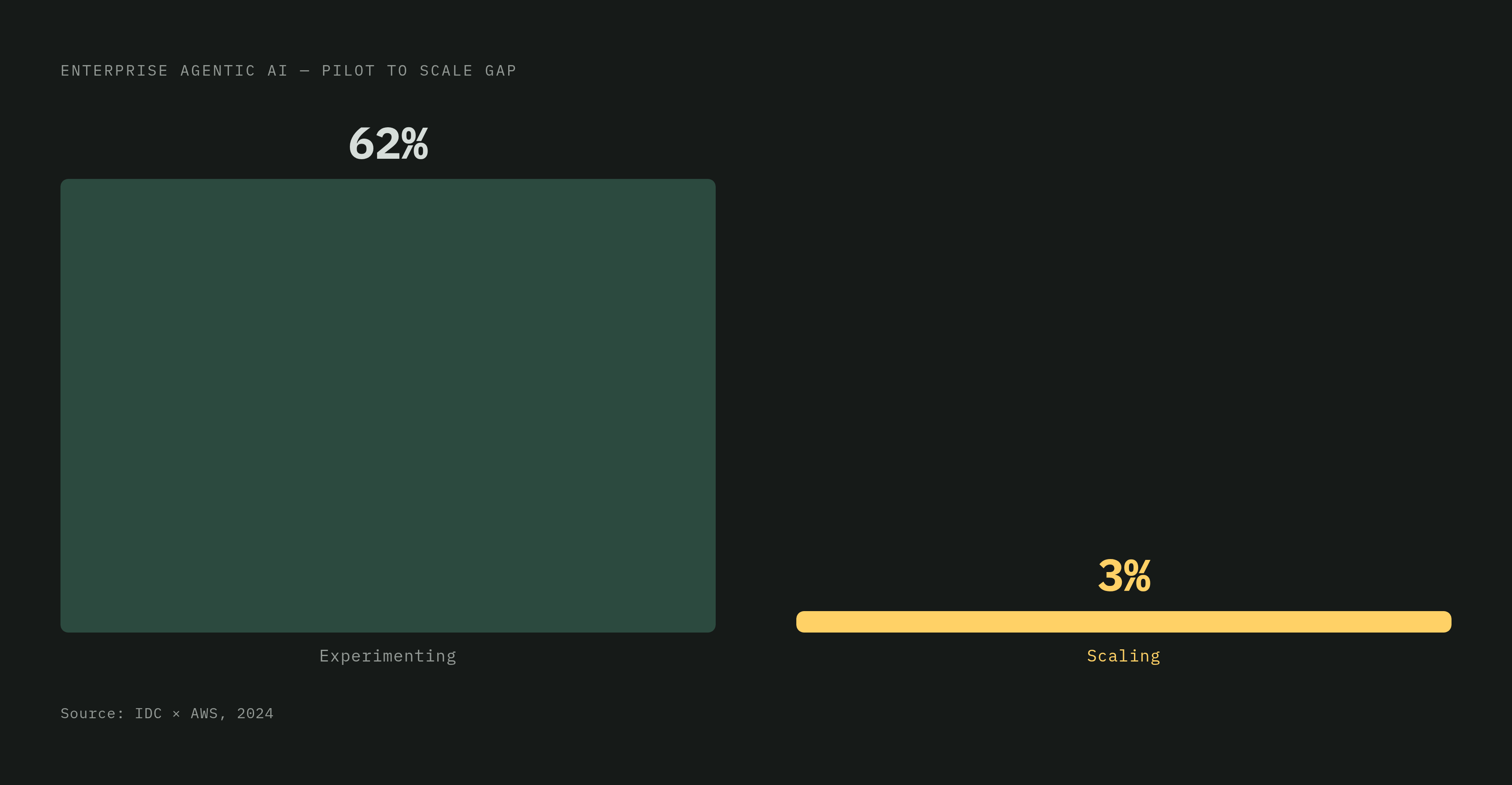
Only 3% of organizations surveyed by IDC and AWS are successfully scaling agentic AI across multiple departments, even as 62% are actively experimenting. Gartner projects 40% of enterprise applications will feature task-specific AI agents by end of 2026, up from less than 5% in 2025. The gap between those numbers is an infrastructure problem.
The 3% share a recognizable pattern. They treated infrastructure architecture as the primary scaling challenge. They built observability and governance before expanding agent scope. They made the orchestration decision with an actual understanding of how each pattern fails, not just how it's supposed to work.
What production at scale requires is straightforward. A stateful orchestration layer. A platform team enforcing shared primitives. A phased governance framework with defined promotion criteria. An evaluation layer that covers intermediate steps. Each component makes the others more reliable.
The organizations that get there aren't smarter. They just stopped treating infrastructure as the thing they'd sort out once the agents were working.