Runbook Automation with AI Coding Agents
AI agents can now adapt when runbooks fail, but only if you build the right constraints first.

Stage 3 feels like a solved problem. Scripts fire on alerts, checks run automatically, humans only get paged when something genuinely unexpected happens. Clean. Efficient. Until you work an incident where the automation ran, hit a branch nobody anticipated, and quietly stopped. Then someone gets paged anyway. At 3 AM. Reading a document that was last updated when a different engineer owned the service.
The real problem with Stage 3 isn't speed. It's brittleness dressed up as reliability — like a fire extinguisher that only works on fires someone already put out.
A few failure modes show up again and again, and they're frustratingly mundane:
- Runbook drift. The script was accurate six months ago. The system changed. The runbook didn't. Nobody noticed until an incident made it obvious. This is runbook drift, and it compounds quietly.
- The partial automation trap. Some steps automated, some manual, team has a vague sense that "it's handled." That false confidence can be worse than no automation at all, because at least with no automation nobody thinks there's a net.
- One-size-fits-all procedures. A runbook written for one service fires on a different one. Outcomes range from a harmless no-op to something you'll be writing a postmortem about for a while.
Here's something that should land harder than it does: operational toil in engineering organizations rose to 30% in 2025. First increase in five years. This happened during a period of record AI investment. The cause wasn't AI failing outright. It was teams deploying agents without runbooks, without escalation paths, without any real thought about blast radius. The automation made things worse because nobody did the unglamorous setup work first.
The bottleneck was never execution speed, and it was never mean time to resolution either. It was always that rule-based systems cannot interpret conditions they were never written for. That's the thing Stage 3 never actually solved, and layering more automation on top of shaky runbooks just exposed the gap faster.
What Changes When an LLM Can Reason About System State Instead of Just Matching Rules
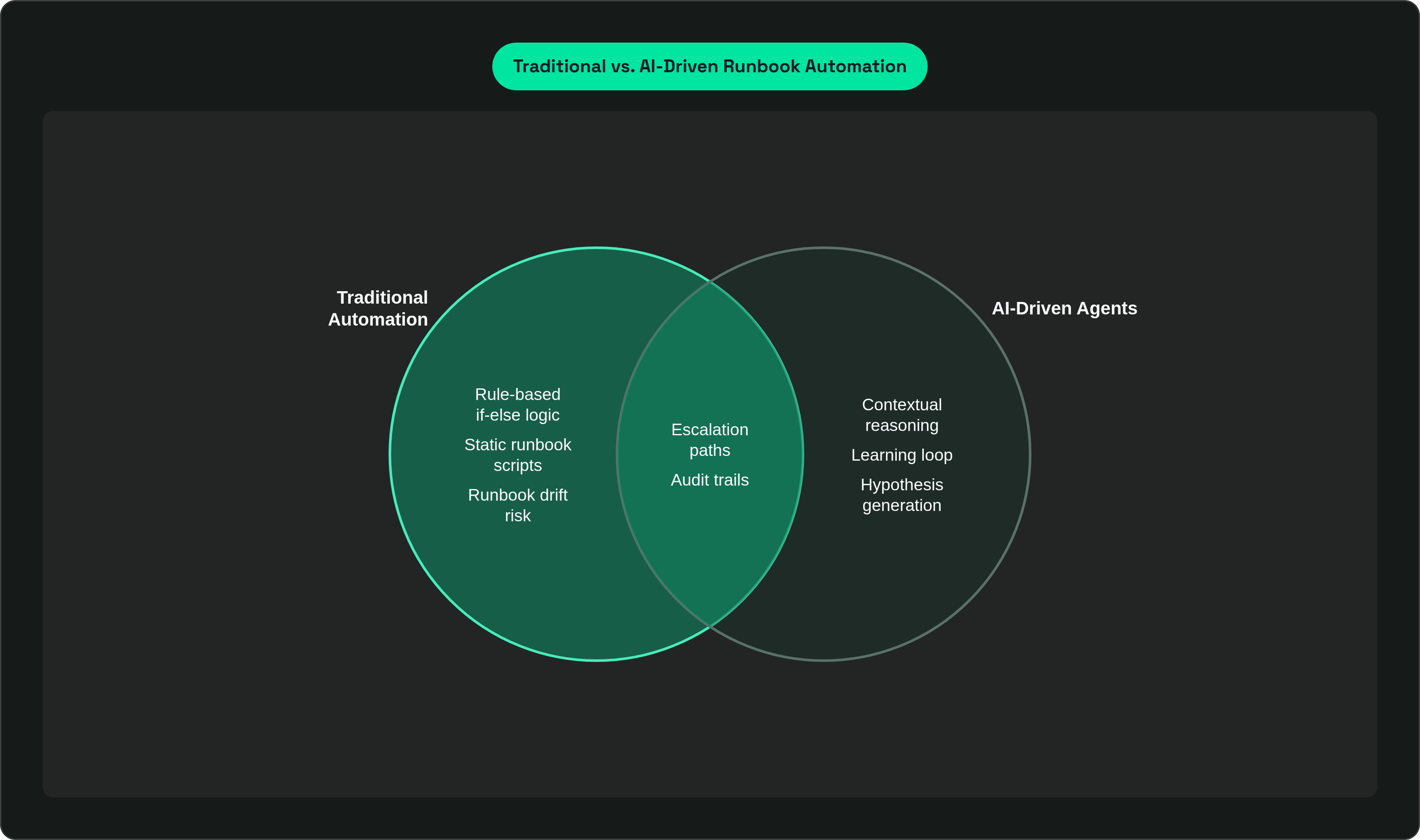
Traditional runbook automation is, at its core, a very large if-else tree. Every branch gets written by a human in advance. The system is exactly as smart as whoever wrote it last, and not one bit smarter. You hit an edge case the author didn't anticipate and the whole thing just stops and waits for a human.
AI-driven automation asks a different question: given what's actually happening right now, what should be done?
The agent reads current system state. Not just the alert that fired, but correlated signals across the environment, a form of retrieval-augmented context at inference time. It forms hypotheses. It chooses among available actions based on context. That's closer to how an experienced SRE reasons through an incident than how a bash script processes conditions, and the difference becomes obvious the first time you watch an agent catch something the old tooling would have missed entirely.
The runbook itself changes shape in this model. It stops being a complete specification of every possible step and becomes structured context the agent reasons within. Constraints, approved actions, escalation rules. A framework rather than a literal script. The agent fills in the gaps based on what it observes, rather than stopping cold when the observed state doesn't match an expected branch.
This is not faster execution of the same logic. It is a genuinely different kind of logic.
The Four-Component Architecture That AI-Driven Runbook Agents Run On
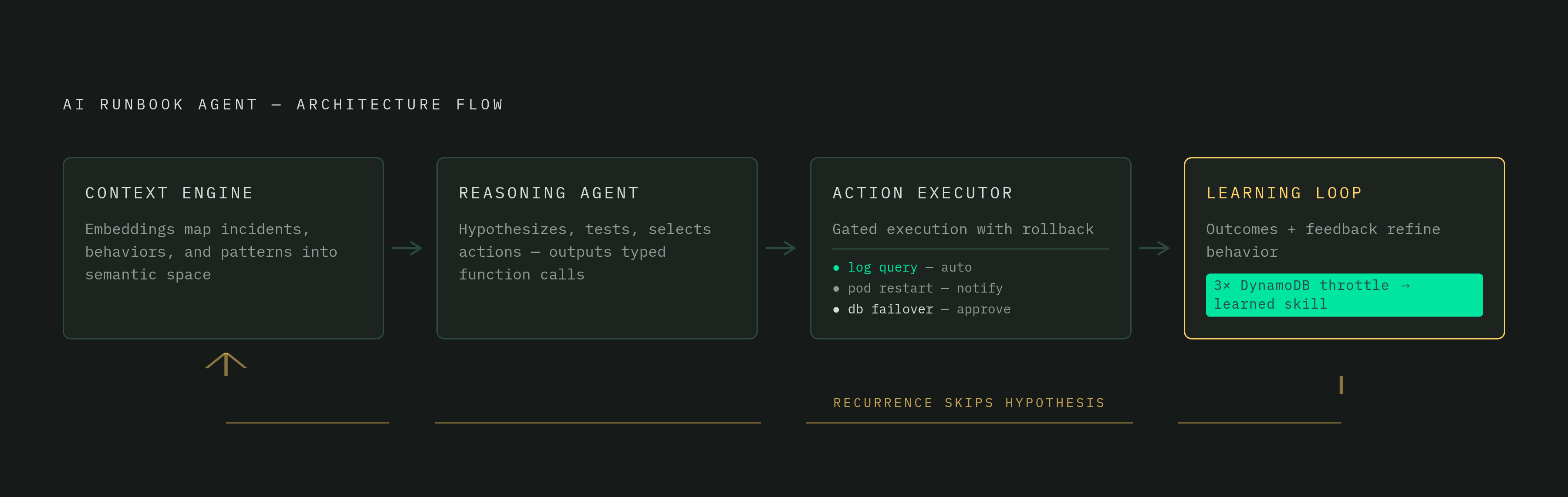
Across the tools and deployments worth paying attention to, the same basic architecture keeps appearing. Four components, each doing a distinct job, and the architecture only holds up when all four are actually there.
The Context Engine. LLM embeddings build semantic relationships between system behaviors, past incidents, and architectural patterns. This is what lets an agent recognize "this looks like the DynamoDB throttling pattern from three weeks ago" instead of treating every incident as brand new. Without this, you're just running a slow if-else tree.
The Reasoning Agent. The LLM-based system that hypothesizes, tests, and selects actions. Good implementations produce structured outputs that behave like typed function calls, not free-form text. That structure is what keeps hallucination risk manageable. Unstructured outputs are where things get weird fast, and in an on-call context "weird" can mean expensive.
The Action Executor. A gated execution environment with rollback capabilities. Permissions are scoped at the action level. A log query runs automatically. A pod restart sends a notification. A database failover requires explicit human approval. The permission lives with the action type, not as a blanket trust setting applied to the whole agent. This distinction matters more than it seems and I'll come back to it.
The Learning Loop. Outcomes and human feedback continuously refine agent behavior. The AWS DevOps Agent illustrates this well: after three DynamoDB throttling incidents, the agent generates something like a learned skill and skips the exploratory hypothesis phase on the fourth occurrence. It gets faster on recurrence, not just on first contact.
One thing worth stating plainly: an effective agent runbook is a directed acyclic graph with typed inputs and outputs at each step. Not free-text "investigate the situation" instructions. Structure is what makes agent behavior auditable and predictable. The open-source project RunbookAI implements this pattern, including hypothesis-driven investigation, operational memory, a full audit trail, and approval gates on sensitive actions. Teams that skip the structure because it feels like overhead usually regret it during post-incident review.
How MCP Became the Connective Tissue Between Agents and Operational Infrastructure
Before there was a standard way for agents to connect to operational tooling, every integration was custom. An agent could reason about what to do. Actually reaching across tools to do it was a different, messier story. You'd end up with a patchwork of one-off connectors, each maintained by whoever built it, none of them consistent.
Model Context Protocol is the answer to that problem. It's an open standard giving AI models a universal connection to external tools, data sources, and services. Anthropic introduced it in late 2024, and by the end of 2025 it had been donated to a vendor-neutral foundation under Linux Foundation governance. That governance piece matters more than it sounds because it means no single vendor controls where the standard goes.
The adoption signal is hard to dismiss. OpenAI, Google DeepMind, and Microsoft are all in. AWS, GitHub, Cloudflare, and Bloomberg are supporting members. Python and TypeScript SDKs are running at roughly 97 million monthly downloads. Community-built MCP servers now exist for GitHub, Slack, PostgreSQL, Docker, Kubernetes, Stripe, Figma, and more than 200 other tools. That's the kind of ecosystem that becomes a default rather than an option, and it's accelerating adoption across AIOps tooling broadly.
What this means for runbook automation in practice: when a canary deployment fails its error rate check, an agent can execute kubectl rollout undo, verify pod health across the replica set, confirm p99 latency recovery, and log a structured audit trail. Without a human reading the runbook and running commands manually. Cutover uses MCP servers to let agents query operational and resilience data and take direct action on runbooks and tasks using natural language, which is a decent illustration of where the standard is actually being applied.
MCP is also why "AI coding agent" and "runbook automation" are converging in a way that would have seemed strange two years ago. The same protocol that lets a coding agent push a fix also lets it trigger a rollback, run a diagnostic, or page a human. Same agent, same protocol, same patterns. The tooling is collapsing into something unified, which creates some genuinely interesting possibilities and also some governance questions that nobody has fully worked out yet.
Approaches to Generating and Maintaining Runbooks with AI Rather Than by Hand
The authorship problem is real and underappreciated. Writing runbooks is tedious. Updating them competes with shipping features. They drift. This is structural, not a discipline problem. If the tooling makes it easier to let runbooks rot than to keep them current, most teams will let them rot, and the teams that feel bad about this are just suffering unnecessarily.
Three approaches are in active use, and they're solving slightly different parts of the problem.
LLM generation from existing incidents and configs. Turn postmortems and alert histories into draft runbooks. The documentation stays closer to current system behavior because it's generated from what actually happened, not what someone imagined would happen when the system was first designed.
RAG-based generation. Cutover's approach: retrieve an existing dataset first, then use it to inform construction of a new runbook. This can generate complete runbooks with tasks, dependencies, and descriptions from flowcharts, spreadsheets, or legacy documents. Grounding in retrieved sources before generating is the key move, and it's what separates this from just asking an LLM to make something up and deploying whatever it returns without scoping the blast radius.
Spec-driven development. Aviator Runbooks takes a different angle. A versioned library of executable specifications that AI agents work from. The system automatically captures repository state, PR feedback, and code changes into a living knowledge base. Multiple engineers co-author and review specs. Every change is recorded.
The hallucination risk here is specific and worth saying plainly: an ungrounded assistant can invent commands, recommend the wrong diagnostic path, or reproduce destructive shortcuts that look entirely plausible. Research published in 2026 in the Journal of Technology Informatics and Engineering concluded DevOps copilots should be treated as retrieval-grounded, policy-checked workflow systems, not free-form chat agents. Spec-driven and RAG-based approaches exist precisely because of this risk. An agent confidently executing a hallucinated remediation step is a different class of problem than an agent giving bad advice, because one of those scenarios involves production.
Evidence from Early Deployments on What AI Runbook Agents Actually Deliver
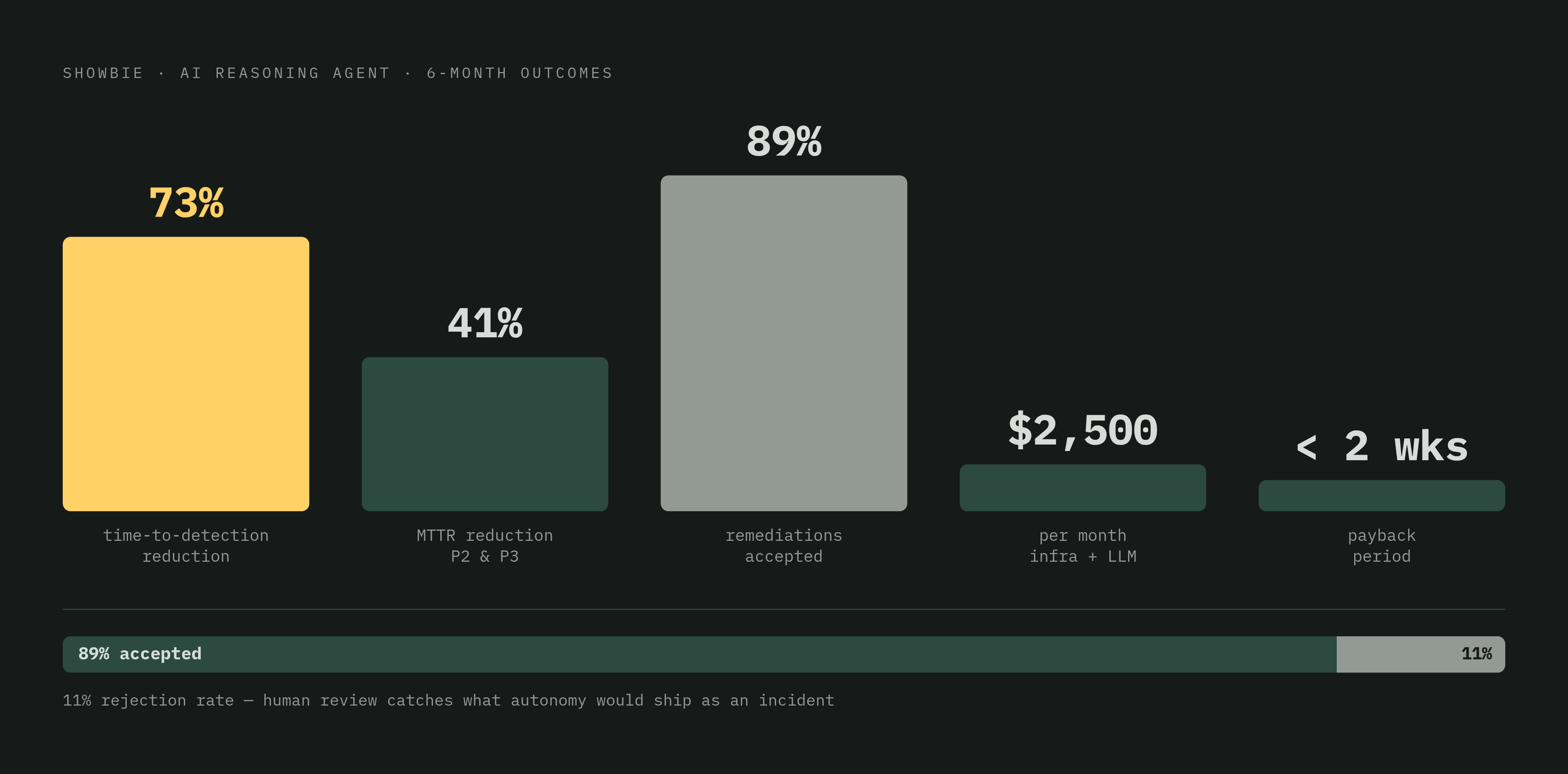
The numbers from Showbie's deployment are worth sitting with. Six months with reasoning agents: 73% reduction in time-to-detection for novel failure modes, 89% of agent-proposed remediations accepted by engineers, 41% decrease in MTTR for P2 and P3 incidents. Infrastructure and LLM costs ran approximately $2,500 per month, with a payback period under two weeks. The skeptic's first instinct is to look for the asterisk, and the honest answer is that they had runbooks in executable form before they started, which isn't true of everyone.
A fintech deployment using MCP brought MTTR down from 45 minutes to under 5 minutes. Agents correlated alerts, identified root causes, and executed remediation playbooks. Human-in-the-loop approval stayed in place for production changes, which matters for the actual adoption story as much as the speed story.
The AWS DevOps Agent reduces MTTR from hours to minutes, and the learning loop is the piece worth watching. It gets meaningfully faster on recurring incident types over time, which means the ROI argument gets stronger the longer you run it.
The biggest gains across these cases don't come from executing faster. They come from eliminating the gap between alert, human awareness, and first remediation action. That gap is exactly where Stage 3 broke down whenever conditions deviated from the script.
The 89% acceptance rate in the Showbie case deserves a second look because it tells two stories at once. It means agents are getting context right most of the time. It also means the 11% rejection rate is where the human-in-the-loop design earns its keep. An agent that's wrong 11% of the time and has a human reviewing every proposal is a useful tool. An agent that's wrong 11% of the time and is operating autonomously is something you'll write an incident report about.
How Autonomy Tiers and Scoped Permissions Keep Agents from Becoming a Liability
The difference between a useful agent and a dangerous one is not intelligence. It's constraint. A highly capable agent with no boundaries is just a faster way to cause problems at scale.
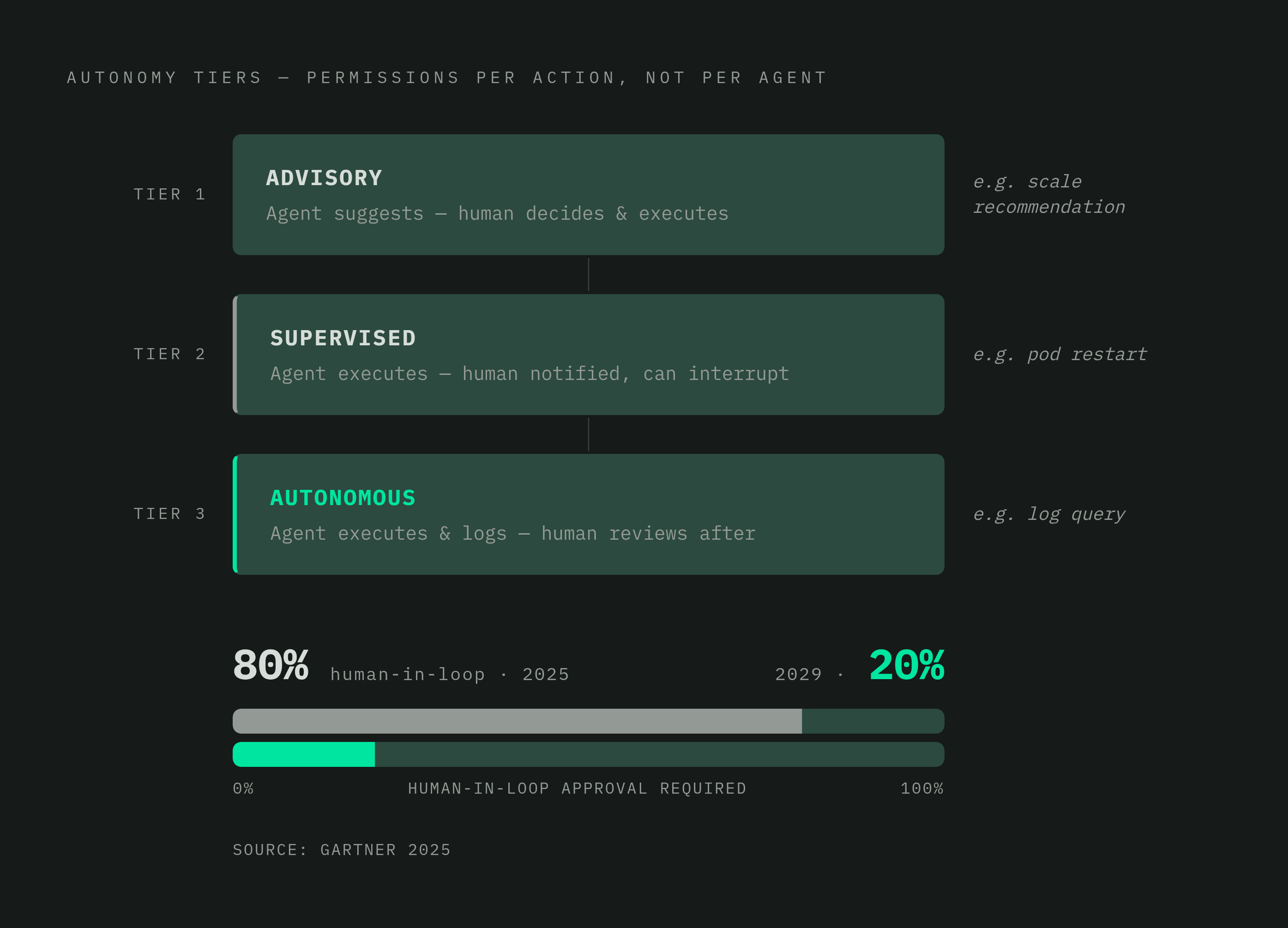
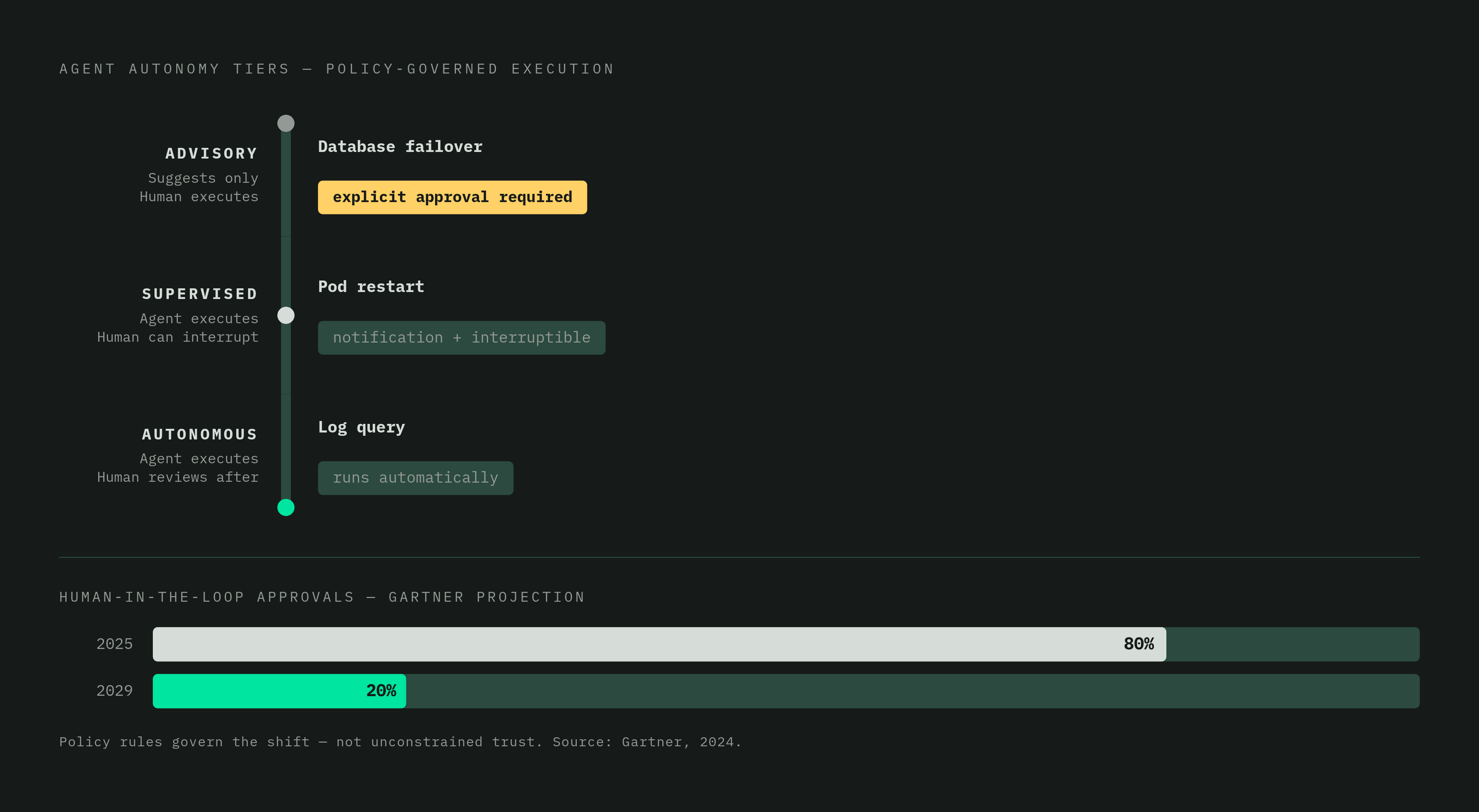
A three-tier autonomy model is emerging as the practical standard:
- Advisory. The agent suggests actions. A human decides and executes.
- Supervised. The agent executes with human notification and the ability to interrupt.
- Autonomous. The agent executes and logs. A human reviews after the fact.
The key design decision is that permissions live at the action level, not as a global trust setting for the whole agent. A log query runs automatically. A pod restart requires notification. A database failover requires explicit human approval. Same agent, different constraints per action type. This seems obvious until you see what happens when teams skip it and give the agent blanket permissions because setting up the action-level policies felt like overhead.
Gartner projected in 2025 that by 2029, only 20% of AI-suggested actions will require human-in-the-loop approval, down from 80% in 2025. The mechanism behind that shift matters. It's policy-driven rules specifying what the agent is permitted to do, not unconstrained trust that expands as the agent "proves itself." The boundary moves deliberately, based on evidence, not because the agent has been running for a while without incident.
Audit trails are not optional. Every query, hypothesis, decision, and action should be logged in structured form. This is what makes post-incident review possible. It's also what financial services and healthcare regulators will eventually require, and teams that aren't already doing it will wish they had started earlier rather than having to retrofit it under pressure.
Per a Cleanlab survey from mid-2025 covering nearly 1,900 respondents, only a small fraction had AI agents live in production. Even within that group, most were still early on control and transparency, still working out when their agents are right, wrong, or simply uncertain. The autonomy tier model isn't a solved problem handed down from on high. It's the frontier most teams are still actively navigating.
The Organizational Conditions That Determine Whether AI Runbook Automation Scales or Stalls
Gartner projected in mid-2025 that over 40% of agentic AI projects will be canceled by end of 2027. Primary reasons: poor data foundations and unclear ROI. The cancellation risk is not about the technology. It's about the foundation underneath it, which is a less exciting thing to think about than the technology but is where most projects actually fail.
The toil paradox that showed up in the 2025 data is instructive here. Teams deployed agents without the same rigor they'd apply to a human on-call rotation. No runbooks for the agents. No escalation paths. No blast-radius constraints. AI amplified the gap rather than closing it. More automation, more toil, nobody planned for that outcome, and a lot of postmortems from that period have a sheepish quality.
What "good data foundation" actually means in practice is less abstract than it sounds:
- Runbooks that are versioned, structured, and machine-readable. Not PDFs or Confluence pages an agent has no way to act on.
- Observability data clean and complete enough for the context engine to build reliable semantic relationships.
- Historical incident data, postmortems, and resolved alerts the learning loop can actually learn from.
The Showbie case is a useful ROI benchmark, around $2,500 per month, payback under two weeks. But that assumed runbooks already existed in executable form. Teams starting from scratch carry higher upfront cost and a longer path to that payback number. The gap between "what early adopters achieved" and "what your team will achieve" depends almost entirely on the state of the foundation before you start.
The scale projections are real. Gartner projects the majority of enterprises will deploy agentic AI in IT operations before the end of this decade. But aggregate projections describe where successful deployments land, not the average path to get there. Collapsing those two things is how teams end up surprised when their situation doesn't match the case study they were using to justify the investment.
The organizational readiness checklist implied by the failure modes is short: structured runbook library, solid observability instrumentation, defined escalation paths, explicit autonomy tier assignments per action type, and a review process for agent-generated runbook updates. Most teams aren't actually ready when they start, which is fine, as long as they know which gap they're filling first.
What the Transition Looks Like for a Team Moving from Scripted Runbooks to Agent-Driven Workflows
Most teams aren't starting from zero, and they're not at the finish line either. They're somewhere between Stage 2 and Stage 3. Some automation, significant manual intervention, runbooks partially documented, observability in place but not yet feeding agent context. That's the actual starting point for most of this work, and the gap between that reality and the case studies you read about is mostly just sequencing.
The staged progression that maps to the architecture and autonomy tiers:
First, get runbooks into structured, versioned, machine-readable form. This is the precondition for everything else. RAG-based generation or spec-driven tooling can accelerate this considerably, especially for teams sitting on a backlog of legacy documentation and postmortems that were never turned into anything actionable. This step is boring and necessary and most teams underestimate how long it takes.
Second, introduce agents in advisory mode on high-frequency, lower-risk incident types. Build acceptance data before expanding autonomy. What are engineers approving? What are they rejecting? That signal is what calibrates the system going forward, and you want it before you give the agent more room to operate.
Third, move approved action types to supervised autonomy with notification. Keep destructive or irreversible actions at the explicit-approval tier regardless of agent confidence. Confidence is not the same as correctness, and the cases where an agent is confidently wrong are exactly the ones that make it into the retrospective.
Fourth, close the learning loop. Feed accepted remediations, postmortems, and new incident patterns back into the knowledge base. Agents should improve on recurrence. If the same incident type keeps requiring the same human intervention, the loop isn't closed and you're leaving the main ROI driver on the table.
Model and infrastructure choice matters throughout this progression. Teams locked into a closed platform lose flexibility as the tooling evolves. The movement toward open standards like MCP and vendor-neutral governance exists partly because teams that got burned by proprietary lock-in in earlier automation cycles had to learn that lesson the expensive way, and enough of them talked about it publicly that the lesson got around.
The transition is not a weekend project. It's a capability build over months, and the early stages feel slow because most of the work is foundation rather than visible output. The teams that have done it aren't going back to manually triggering scripts in the middle of the night, though. That part nobody misses.