Agentic Workflow Examples in Software Delivery
Software agents that plan, act, and iterate autonomously are reshaping how teams ship code in 2026.
Agentic delivery means software agents that plan, act, check their own work, and try again, without a person watching every step. Not a chatbot that gives you one answer and stops. Not a script that runs the same five steps no matter what breaks. An agent that hits an error, reads it, edits the code, and reruns the test on its own, that's the whole trick, and it's why 2026 is the year software teams became the test kitchen for this entire category.
Three flavors of automation are worth keeping straight before going further, because people mix them up constantly. Rule-based automation follows the same fixed steps every time and falls over the second an input changes shape. AI workflows produce one output and stop, useful, but static, like asking a smart friend a single question and hanging up before they finish the sentence. Agentic workflows are different: the agent owns the task. It plans, acts, watches what happens, replans, and keeps going until the goal is actually met, not until it's produced something.
That loop, plan, act, observe, adjust, is the entire definition. An agent that stops cold when it hits an error isn't agentic, it's just automation wearing a nicer outfit. The live argument in the industry right now is whether fully autonomous agents or tightly controlled, human-defined pipelines end up running production systems. The honest answer is probably both: agents handling the messy, high-level orchestration, while deterministic, tested workflows execute the steps where a mistake actually costs money.
Where agentic delivery stands in 2026 and why software teams are the primary proving ground
Gartner expects 40% of enterprise applications to embed task-specific AI agents by the end of 2026, up from under 5% in 2025. That's not gradual growth, that's a cliff. Spending is following the same curve: Gartner puts agent-related spend at roughly $201.9 billion in 2026, a 141% jump from the year before.
McKinsey's numbers tell a quieter but more telling story. 62% of organizations are experimenting with AI agents, but only 23% report full-scale deployment. Most of the industry is stuck in that gap between "we tried it" and "it runs everything now." PwC surveyed 308 senior executives and found 79% say agents are already adopted somewhere in their company. Of those, 66% report real productivity gains, which sounds great until you notice the 13-point gap between adoption and actual measurable payoff. Adopting something and it working are two different sentences.
Software delivery leads this shift for a simple, almost boring reason: the software development lifecycle already comes broken into discrete stages with clear inputs and outputs. Requirements go in, a spec comes out. Code goes in, a passing test suite comes out. That structure is exactly what an agentic loop needs to grab onto. So the useful question for the rest of this piece isn't "should teams use agents." It's: at which stage of that lifecycle does agent autonomy actually pay off, and what does it look like when it does?
Requirements and planning: agents that turn ambiguous intent into executable specifications
Skip structured requirements and everything downstream inherits the mess. EPAM's Agentic Development Lifecycle framework centers this concern: without well-specified processes, agent automation compounds the underlying problem rather than solving it.
A planning agent's job looks less like writing and more like interrogating. It takes a vague ticket, say, "make checkout faster", and starts asking the questions a good product manager would ask anyway. What does "faster" actually mean, in milliseconds? What happens on a failed payment retry? It then produces or checks a structured spec against a schema: acceptance criteria, constraints, a clear definition of done, written precisely enough that another agent could act on it without a human translator standing in between.
One concrete version of this already running in practice: AI PRD linting. An agent checks a product requirements document against a schema, flags vague terms and missing edge cases, and hands back a structured diff before a single engineer opens their editor. That replaces the one-to-two-day back-and-forth that usually follows a handoff, the emails, the Slack threads, the "wait, what did you mean by fast" conversations.
A framework published via Zenodo describes a 13-phase AI-first SDLC where a Central Orchestrator Agent coordinates specialized agents starting right at requirement ingestion. Requirements aren't an afterthought bolted onto the front of the pipeline, they're where the whole chain gets anchored. Feeding that planning agent real context matters too: MCP-based context pipelines give it access to actual architecture docs, past tickets, and API specs, so it reasons from what the system actually does instead of guessing from a generic training set. The human's job here isn't disappearing, it's shrinking to the right size: review and approve the structured spec before it goes downstream. The agent kills the ambiguity. The human still makes the call.
Coding agents: what multi-file, multi-step autonomous code generation looks like in practice
Something changed in how these tools move through a codebase. Older tools completed a line or a function. Current coding agents navigate: they read the repository, trace which files depend on which, generate changes, run the tests, read the failures, edit again, and rerun, all without asking a human to interpret a stack trace in between. One plain-English instruction now triggers coordinated edits across imports, test files, and config, at the same time, not in sequence with a person approving each hop.
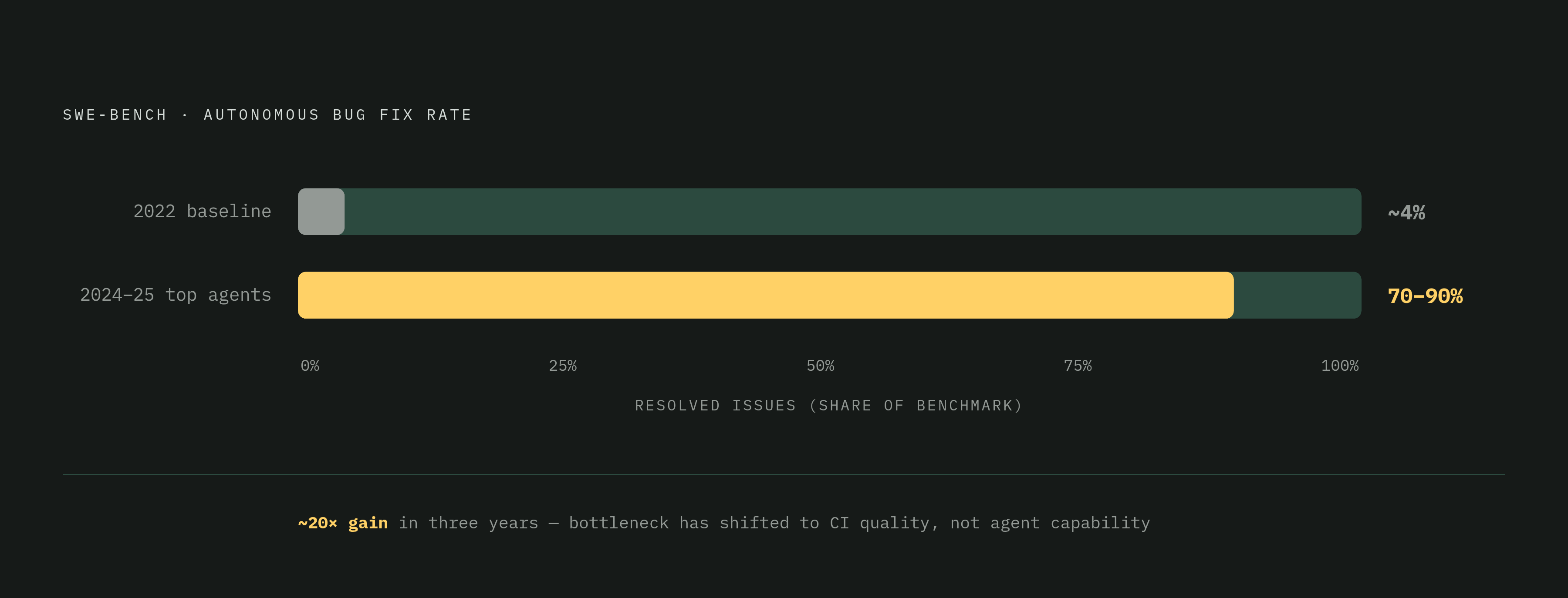
The scale of that shift shows up directly in usage data: by Q1 2026, 78% of agent sessions involved coordinated edits across multiple files, up from 34% just a year earlier. Single-file autocomplete became repository-level reasoning in about twelve months, which is a fast turn for anything in software tooling.
The tool landscape got crowded fast, and it's worth naming who's actually in the room: Devin (March 2024), SWE-agent (April 2024), other open-source agent platforms (2024), Copilot Workspace (2024), Windsurf/Cascade (November 2024), Cline (2024), Jules (Google Labs preview December 2024, public beta May 2025, general availability August 2025), Copilot agent mode (February 2025), Claude Code (February 2025), Codex CLI (April to May 2025), Gemini CLI (June 2025), and Kiro (July 2025). Every one of them runs the same basic loop: inspect the repo, edit files, run commands, read the errors, iterate from plain language. The open-source entries stand out as the model-agnostic option, self-hostable, which matters a lot to teams that need code processed on their own systems instead of inside a vendor's cloud.
The infrastructure load behind all this is not small. Microsoft Research's characterization of GitHub Copilot's coding agent, using sampled traces from June 2026, covered 3.2 million users, tens of millions of sessions, hundreds of millions of LLM calls, and tens of trillions of tokens. That's the actual compute weight of "just ask the agent to fix it."
Here's the part that should temper any breathless productivity claim: GitClear's data through 2025 shows daily AI users producing roughly 4x the raw code output of non-users. Measured against their own output a year prior, though, the real gain lands closer to 12%. Raw volume and meaningful throughput are two different measurements wearing the same shirt. Teams that chase the 4x number and ignore the 12% number are going to misread their own return on investment, badly.
Automated testing: the agent loop that runs, fails, fixes, and reruns without waiting for a human
This is the loop in its purest form. An agent writes the first pass of an implementation, runs the test suite, reads whatever fails, edits the code or the test itself, and reruns. It keeps generating edge-case variants and pushing them through CI, cycling until the suite goes green or the agent hits something genuinely ambiguous and escalates to a human with a structured report instead of a shrug.
QA used to sit at the tail end of the pipeline, the place where everything slowed down waiting on regression tests and bug writeups. That gate is dissolving. Testing now runs alongside development in real time instead of after it.
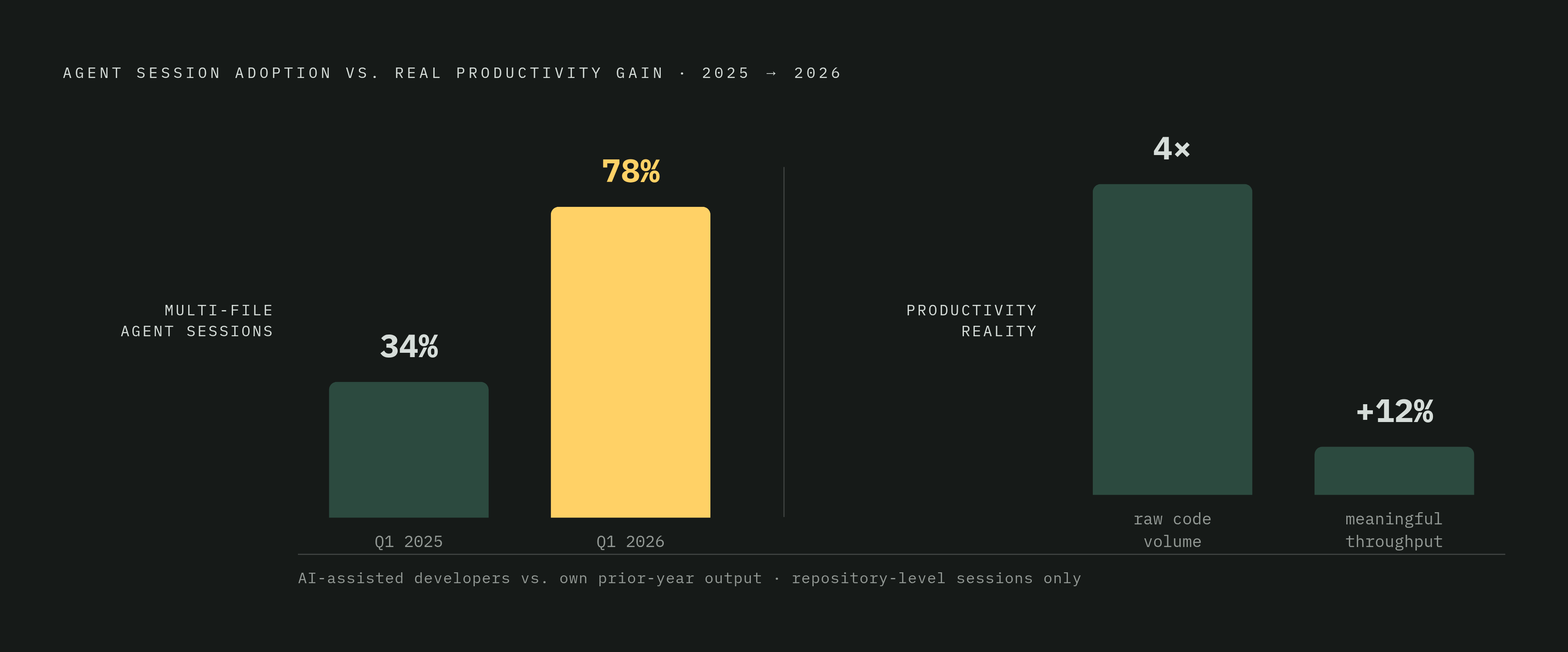
SWE-bench has become the standard yardstick for this exact capability: it measures whether an agent can autonomously fix real bugs in open-source repositories by reading, editing, and validating through actual CI workflows, the same read-fix-rerun loop happening in production. The trajectory on that benchmark is almost absurd: top models paired with a solid agent harness now clear success rates of 70 to 90%, up from around 4% just a few years prior. That's not steady progress, that's a hockey stick. Some production setups are hitting 70%-plus resolution on complex benchmarks with minimal human input along the way.
What that means practically: the bottleneck stopped being "can the agent fix the test." It's now whether a team has CI gates and test coverage solid enough to give the agent something reliable to work against. Garbage signal in, garbage fix out, same as it ever was.
Agentic code review: why higher agent output volumes are creating a new quality problem
More code getting written faster creates a backlog somewhere else, and that somewhere is review. Merged pull requests across the platform rose from a 2024 monthly average of 35 million to 43.2 million in 2025. That's not a people shortage, it's a straightforward throughput mismatch, more code coming in than human reviewers can reasonably look at.
GitHub reports Copilot review has now run over 60 million reviews, a tenfold jump in under a year, with more than one in five reviews on the platform now involving an agent somewhere in the loop.
Here's the catch worth sitting with: AI-authored pull requests don't carry the same defect profile as human-written ones, and review tooling needs to be built for that difference. CodeRabbit studied 470 open source pull requests in December 2025, split between 320 AI-coauthored and 150 human-only. AI-authored changes carried about 1.7x more issues overall. Logic and correctness problems rose roughly 75%. Security issues showed up 1.5 to 2x more often. Translation: the code often runs, but it runs wrong, or it runs in a way nobody can read six months later.
Developers feel this. Stack Overflow's 2025 Developer Survey found 66% of developers spend more time fixing "almost-right" AI-generated code, and trust in AI accuracy dropped to 29% in 2025. Part of the case for agentic review isn't productivity, it's damage control for a trust problem the industry created for itself.
Taskrabbit offers a useful sequencing lesson here. It fixed its review infrastructure before adopting AI coding agents, and cut time to merge from 10 days to 7, a 25% reduction, while running 300 pull requests a week through CodeRabbit. Review capacity came first. Coding volume followed. Get that order backwards and the backlog just moves one stage down the pipeline instead of disappearing.
Security scanning inside the pipeline rather than as a separate audit
Security used to be a scheduled audit, someone comes in every quarter and pokes at the code. Now SAST and DAST agents run inside the delivery flow itself, which shrinks the gap between a commit and a caught vulnerability down to almost nothing.
GitHub's Copilot coding agent started proactively running CodeQL on its own generated code as of October 2025. It also checks dependencies against the GitHub Advisory Database and tries to resolve issues before the pull request is even finalized, the agent auditing its own work before a human ever lays eyes on it.
An arXiv analysis from 2026 looked at more than 33,000 AI-generated pull requests and identified 675 security-related submissions from agentic AIs. The recurring problems formed a concentrated, learnable pattern, which is actually good news, because security tooling can be tuned specifically to catch it.
That's the real implication for teams adopting these tools: generic static analysis wasn't built for the specific mistakes AI agents tend to make. Security scanning configurations need updating alongside agent adoption, not after the first breach makes the decision for you. And the oversight model here mirrors incident response almost exactly: the agent flags a problem and proposes a fix, a human approves before anything merges. Not full autonomy. A very fast, very well-informed assistant.
CI/CD orchestration and deployment: agents that manage pipeline state and handle failures without waiting for a human on call
CI/CD is practically built for agent autonomy: high frequency, bounded by rules, and every state is observable. An agent can watch a pipeline, read a failure signal, trigger a rollback, and notify the right person faster than any on-call engineer squinting at a dashboard at 2 a.m.
GitHub Copilot Agent Mode is a concrete example of what that looks like in production. It translates a plain-language idea into code, breaks the work into subtasks, and executes across multiple files. For DevOps specifically, it handles infrastructure tasks, suggests terminal commands, makes tool calls, and self-heals runtime errors when they crop up. Paired with Claude 3.7 Sonnet, it hits a 56% pass rate on SWE-bench Verified.
There's also an async pattern worth naming: Copilot can turn a GitHub issue directly into a pull request using any of several underlying models. The issue tracker effectively becomes the agent's task queue, which decouples a developer's attention from however long the agent actually takes to finish the work.
Documentation gets swept into this too. A merged pull request can automatically trigger doc updates, keeping endpoints, configs, and changelogs aligned with whatever actually shipped, killing off the slow documentation drift that builds up in every manual process ever devised.
None of this works without a governance layer, though. Any agent with write access to a production pipeline needs explicit approval gates and clearly defined rollback authority before it deploys anything, not after the first bad push takes a service down. The architecture of control matters just as much as the architecture of the agent itself. Self-hosted platforms matter here too, for teams that want agents running inside their own CI infrastructure instead of calling out to a vendor's orchestration service. Owning the pipeline means owning exactly what the agent is and isn't allowed to trigger.
Incident response: an agent that diagnoses, proposes a fix, and routes to a human rather than touching production directly
Incident response is where full autonomy stops making sense, and that's by design, not a limitation someone hasn't gotten around to fixing yet. An agent can diagnose a production issue, trace it back through logs and recent deploys, and draft a proposed fix. What it doesn't do is push that fix to production on its own.
Instead, it routes the diagnosis and the proposed remediation to a human, the person on call gets a head start instead of a blank page. The agent does the archaeology: what changed, what broke, what the likely fix looks like. The human still makes the call on whether to ship it. That division isn't a limitation of what these agents can technically do, it's a deliberate boundary, because the cost of an autonomous agent making the wrong call on live production traffic is a different category of risk than a wrong guess on a spec or a failed unit test. Some mistakes are cheap to undo. A bad production push at 3 a.m. usually isn't one of them.