Licensing Considerations for Open-Source AI Agents
Four separate licensing layers govern your deployed agent, and they often contradict each other.
If you've spent any time building AI agents, you've probably skimmed a model card, seen the word "open," and moved on. That instinct will cost you. The licensing landscape around open-source AI agents in 2025 is genuinely complicated. Not in a "read the fine print" way. In a "there are four separate legal documents governing your single deployed agent, and they contradict each other" way. This piece lays out what those layers are, where the surprises live, and what a reasonable audit process looks like before you ship something at scale.
"Open Source" for AI Models Is a Broken Label Right Now
Let's start with the word "open." It means almost nothing by itself in 2025.
The Open Source Initiative published its Open Source AI Definition (OSAID 1.0) in October 2024. The bar they set is high. To qualify as genuinely open source under that definition, a model must ship with:
- Detailed training data information sufficient for someone skilled in the field to recreate a substantially equivalent system
- Complete training and inference source code
- Full model parameters, including weights
Most models people call "open" don't clear that bar. They release weights and inference code. They don't release training data provenance. That gap has a name: "open washing." Companies put the word open on a model card while the actual license contains restrictions OSI explicitly disqualifies, a practice the community has labeled open washing.
The OSI has signaled a 1.1 or 2.0 update to OSAID is planned through Q4 2026. So the definition itself is still moving.
Here's the practical takeaway: the word "open" on a model card is not a compliance signal. The license document is. Find it, read it, and do not assume the headline matches the terms.
Weights being downloadable is not the same as being free to use. A model can be freely downloadable and still carry commercial-use restrictions, monthly active user caps, field-of-use prohibitions, or attribution requirements that don't appear anywhere near the download button.
The Three Independent Licensing Layers in a Deployed Agent Stack
Here's the thing that catches developers most off guard. There isn't one license governing your agent. There are at least three, and they're completely independent of each other.
Layer 1: Framework and library code. This is your orchestration layer. LangGraph, AutoGen, CrewAI, Anthropic's MCP SDKs (which are Apache 2.0). These carry their own licenses, same as any software dependency. Most developers already know how to handle this layer because it looks like normal software compliance. Check every dependency. Keep the notices. Done.
Layer 2: Trained model weights. This is where most surprises live. The weights often carry a completely separate, often custom license that has nothing to do with the code license. A model's source code can be MIT-licensed. The weights can still have significant restrictions. These two things coexist on the same model card all the time.
Layer 3: Training data. This one gets overlooked the most. Creative Commons non-commercial licenses (CC BY-NC and similar) on training data can create obligations even when the model weights themselves permit commercial use. Courts haven't settled whether using NC-licensed data to train a model counts as the kind of "use" the license restricts. That ambiguity doesn't protect you. It just means the outcome is unpredictable.
A few things worth knowing about how these layers interact:
- Fine-tuning sits at the intersection of all three. Under many licenses, fine-tuning is treated as modification and distribution, which can trigger attribution requirements, share-alike obligations, or redistribution conditions you didn't expect.
- A permissive weight license does not clean up a restrictive training-data license. They don't cancel each other out, and license compatibility across all three layers has to be assessed independently.
- Compliance requires three separate audits, not one, and a software bill of materials covering all three layers is the starting point.
Permissive, Copyleft, and Custom Open-Weight Licenses Are Not Interchangeable
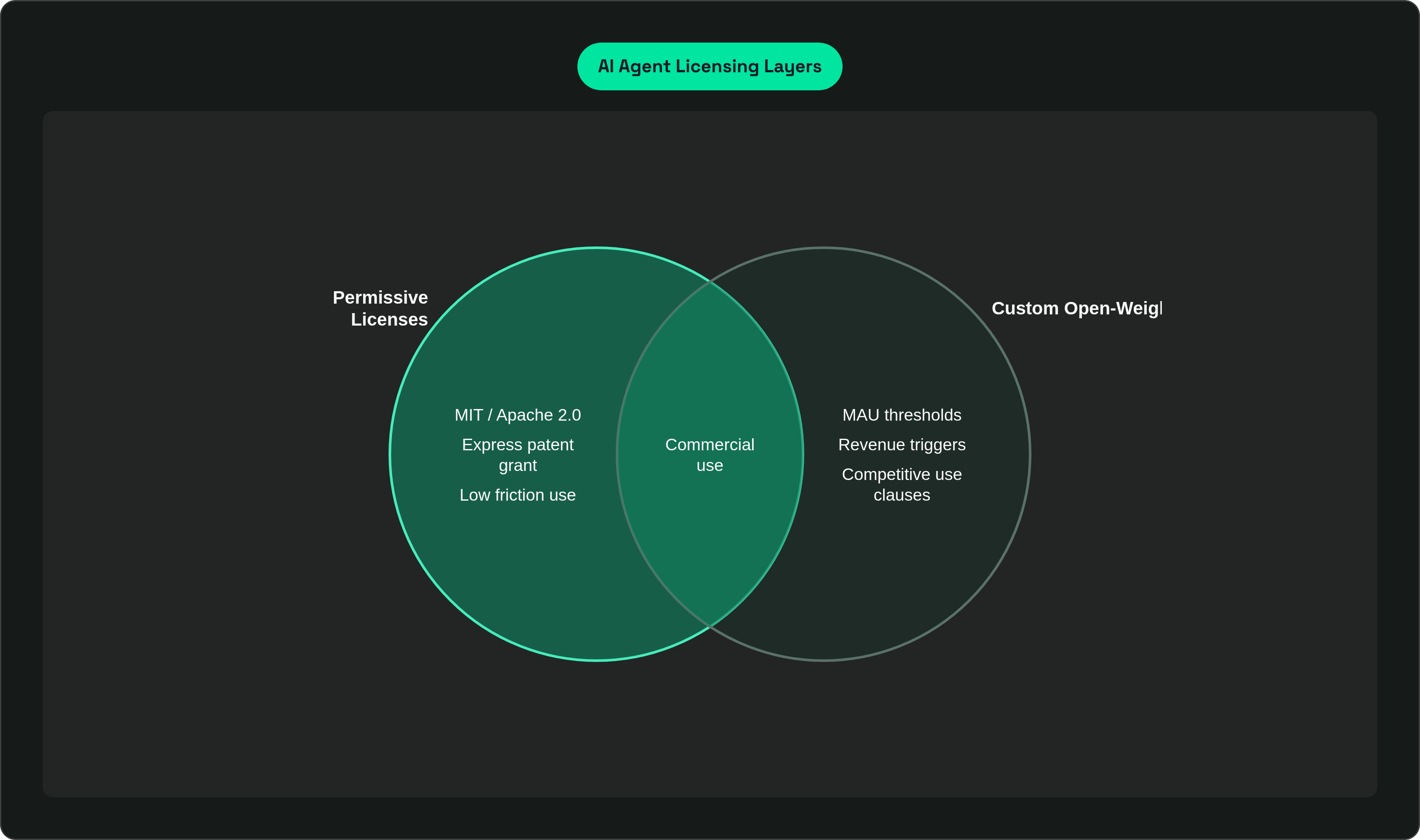
Once you've found your three license documents, you need to understand what category each one falls into.
Permissive Licenses (Lowest Friction)
MIT and Apache 2.0 are the cleanest for commercial use. Keep the copyright notice. In Apache 2.0's case, include the NOTICE file. That's most of it.
Apache 2.0 also includes an express patent grant covering contributor patents, which matters for AI components where patent risk from contributors is real. MIT and BSD don't have this. If you're choosing between them and patent exposure is a concern, Apache 2.0 is the better pick.
Recent permissive releases worth knowing: Mistral Small 3.1 (Apache 2.0), DeepSeek R1 source code (MIT), Gemma 4 (Apache 2.0, which is actually a departure from Gemma 3's more restrictive terms).
Copyleft Licenses (Highest Integration Risk)
GPL and AGPL require derivative works to be released under the same license. This is the "viral" effect, or copyleft propagation, people talk about. Few commercial AI models use GPL directly, but research tools and some datasets do. The risk is encountering GPL components inside your orchestration or fine-tuning layer without realizing it.
AGPL closes a gap that GPL leaves open. Running a GPL model as a network service doesn't trigger redistribution requirements under GPL. Under AGPL, it does. If you're building a SaaS agent product, that difference matters a lot.
Custom Open-Weight Licenses (Most Common, Most Variable)
This is where most prominent models land. Llama 3, many Mistral variants, Falcon. These are bespoke licenses that don't fit neatly into permissive or copyleft. There's no standard form. Each one has to be read individually.
Common restrictions you'll find in this category:
- Monthly active user thresholds
- Revenue thresholds
- Competitive use prohibitions
- Distillation and derivative model clauses
The Specific Clauses That Catch Developers Off Guard
Let me walk through the specific clause types that create problems, because knowing they exist is only half the battle.
MAU thresholds. Meta's Llama 3 license bars companies with more than 700 million monthly active users from deploying Llama models without a separate commercial license. That sounds like a number you'd never hit. But the clause doesn't disappear as you grow. It becomes a compliance trigger. The time to know about it is before you build your product on Llama, not after you've scaled.
Competitive moat clauses. Meta's Llama 3 license prohibits using model outputs to improve any model other than Llama 3 or its derivatives. An agent that uses Llama outputs as training signal for a different base model would violate this. Agentic pipelines that automatically collect and reuse outputs are particularly exposed here.
Revenue thresholds. Stability AI's Community License permits commercial use for organizations under a specific annual revenue ceiling. Above that, you need a separate commercial license. Again, this is a latent condition. It activates as you succeed.
Scale-based attribution. Moonshot AI's Kimi K2.5 uses a Modified MIT license that requires products exceeding certain MAU or revenue thresholds to prominently display the Kimi model name. A startup can launch, grow organically, and discover retroactively that it's non-compliant.
The pattern across all of these is the same: conditions are latent at launch, triggered by growth, and retroactive non-compliance isn't always curable without renegotiation.
If you're planning to scale an agent product, model which license thresholds you will cross within a 24-month planning horizon before you pick your base model. Not after.
DeepSeek R1 as a Worked Example of Layered Licensing Complexity
DeepSeek R1 is a useful case study because it looks straightforward on the surface and isn't.
The source code is MIT-licensed. MIT is about as permissive as it gets. Easy.
The trained weights carry a separate custom license. That license permits commercial use but prohibits military use, uses that adversely affect individuals' legal rights, and uses that create or modify binding legal obligations. Those are field-of-use restrictions. OSI's definition explicitly disqualifies field-of-use restrictions from "open source." The MIT label on the source code does not extend to the weights.
Then it gets more interesting when you look at the distilled variants:
- DeepSeek-R1-Distill-Qwen variants derive from Qwen-2.5, which is Apache 2.0. Relatively clean.
- DeepSeek-R1-Distill-Llama-8B derives from Llama 3.1-8B-Base. It inherits the Llama 3.1 license.
- DeepSeek-R1-Distill-Llama-70B derives from Llama 3.3-70B-Instruct. It inherits the Llama 3.3 license.
A developer who picks a "DeepSeek R1" variant without checking the specific distillation lineage will unknowingly pull in Llama's MAU threshold and output-use restrictions without ever touching a Llama model directly.
The base model's license does not govern distilled variants. Each variant is its own audit item. As distillation becomes the standard technique for producing smaller, deployable agents, parent model licenses travel with the derivative. License lineage tracking stops being an edge case and becomes a core workflow.
Responsible AI Licenses Create a New Kind of Compliance Obligation
Responsible AI Licenses, or RAIL licenses, are a different animal. They're built by communities that deliberately reject the OSI principle of non-discrimination against fields of use. The reasoning is that AI's power justifies restricting certain uses. That's a values argument, not a legal one, but the license terms that follow from it are very real.
Typical RAIL prohibitions include:
- Surveillance systems
- Weapons development
- Uses that discriminate against protected characteristics
- Some versions restrict medical and law-enforcement applications
Here's what makes RAIL licenses categorically different from what most compliance teams are used to. These aren't distribution or attribution obligations. They're use restrictions. You don't satisfy them at the point of license acceptance. You have to monitor them operationally, on an ongoing basis.
For agent deployments specifically, this creates a real problem. An agent that autonomously takes actions across systems will trigger a RAIL use restriction without any human reviewing whether that specific action falls within permitted uses. The agent doesn't know it's violating a license. Nobody gets an alert. The violation just happens.
RAIL adoption has grown alongside the broader 2025 trend of AI-specific license variants. Organizations should treat RAIL-licensed components as requiring a use-case review, not just a license-terms review, before deployment.
Agentic Behavior Creates Licensing Risk That Static Deployments Don't
This is the part that has no good playbook yet.
Agents write code, commit it, and open pull requests. Contributor license agreements (CLAs) were designed for human contributors. They don't address authorship, intent verification, or accountability for non-human contributors. When an agent opens a PR, the CLA question doesn't resolve cleanly.
When an agent generates a code snippet trained on GPL-licensed code, whether that output constitutes a derivative work is legally unsettled. The GitHub Copilot litigation is the most visible test case here. In summer 2024, a judge dismissed some claims on the reasoning that AI-generated code isn't identical to training data and therefore doesn't violate U.S. copyright law under those particular claims. Plaintiffs appealed in 2025, arguing derivative works don't need to be identical to infringe. As of spring 2025, the case is ongoing.
There's also a scale problem specific to agents. A 2025 empirical audit that traced license lineage across hundreds of thousands of datasets and models from Hugging Face into downstream applications found that more than a third of model-to-application license transitions violated the upstream model's license. That's not a corner case. That's the norm.
And about a third of models on Hugging Face carry any license at all. An agent that retrieves or fine-tunes on unlicensed models doesn't get clarity by reading a document that doesn't exist. The developer just operates in ambiguity.
Visibility into what the agent is doing, which models it's calling, what outputs it's incorporating, what code it's generating, is a prerequisite for any runtime compliance posture. You can't audit what you can't see.
The Copyright Questions That Determine How Enforceable Any of This Actually Is
Before you finalize your operating assumptions about AI licensing, you need to know that the underlying copyright questions are still being resolved. Here's where things stand in 2025.
Are model weights copyrightable? The U.S. Copyright Office's May 2025 report found a strong argument that weights can implicate reproduction and derivative-work rights. It stopped short of a definitive ruling. Most legal practitioners are now operating on the assumption that weights are copyrightable, which would strengthen license enforceability.
Does training on copyrighted data infringe? The Copyright Office's May 2025 report stated that building a training dataset from copyrighted works clearly implicates the right of reproduction. Courts in 2025 have ruled in conflicting directions on whether AI training qualifies as transformative use under the fair use doctrine. No settled answer yet.
Who owns AI-generated output? The Copyright Office's January 2025 report reaffirmed that human authorship is required for copyright protection. Thaler v. Perlmutter (D.C. Circuit, March 2025) confirmed that AI cannot be named as an author.
The implication for agents that generate code is interesting and uncomfortable. Output lacking human authorship is not copyrightable. That cuts both ways. The organization does not own what its agent produces. The agent's output does not infringe on training data copyright. Neither position is settled.
The practical operating assumption for 2025 is this: treat licenses as enforceable, treat weights as copyrightable, and treat training data provenance as material. The legal trajectory runs toward stricter protection, not looser. Building your compliance posture on the assumption that these rules won't apply to you is not a bet worth making.
A Practical Audit Framework for Organizations Building or Deploying Open-Source Agents
Here's what an actionable pre-deployment audit looks like. This isn't theoretical. This is the checklist.
Step 1: Inventory all three layers separately.
List every framework and library (Layer 1), the base model and every distilled variant with its specific license (Layer 2), and every training or fine-tuning dataset with its license (Layer 3). Do not assume the model card headline reflects full license terms. Distilled variants are their own line items.
Step 2: Flag custom licenses for clause-level review.
For any model not using a named standard license (MIT, Apache 2.0, GPL), read for MAU thresholds, revenue triggers, competitive use clauses, and field-of-use restrictions. Model your growth trajectory against those thresholds over a 24-month horizon.
Step 3: Treat fine-tuning as a distribution event.
Check whether fine-tuning on a given model or dataset triggers attribution requirements, share-alike obligations, or redistribution conditions. Don't assume permissive weights mean permissive fine-tuning terms.
Step 4: Separate use-restriction review from license-terms review.
For any RAIL-licensed component, conduct a use-case review. Map what your agent actually does against the restricted-use categories in the license. Do this before deployment, and revisit it when the agent's capabilities expand.
Step 5: Build runtime visibility into the agent's actions.
Know which models your agent is calling. Know what outputs it's incorporating. Know what code it's generating. Licensing compliance for an agent system is not a one-time legal review. It's an ongoing operational posture. You need the telemetry to support it.
Step 6: Document your audit trail.
When a compliance question comes up later (and it will), you want evidence that you took reasonable steps at the time of deployment. A written record of what you reviewed, what you found, and what decisions you made is protection. The absence of that record is exposure.
None of this is particularly glamorous work. But the alternative is building a product on a legal foundation you haven't looked at, which is a much less fun problem to discover after you've scaled.