Regulatory Compliance and AI Agent Deployments
Companies are deploying AI agents faster than they're building governance to control them.

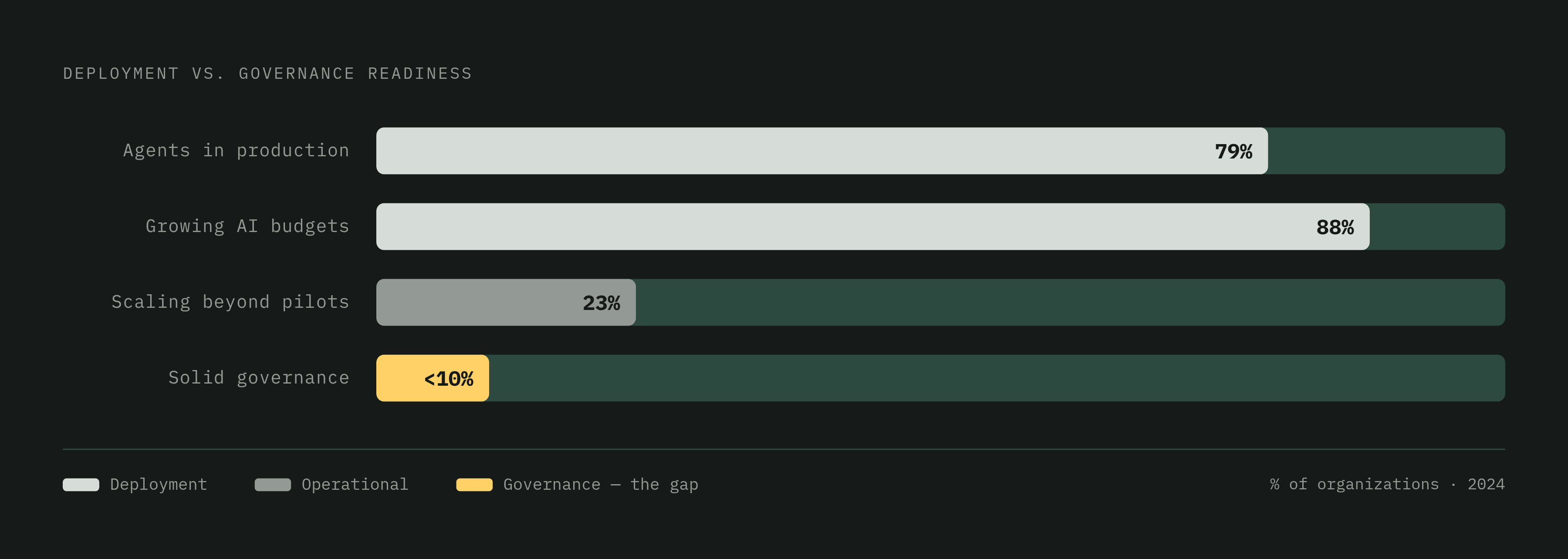
AI agents are already running inside banks, hospitals, and insurance companies, and most of them were not built with regulators in mind. Adoption is moving faster than governance, and the gap between the two is where the fines live. PwC's May 2025 survey of 300 senior executives found 79% already have agents in production, with 88% planning to grow AI budgets over the next year specifically because of agentic AI. McKinsey's 2025 State of AI, though, found only 23% of organizations are scaling agents anywhere beyond a pilot, a wide gap representing most of the market experimenting with something Gartner says will sit inside 40% of enterprise applications by the end of 2026, up from under 5% in 2025.
Put plainly: the decisions made about agent architecture right now are going to govern deployments at a scale nobody's built for yet. And agents are routinely deployed without IT or security teams even knowing about it, leaving adoption further and further ahead of governance.
What makes AI agents structurally different from earlier software for compliance purposes
Old-school compliance was built for software that behaves like a vending machine: put in a request, get out a predictable, loggable transaction. A single system does a single thing, writes it down, and an auditor can reconstruct exactly what happened months later. Agents work differently, and pretending otherwise is where most of this trouble starts.
Four things break the old model. Agents act autonomously across multiple steps without waiting for a human to sign off on each one. They reach outside their own walls to call APIs, hit databases, and touch other services, which means the compliance perimeter isn't the system anymore, it's everything the system can talk to. Their behavior can shift over time as the underlying model gets updated or as they accumulate context, so an agent that passed review in January might act differently by July without anyone changing a line of code. And in setups where one agent orchestrates several others, figuring out which agent actually produced a specific output can turn into detective work with no leads.
The EU AI Act saw this coming. Its framework makes clear that in a chain of agents, every agent performing a high-risk function sits inside the compliance boundary, not just the one giving orders. Oversight built around episodic approvals and siloed compliance teams was designed for a slower, more contained kind of software, not something that operates continuously and crosses departments without asking permission. The numbers back this up: fewer than 10% of organizations say they have solid governance frameworks for AI deployment, and global trust in fully autonomous AI actually dropped, from 43% in 2024 to 27% in 2025. People are noticing the gap even if the architecture isn't catching up yet.
The regulatory landscape organizations must actually navigate in 2025–2026
There's no single global AI law to check against. Instead, there's a stack of overlapping rules, and the stack itself is the compliance problem. In the EU, a deployment can simultaneously trigger the AI Act, GDPR, the Cyber Resilience Act, NIS2, the Digital Services Act, the Data Act, and the revised Product Liability Directive. In the US, there's no federal AI law at all, so sector regulators like the SEC, FINRA, FDA, and HHS OCR are stretching existing frameworks to cover AI, while states race ahead with their own rules.
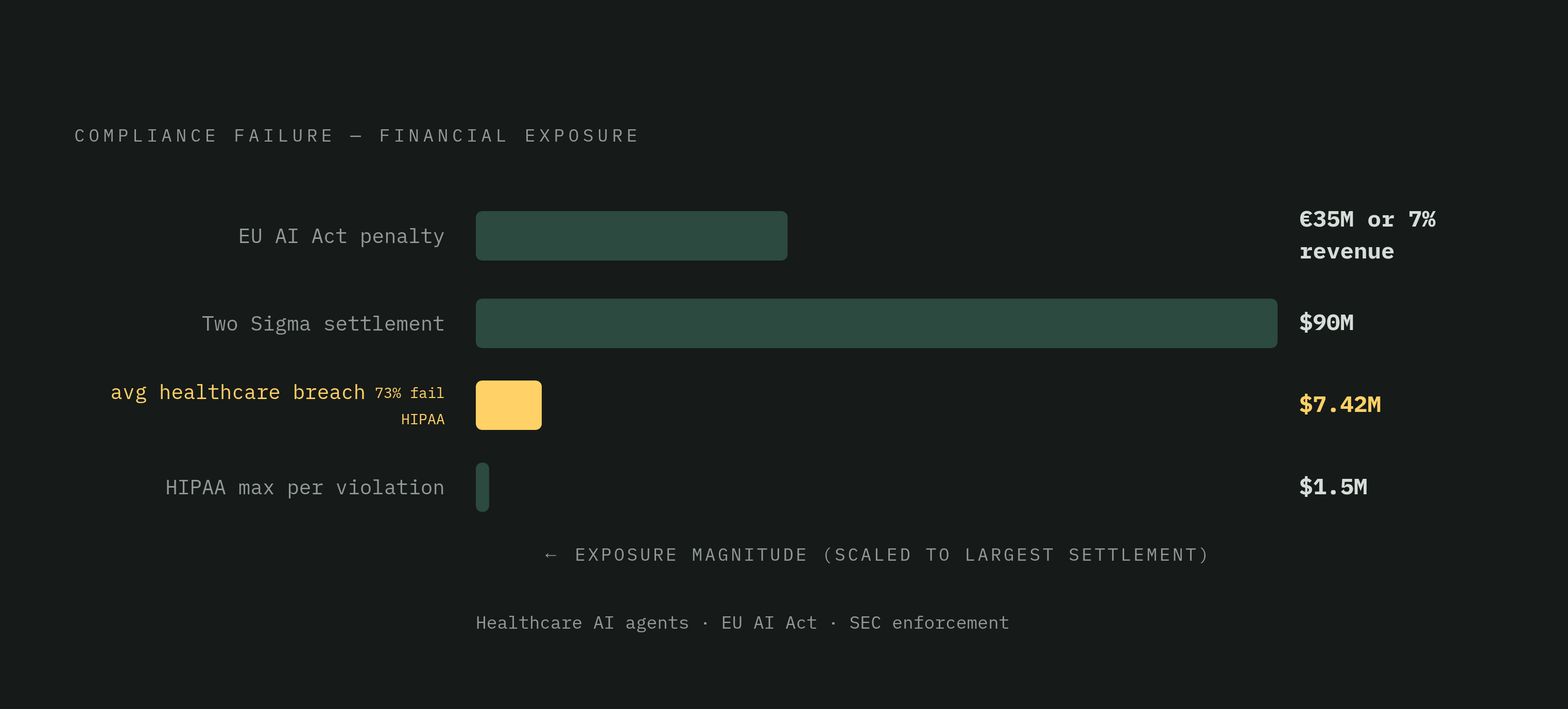
The EU AI Act's timeline matters because parts of it are already live. Prohibitions on unacceptable-risk systems became enforceable in February 2025, and transparency obligations for general-purpose AI models kicked in this past August. The big one, full high-risk system requirements including human oversight mandates, conformity assessments, and EU database registration, is set to activate on a later deadline under the Act's phased timeline. Miss it at the high-risk tier and penalties run up to €35 million or 7% of global annual revenue, whichever stings more.
On the US side, NIST's AI 800-4 guidance is expected to address post-deployment monitoring of AI systems. Broader NIST efforts are moving toward treating agents as their own regulatory category rather than a footnote to general AI guidance. States aren't waiting around either: California has moved to regulate automated decision systems, including requirements around record retention for AI hiring tools. Multiple US states and localities have introduced or enacted their own AI-specific rules covering impact assessments, bias audits, and record retention for high-risk AI tools.
Gartner projects more than half of large enterprises will face mandatory AI compliance audits by 2026. Worth saying plainly, though: detailed regulatory guidance specifically addressing autonomous agents and runtime behavioral drift remains limited. The challenge of untraceable behavioral drift in high-risk agentic systems raises real questions about whether current architectures can satisfy the Act's essential requirements. The law got ahead of its own instructions.
What sector-specific regulation adds on top of horizontal AI law
Financial services got specific fast. Sector regulators have increasingly focused on generative AI and autonomous agents, with governance, recordkeeping, and auditability as recurring concerns. Key risks that have drawn regulatory attention include agents acting without human validation, agents operating beyond their authorized scope, and gaps in auditability. Existing model risk guidance already demands documentation, validation, and ongoing monitoring for AI influencing financial decisions.
There's precedent for how expensive ignoring this gets. Two Sigma Investments and Two Sigma Advisors paid a combined $90 million to settle SEC charges. That's not an AI agent case specifically, but the fiduciary duty logic transfers directly: not knowing your model had a problem isn't a defense. Banking institutions already spent over $3.2 billion on compliance-related fees in 2024, before AI-specific mandates even fully landed.
Healthcare is where the gap between a standard AI setup and what compliance actually requires gets widest. Under HIPAA's existing framework, vendors handling protected health information on behalf of covered entities count as business associates, meaning a formal data processing agreement isn't optional. And this matters: 73% of healthcare AI agent deployments fail HIPAA compliance because standard AI architectures violate Technical Safeguards mandates. Each violation can cost up to $1.5 million, and the average healthcare breach now runs $7.42 million. Regulatory expectations for clinical AI increasingly require documented change management before agents are deployed in patient-facing settings, not after something goes wrong.
Internationally, watch Singapore and Vietnam. Singapore has moved to develop governance frameworks specifically for autonomous agents, with expectations around agent identity and audit trails tracking which agent acted under whose authorization. Vietnam's standalone AI law, effective March 2026, classifies financial-services AI as high-risk. Southeast Asia is drifting toward the EU model rather than the US one.
The four architectural requirements that compliance actually imposes on agent deployments
This is where compliance stops being a policy document and starts being a design spec. Four requirements show up across every regulation covered so far, and each one maps to something specific an engineer has to build.
Auditability comes first. FINRA's recordkeeping rules, the EU AI Act's Article 12 logging requirement, HIPAA's audit controls, and SEC exam priorities all converge on the same question: what did the agent do, when, on whose authority, and with what data. In a multi-agent chain, every agent needs its own attributable log, not just the one orchestrating the others, because Recitals 99 and 100 extend liability down the whole chain. Logs need to be tamper-evident and retrievable on demand; California's rules alone require four years of retention for employment-related AI. This has to live inside the agent runtime itself, so every tool call, every decision branch, and every API hit gets captured as it happens, rather than getting bolted on after the fact.
Human oversight comes second, and it has to be tiered by consequence, not by whatever's convenient for the workflow. Article 14 of the EU AI Act mandates human oversight for high-risk systems, and in practice that means building two tiers: human-in-the-loop for anything irreversible and high-stakes (a financial transfer, a production config change, a clinical decision), and human-on-the-loop, meaning retrospective log review, for lower-risk, reversible work. FINRA already named "autonomy without validation" as a specific compliance failure, and Gartner expects at least 15% of daily work decisions to be made autonomously through agentic AI by 2028. The tier boundaries need to exist before that volume shows up, not after.
Data residency and access controls come third, and they need enforcement at the agent layer, not just the database layer. GDPR's localization rules, HIPAA's technical safeguards, and Vietnam's financial-services classification all require that data doesn't cross jurisdictional lines without authorization. The problem is that agents calling external tools can move data across those lines entirely on their own, no human transaction required, which means the compliance failure happens in the tool-use layer, not in storage. Agents need least-privilege credentials scoped to the specific task in front of them, not inherited access to the whole enterprise. And since HHS OCR already confirmed LLM providers handling PHI are business associates, picking a vendor is now a compliance decision, not just a procurement one.
Behavioral monitoring and change control round it out. NIST's AI 800-4 guidance set post-deployment monitoring as a federal expectation, and the FDA's change control plans apply the same logic to clinical AI. Behavioral drift, an agent acting differently as its underlying model updates, is exactly the failure mode that a one-time validation can't catch. Researchers have flagged this as a real, identified gap: high-risk agentic systems with untraceable drift can't currently satisfy the EU AI Act. NIST's AI 100-2 E2025 taxonomy now includes prompt injection and retrieval-augmented generation attacks across multi-agent setups, which means security monitoring and compliance monitoring have effectively converged into a single job.
Why data residency and model choice are compliance decisions, not just infrastructure preferences
Here's a tension that doesn't get enough attention: when a closed, cloud-hosted platform runs both the model and the agent runtime, the organization using it often can't say for certain where its PHI, financial records, or personal data are actually being processed. GDPR's Chapter V restrictions on cross-border data transfer, HIPAA's business associate rules, and the localization expectations building in Vietnam and Singapore all point the same direction: for a lot of regulated workloads, compliant deployment means running on infrastructure the organization itself controls.
That's where model-agnostic architecture earns its keep. An organization that can choose its own inference provider, or run models on its own hardware, can route sensitive workloads to compliant infrastructure without redesigning the entire agent layer around it. Singapore's expectation around agent identity and audit trails implies something specific: the organization has to be able to say exactly what model version was running at a given moment, which is difficult when a vendor controls the updates and doesn't expose version history.
So the deployment model, self-hosted versus vendor-managed SaaS, isn't an infrastructure detail to sort out after the compliance review. It's part of the review. Agent platforms that deploy into infrastructure the organization already owns, where the organization picks the model and keeps full access to its own logs, are simply better positioned to meet data residency, audit, and attestation requirements than platforms where those controls sit behind a vendor's wall.
The real cost of treating compliance as a post-deployment retrofit
Start with the number that says it all: 73% of healthcare AI agent deployments fail HIPAA compliance because standard architectures violate Technical Safeguards mandates, which is the default outcome of shipping an agent without designing for compliance from day one.
Retrofitting doesn't work the way people hope it will. Compliance gaps discovered after an agent is already live, missing logs, weak access controls, no oversight gates, live at the runtime level, not the surface, so fixing that means re-architecting, not patching a config file. Enforcement isn't slowing down to make this easier, either: more than 25 countries have introduced or passed AI-specific legislation since 2023, and Gartner's projection of mandatory compliance audits hitting more than half of large enterprises by 2026 is coming whether or not the architecture underneath is ready. The Two Sigma settlement already established that "the model had a problem we didn't catch" doesn't hold up as a defense; agents just widen that exposure.
There's a paradox worth sitting with here. Organizations that skip compliance work to move faster usually end up slower: agents pulled out of production for remediation, audit findings that freeze scaling plans, regulatory inquiries that eat up engineering time that was supposed to go toward building. Fewer than 10% of organizations say they have solid governance frameworks in place, which means most of them are quietly betting they won't be in the first wave of audits, a bet that gets a lot riskier as the audit rate climbs toward Gartner's 50% mark.
What building for compliance from the start actually looks like in practice
None of the four requirements above are exotic. Auditability, tiered human oversight, agent-layer access controls, and ongoing behavioral monitoring are achievable with today's tools, but only if they get built into the runtime from the first commit, rather than bolted onto a working prototype later. An agent that logs every tool call from day one doesn't need a logging retrofit when the auditor shows up, and an agent built with least-privilege credentials scoped to its actual task doesn't need an access review that takes six months.
The organizations moving fastest right now are the ones treating the four architectural requirements as the actual product spec, not a legal add-on. That means picking infrastructure that supports self-hosting or model choice before a vendor contract locks in a black box. It means defining human-in-the-loop versus human-on-the-loop tiers before the agent goes live, not after a near-miss forces the conversation. It means building logging into the agent runtime itself, so every decision branch and API call leaves a trail an auditor can actually follow.
The regulatory stack isn't getting simpler, and the audit rate isn't heading down. Agents are already inside regulated industries, doing regulated work, whether or not the architecture underneath was built for it. The organizations that treated compliance as infrastructure will be the ones that don't need to rebuild when the regulators finally show up asking questions.