Open-Source Agent Frameworks for Code Review Automation
AI-generated code needs smarter review agents that catch semantic bugs, not just patterns.
Pull request volume has climbed hard year over year, and no engineering org is hiring its way back to zero backlog. A big chunk of the new code showing up in those PRs is AI-generated, and it carries more bugs per diff than code a human typed out line by line, logic errors and security holes included. The same wave of AI tooling that's making developers faster is quietly making review harder. Developer adoption of AI-assisted review has roughly doubled over the past two years, which means the automation train has already left the station. The real question left standing is which architecture actually catches the right things once it gets there.
What "agentic" code review actually means, and how it differs from linting
Static analysis is a rule follower. Feed it a pattern, it flags every instance of that pattern, forever, with zero drift and zero imagination. Fast and deterministic, about as smart as a smoke detector: it only knows what it's built to smell.
An agent has an LLM sitting at the center making decisions, planning a sequence of actions, calling tools, and reasoning across a pile of context it wasn't explicitly told to check. That's what lets it catch semantic problems, the kind where the code is syntactically fine but does the wrong thing anyway. An agent can summarize a diff, connect a change in one file to a consequence in another, and guess at what the developer meant to do rather than just what they typed.
None of that replaces the deterministic gate. Linting and SAST tools still run because they're fast and near-certain on the rules they cover. Most teams that get this right layer agentic review on top of that foundation, alongside it rather than in place of it.
What actually separates one agent framework from another comes down to four things:
- How autonomy is structured (one agent working alone, or several handing off tasks; reacting to triggers, or planning ahead)
- How tools get exposed to the agent (bespoke integrations bolted on one by one, or a shared protocol)
- How state and memory persist across steps
- Where the thing actually runs (cloud sandbox, self-hosted box, local machine)
Everything else in this piece runs through those four questions.
How MCP changed what tool integration looks like for review pipelines
Before there was a shared protocol, wiring an agent into GitHub, GitLab, and Jira meant building a custom connector for every single pairing. Add a fourth tool, and you're maintaining six relationships instead of three. It scaled about as gracefully as a chain letter.
Open Hands, an open platform for running coding agents at scale, handles this by building native integrations for GitHub, GitLab, and dozens of other tools into the platform itself.MCP (Model Context Protocol) flattened that into one integration per tool. An agent built to speak MCP can pull a PR diff, grab ticket context, and read repo history without anyone writing glue code for each new destination. By late 2025 the protocol had reached well into the tens of millions of monthly SDK downloads and thousands of public servers, and every major AI vendor had signed on. Anthropic handed MCP over to the Linux Foundation in December 2025, which is the corporate equivalent of saying "this isn't ours anymore, this is everyone's plumbing now."
For review pipelines specifically, MCP servers exposing the GitHub and GitLab APIs mean any MCP-compatible framework can hook into the PR lifecycle without custom webhook wiring. Practically, that means MCP support isn't a feature worth bragging about anymore. It's table stakes, though what still varies is how deeply a given framework has built around it versus bolted it on as an afterthought.
Purpose-built review agents: PR-Agent and what a focused tool trades away for depth
PR-Agent is built for one job: reviewing pull requests. It's MIT-licensed now and community-owned, after Qodo donated it to the PR-Agent GitHub org.
It plugs into GitHub or GitLab with almost no setup, and it gives you feedback on a diff right away. If your goal is "get comments on this PR without building a pipeline," this is about as close to plug-and-play as the category gets.
What it doesn't do is anything past the PR event. There's no issue-to-PR planning, no multi-step code editing, no memory that carries from one review to the next. It's reactive: something triggers a review, and it reviews. It doesn't reason forward from a problem statement the way a planning agent would.
Good fit for a team that wants fast, low-effort PR commentary and has zero interest in building a broader agent pipeline. Wrong fit if you want the agent to actually fix what it flags, or operate across more of the development cycle than a single PR event.
General-purpose frameworks applied to review: how LangGraph, CrewAI, AutoGen, and smolagents differ architecturally
These four get lumped together a lot, but they're built on genuinely different mental models, and that difference is the whole point.
LangGraph treats a review pipeline as a graph: nodes, edges, conditional branches, cycles that loop back on themselves. That's the right shape when your workflow actually has that kind of complexity, say, parallel checks fanning out across security and quality, with conditional re-review loops depending on what gets found. LangSmith bolts on observability and audit trails, which matters if you're an enterprise team that needs to show what the agent reasoned at each step and not just what it concluded. The cost is upfront design work, and the graph abstraction only pays for itself once your pipeline is more complicated than "step one, then step two, then step three."
CrewAI treats the pipeline as a crew, a group of agents each holding a role. That maps naturally onto how code review already splits: a reviewer, a security checker, a test coverage checker, a summarizer, each owning their stage. It's built on top of LangChain, so it inherits a wide net of existing integrations. It works best when the review stages are stable and known in advance, and it works less well when the right set of stages actually changes depending on the PR, say, a docs-only change needing a completely different crew than a database migration.
AutoGen, out of Microsoft Research, treats agents as participants in a conversation talking to each other. It's an expressive model, but it came with real growing pains: the event-driven architecture didn't reach general availability until early 2026, and the older, more experimental version broke API compatibility for a meaningful share of production users along the way. That instability is worth weighing seriously if your team needs review coverage that runs unattended and doesn't surprise you on a Tuesday.
Smolagents, from Hugging Face, strips the overhead down to almost nothing: agents write actual Python at each reasoning step instead of chaining prompts together. It's the fastest way to get a working agent loop up and running, full stop. It's not built for durable state or complex multi-agent orchestration, so think single-agent review task, not enterprise pipeline. Good for prototyping, or for a team that wants to understand how an agent actually works mechanically before betting on something heavier.
The question across all four comes down to how much control-flow complexity your review pipeline actually has, rather than which one's most popular. Simple, sequential review favors smolagents or CrewAI, while complex, conditional pipelines that need an audit trail favor LangGraph.
Full-autonomy agents that go beyond review: OpenHands and the issue-to-PR pattern
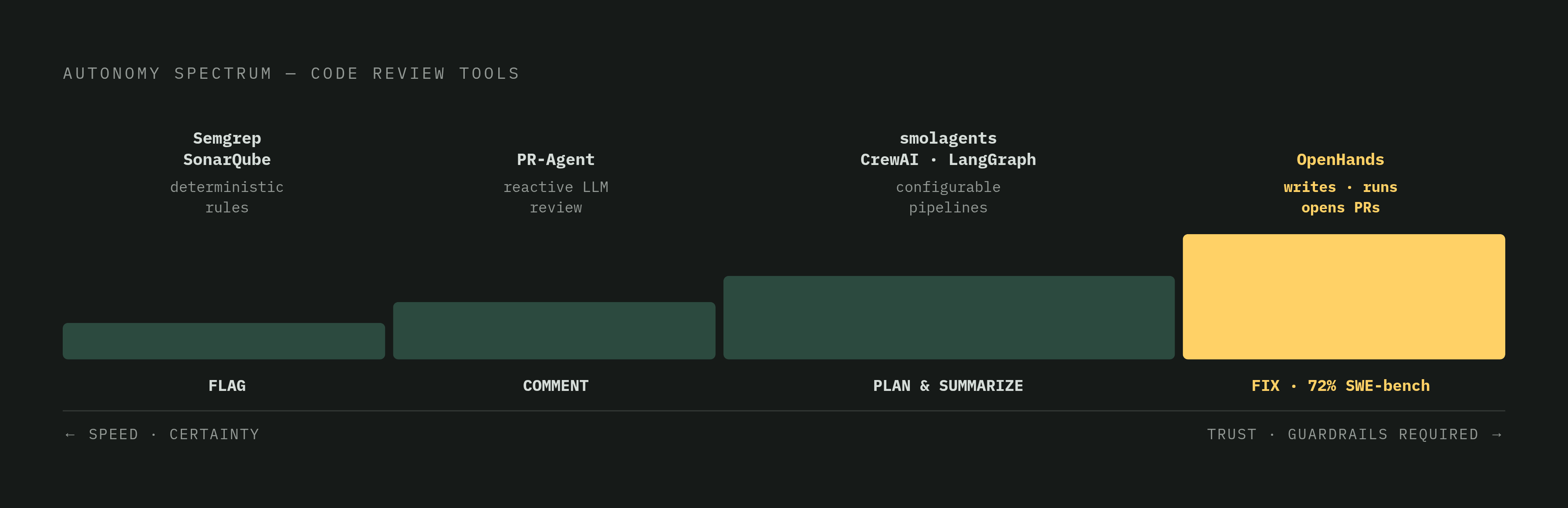
OpenHands is MIT-licensed, self-hosted, and model-agnostic, and it's built to act like a full software engineer rather than a reviewer standing at the door checking IDs. It writes code, runs terminal commands, reads documentation, and opens PRs on its own.
Wired into a GitHub webhook, every incoming PR gets an autonomous pass covering code quality, security issues, test coverage gaps, and architectural concerns before a human ever opens the tab. The real architectural difference from PR-Agent or a CrewAI pipeline: OpenHands can act on what it finds. Flag an issue and fix it in the same session, no human needed to kick off a separate task for the fix.
It scores 72% on SWE-bench Verified, a benchmark that measures autonomous issue resolution, which happens to be the exact skill that makes an agent useful for catching and closing problems in a review loop instead of just naming them.
Because it's self-hosted, it runs inside the team's own infrastructure with whatever model they choose. No code leaves the perimeter, and no one's locked into a single vendor's LLM.
Good fit for teams drowning in PR volume who want obvious issues caught and closed before they eat a senior developer's afternoon, and for orgs with data residency requirements or a strong opinion about which model they use. The tradeoff is trust: broader autonomy means you need stronger guardrails around what the agent's allowed to touch, which is exactly where the security conversation picks up.
Where static analysis still earns its place alongside agentic review
Agents catch a meaningfully bigger share of real-world runtime bugs than a static analyzer ever will. Static analysis, in return, catches what it's built to catch with almost no false negatives on the rules it actually covers. Each answers a different question, and neither makes the other obsolete.
Semgrep OSS (LGPL-2.1) is the strongest open-source option if security is the priority: more than twenty thousand security rules, cross-file taint analysis, reachability-based software composition analysis. Its real value shows up when a team writes custom rules for its own codebase's specific patterns, the stuff a generic rule set was never going to catch on a large monorepo. That leverage isn't free, though, since writing good custom rules takes dedicated security engineering time, so it's not a tool you just drop in on day one.
SonarQube Community Build is the incumbent. A large share of enterprise teams already run it, so the real decision is whether to extend it with an agent layer, not whether to rip it out and replace it. Its rule set leans more toward code quality than security vulnerabilities specifically. AI features have been added on top over time, but underneath, it's still a static analysis engine rather than a planning agent making judgment calls.
CodeQL is strongest for deep semantic analysis, and it's free on public repos. Private repos need a paid GitHub tier, following the 2025 restructuring of Advanced Security.
The pattern most mature teams land on: static analysis as the fast, high-confidence gate everything passes through first, and agent-based review as the semantic layer catching what rules can't express in the first place.
Security risks that agentic code review introduces into the pipeline itself
Here's the uncomfortable part. The agent reviewing your code is reading your code, and code is exactly where an attacker would hide instructions meant for the agent, not the compiler.
Indirect prompt injection is the primary threat vector here: adversarial instructions buried in a code comment, a commit message, or a PR description that change how the agent behaves, without the attacker ever touching the agent's actual configuration. Picture a malicious contributor opening a PR whose comments quietly tell the reviewing agent to suppress its own security findings, approve the PR, or leak internal context. The agent reads the PR as input; the injection just rides along inside the content it was already going to process. OWASP's Top 10 for LLM applications lists this among the most serious risks for deployed agents, and it's not a hypothetical, it's a design flaw waiting for the wrong PR.
Autonomy scales the risk in other ways too. An agent with broad repo access can accidentally surface secrets or internal architecture details in its output. And an agent that's allowed to open PRs or modify files on its own is a new entry point into the supply chain if its tool permissions are broader than they need to be.
The fixes belong in the framework decision itself, not bolted on afterward:
- Run agents in sandboxed, isolated environments so a hijacked agent can't touch anything that matters
- Give review agents read access and comment rights, nothing more; merge rights and write access to main stay off the table
- Log the agent's reasoning so an injection attempt is visible after the fact, not invisible forever
- Put a human gate in front of any agent action that actually changes the repo
Self-hosted, open-source deployments let a team inspect and constrain agent behavior down at the infrastructure level. Closed platforms ask you to just trust their security model, a fine arrangement right up until it isn't.
Matching framework architecture to actual team constraints
Four questions actually decide this, and they're worth answering in order rather than picking whatever framework had the flashiest demo.
How complex is the review workflow, really? Simple diff commentary points toward PR-Agent or smolagents, a multi-stage pipeline with parallel checks points toward LangGraph or CrewAI, and full issue-to-fix autonomy points toward OpenHands.
Where does the code have to stay? Data residency or compliance requirements mean self-hosted, model-agnostic setups; without that constraint, cloud-hosted agents are perfectly viable.
How much does model flexibility matter? Teams that want the freedom to switch models as the landscape shifts need a bring-your-own-key architecture, while closed platforms lock that choice in for you.
How much pipeline investment can the team actually sustain? General-purpose frameworks like LangGraph and CrewAI ask for real engineering time upfront, whereas purpose-built tools like PR-Agent are running the same day you install them.
Layering static analysis under agentic review is the pattern most teams settle on, a foundation to build on rather than a fork in the road where you pick one and abandon the other. MCP compatibility should be treated as infrastructure at this point, not a checkbox feature to compare on a spec sheet. And the autonomy-trust tradeoff runs under every single one of these decisions: the more an agent is allowed to fix rather than just flag, the more guardrails, observability, and permission scoping it needs going in. Skip that design work, and you'll pay for it later in agent behavior nobody predicted and nobody can fully explain.
Open-source frameworks give teams the ability to inspect, constrain, and rebuild agent behavior as review needs change, and that matters a lot more once automation stops being one team's experiment and starts being everyone's Tuesday.