Agentic Coding Tools Evaluated for Production Use
Benchmark scores mask what matters in production: latency, cost, and pipeline integration.
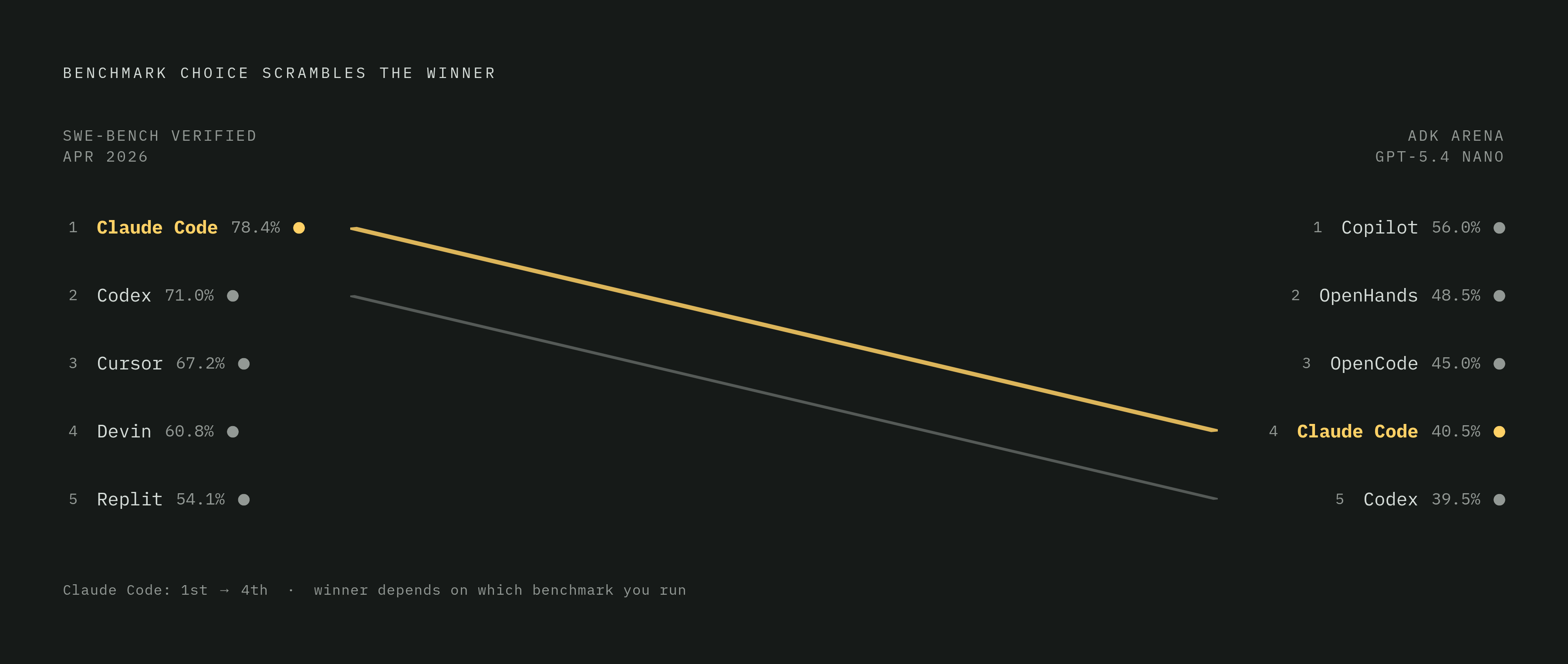
SWE-bench Verified is the benchmark everyone cites, and for good reason: it's gone from roughly 4% success rates in 2023 to top agent-model pairings now clearing 70 to 90%. That's real progress, but it also means the spread between competing tools has compressed into a tighter band than the marketing suggests.
As of April 2026, per digitalapplied.com, the scores break down like this: Claude Code at 78.4%, Codex at 71.0%, Cursor at 67.2%, Devin at 60.8%, Replit at 54.1%. These are meaningful differences, but every single one of these tools is operating in the same general order of magnitude, and nobody's failing the class here.
The deeper issue is structural. These benchmarks measure end-to-end outcomes, pass or fail, and that masks everything interesting that happens in the middle. Research from arxiv in 2026 points out these scores are disconnected from the stuff that actually matters in deployment: latency, cost, how well the thing plays with your CI pipeline. A benchmark doesn't know if your build takes four minutes or forty.
This gap has consequences. Gartner predicts more than 40% of agentic AI projects will be canceled by 2027, and a chunk of that failure traces back to teams having no systematic way to evaluate agents once they're actually deployed, since a high SWE-bench score didn't warn anyone about that.
Vendor-reported numbers make it murkier still. Cognition reported Devin's SWE-1.7 model hitting 77.8% on SWE-bench Multilingual and 81.5% on Terminal-Bench 2.1 in July 2026. Nobody's independently verified those, and that doesn't make them false, but it does make them marketing collateral rather than something you'd hang a procurement decision on.
And here's the part that should really give you pause: run a different benchmark suite, and the leaderboard scrambles completely. ADK Arena tested multiple tools on the same GPT-5.4 Nano backbone, with results that reflect differences in the agent harness rather than the underlying model. The result: Copilot led with 56% average resolution, OpenHands came in at 48.5%, OpenCode at 45%, Claude Code at 40.5%, Codex at 39.5%. These are the same tools, but a wildly different order, and depending on what you measure, you get a different winner.
The takeaway carries forward through the rest of this piece: treat benchmark scores as a floor for raw capability, nothing more. The real evaluation starts after the code gets generated.
The five criteria that distinguish production-grade tools from developer-grade ones
Five decisions separate a tool that's fun to use from a tool you can actually run a business on.
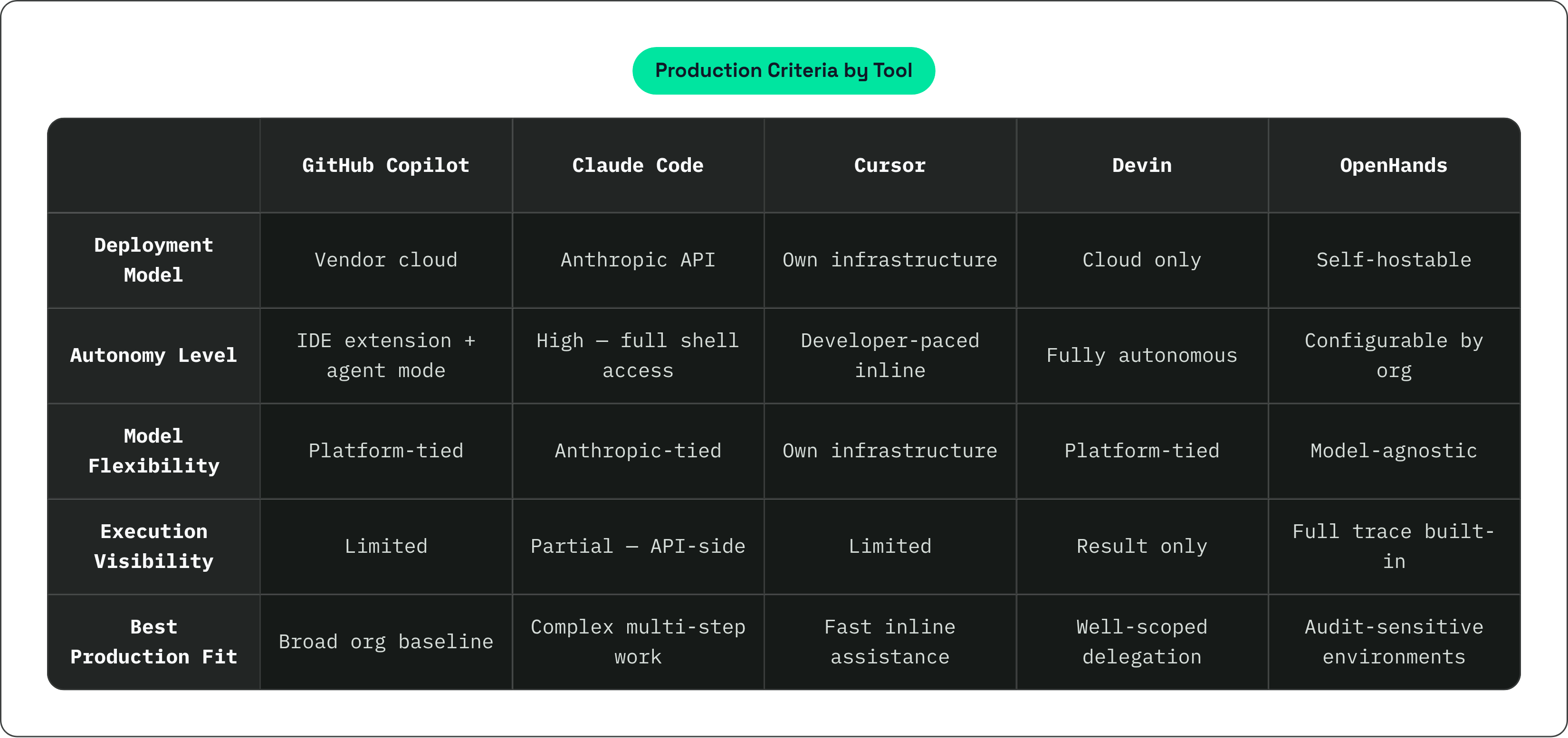
Deployment control. Does the tool run inside your infrastructure, or does every line of code get routed through a vendor's cloud first? For regulated industries, on-premise or VPC deployment isn't a nice-to-have, it's the whole ballgame.
Visibility into agent behavior. Can your engineers see, step by step, what the agent actually did, which files it touched, which commands it ran, and why it made the call it made? Or is the whole thing a black box that hands you a diff and a shrug?
Model flexibility. Is the tool welded to one provider's model, or can your team swap in whatever fits the cost, the capability, or the compliance box you need to check that week?
Infrastructure fit. Does this thing slot into your existing CI/CD, version control, secrets management, and access control, or does it demand its own parallel universe of tooling?
Autonomy level and human-in-the-loop design. The spectrum runs from inline autocomplete all the way to a fully autonomous agent that just goes and does the thing. Production teams need to match the autonomy level to the risk of the task, not just grab the most independent option because it sounds impressive in a demo.
Think of these less as a feature checklist and more as five separate bets you're placing on how your engineering org will actually function a year from now.
How the current field maps onto the production criteria
The market splits into four architectural buckets, per artificialanalysis.ai: IDE extensions (Copilot, Cline, Continue, Amazon Q, Gemini Code Assist, Augment Code, Amp), dedicated IDEs (Windsurf/Devin Desktop, Zed, Kiro), CLI tools (Claude Code, Aider, Codex, Gemini CLI), and cloud platforms (Devin, OpenHands, Jules, Genie).
The category a tool falls into shapes its answer to the deployment question. Cloud platforms process your code through vendor infrastructure, while CLI tools and self-hosted platforms give you the option to keep things in-house.
GitHub Copilot has the biggest footprint by a wide margin: roughly 20 million total users as of July 2025, 4.7 million paid subscribers as of January 2026, and adoption across a large share of major enterprises. It remains fundamentally an IDE extension, though. Its agent mode, generally available across VS Code and JetBrains since March 2026, extends what it can do autonomously, but it doesn't touch the underlying deployment model.
Claude Code sits at the top of the autonomy ceiling among terminal-based agents, with full shell access, a 200K context window, and MCP connectivity for hooking into external tools. It runs through Anthropic's API though, with no self-hosted option on the table. Adoption tells the story here too: work usage jumped from 3% to 18% between April 2025 and January 2026 according to axis-intelligence.com, a six-fold increase in under a year.
Cursor wins on speed, plain and simple, with a roughly 3-second median time to first token for inline suggestions. Its local filesystem indexing gives it a real edge on large codebases, though it runs through its own infrastructure by default.
Devin takes autonomy furthest. It spins up its own virtual machine, plans the work, executes it, and hands you a result to review, rather than working alongside you in real time. Devin has significantly lowered its entry price since launch, which changes who can afford to experiment with it, though the cloud-only deployment model hasn't budged.
OpenHands is the outlier worth paying attention to, since it's open-source, self-hostable, model-agnostic, and built for auditable execution. It sits squarely in the gap that the other tools on this list leave open: deployment control and behavioral visibility.
The pattern showing up most in large organizations, per axis-intelligence.com's June 2026 reporting, is a two-layer stack: Copilot as the broad autocomplete baseline across the whole org, paired with Claude Code or a cloud agent reserved for senior engineers tackling the gnarlier tasks. Nobody's betting the whole farm on one tool doing everything.
Where closed platforms create real production risk
Vendor lock-in isn't just about pricing creeping up on you. When a tool is your only door into a given model or runtime, any change on the vendor's end, a pricing shift, a capability regression, a policy update, lands directly on your production systems, and you don't get a vote.
The Windsurf situation is the clearest recent illustration. Google's planned acquisition collapsed after key leadership departed the company, leaving employees without payouts they'd been expecting and customers staring at a roadmap that suddenly meant nothing. Windsurf was later sold to Cognition. A governance mess at the vendor level turned into an engineering risk sitting on somebody else's desk, and that's the whole lesson in one sentence.
Model lock-in stacks on top of this. A team whose agent is welded to a single model provider has no move to make if that model regresses in quality, costs spike overnight, or a new compliance requirement rules out how that provider handles data. They're just stuck watching.
There's a security angle too, and it's a real one: autonomous agents with broad permissions widen the attack surface. An agent with shell access and zero audit trail is a fundamentally different risk than one whose steps are observable and reversible along the way.
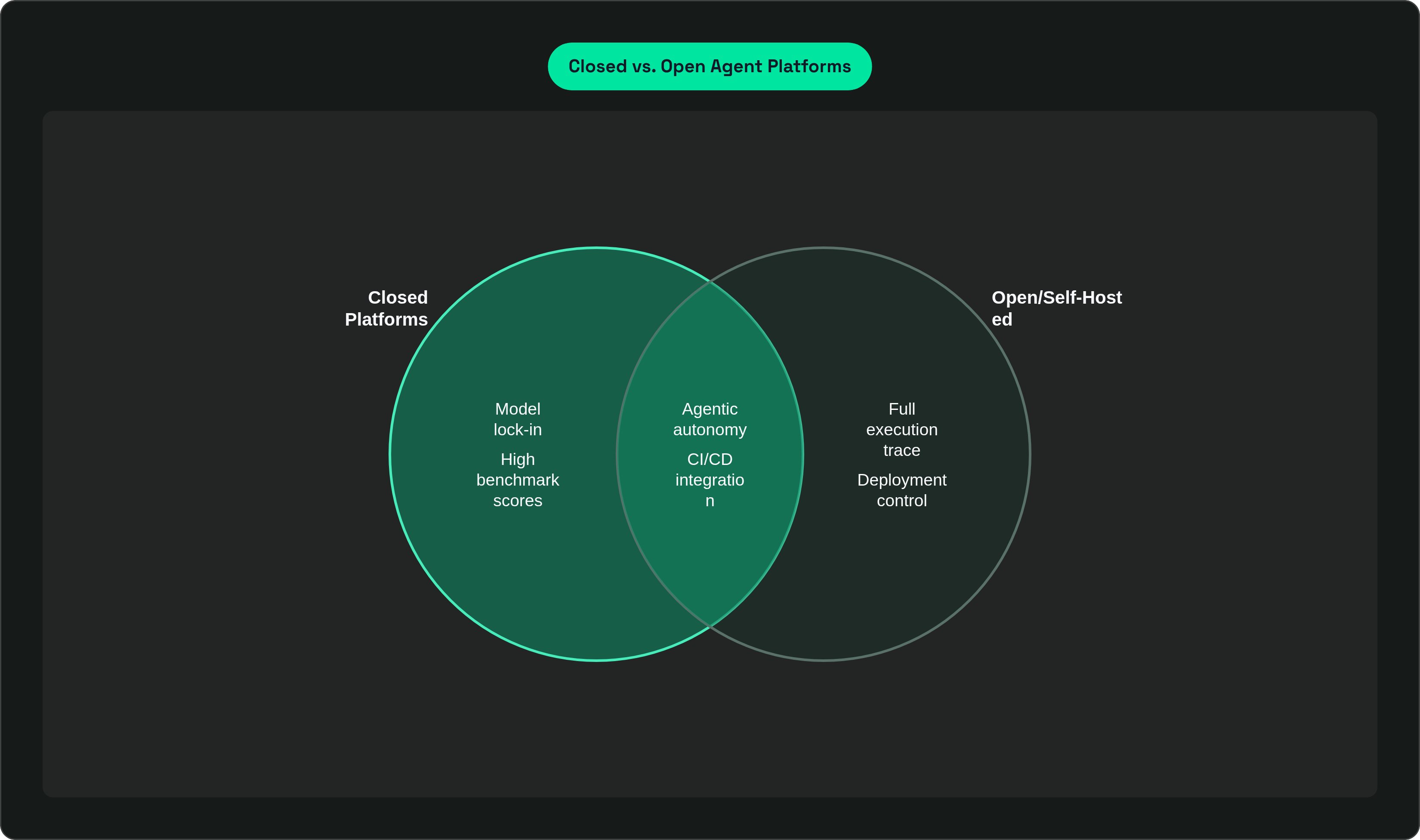
Recent research shows 62% of organizations still experimenting with agents and 23% already scaling them. Those two groups are carrying very different levels of exposure. A behavioral blind spot that's tolerable during a pilot becomes a systemic problem the moment you scale it across hundreds of repos. This is exactly where the closed-versus-open divide stops being a philosophical debate and starts being a Tuesday-morning incident report.
What genuine visibility into agent behavior requires
Visibility and logging get conflated often, and that mix-up is where a lot of teams get burned. A log of outputs tells you what got produced, while actual visibility means watching the reasoning steps, the tool calls, the file edits, the command executions, in sequence, as the agent works through the problem.
For production use, the questions that matter are specific. Can an engineer trace back why a particular change got made, can a security team audit what the agent touched, and can a team lead review the agent's decisions before merge, rather than just squinting at the final diff and hoping for the best?
Fully autonomous agents built on the Devin model are optimized to minimize how often they interrupt a human. By design, you see the result, not the process that got there. That's the right call for some tasks, the wrong call for others, and knowing which is which is most of the job.
Human-in-the-loop design runs along a spectrum: inline autocomplete, agent mode with approval gates built in, fully autonomous with an audit log, and fully autonomous with no trace at all. The real production question centers less on how autonomous a system should be and more on what minimum visibility a given security and compliance posture actually requires for that class of task.
Open-source agent platforms can expose the full execution trace as a built-in feature, not a bolt-on, because the team running it controls the runtime end to end. That's structurally off the table for closed cloud platforms processing everything server-side, no matter how good their intentions are. Gartner's cancellation prediction for 2027 is, in part, a visibility failure hiding in plain sight: teams find out too late that they can't explain what their agent did to an auditor, a security reviewer, or their own VP.
Model flexibility as an infrastructure decision, not a preference
Most closed agent tools are built around one specific model or provider. Copilot ties to its platform's models, Claude Code ties to Anthropic, Devin ties to its platform's models. The tool and the model get sold as a package deal, take it or leave it.
That's a problem because the "best" model for a given task, cost target, or compliance rule keeps shifting. A team locked to one model at the agent layer has exactly one move when that model stops being the best fit: rip out the whole tool and start over.
This matters most at scale. A ten-person team can absorb a model swap by hand without much drama, but an organization running agents across hundreds of repositories cannot do so without a real plan.
Open, model-agnostic architectures (OpenHands being the clearest production example) treat which model you use as a config setting, not an architectural commitment, letting you swap models without rebuilding your workflows, your integrations, or your audit trail. That ADK Arena result from earlier, where every tool ran the same GPT-5.4 Nano backbone yet still produced wildly different scores, backs this up sideways: the harness design and the tool-use implementation matter just as much as the model sitting underneath it.
For regulated environments, this gets even more concrete. Data residency rules and a model provider's own data handling policies often decide which models you're even allowed to use. Lock in your model choice, and you've quietly locked in your compliance posture along with it, whether anyone signed off on that or not.
Matching autonomy level to task risk in a production codebase
Lay out the autonomy spectrum in order: tab autocomplete, file-scoped edits with inline review, multi-file agentic tasks with approval gates baked in, async autonomous tasks running on isolated branches, and finally fully autonomous execution with review happening after the fact.
Task risk is the input here, not tool capability. A greenfield feature on some non-critical internal service can tolerate a lot of autonomy, but a refactor touching payment logic or your authentication layer cannot, and no amount of benchmark bragging changes that math.
Devin, the longest-running autonomous option in the field, is built for delegation. It's the right call when the task is well-scoped, the codebase has decent test coverage, and the team has time to review outputs rather than babysit execution in real time.
Claude Code's 200K context window and full shell access make it the strongest pick for complex, multi-step work where a senior engineer wants to stay in the loop at key decision points but hand off the grunt work of execution. Its fit comes down to how well its architecture matches that specific rhythm of collaboration, more than any claim to being objectively "the best" tool on the market.
Cursor's speed advantage, that roughly 3-second time to first token, and its IDE-native surface make it the right fit when a developer is in the driver's seat and just wants fast inline help. The autonomy level there is developer-paced, on purpose, by design.
Here's the practical fallout: organizations that pick a single tool for every task type end up either over-constraining a capable agent or under-controlling an autonomous one, and neither outcome serves them well. That two-layer stack pattern, Copilot for the baseline, a heavier agent for the hard stuff, exists precisely because no single autonomy setting fits every risk profile a codebase throws at you.
OpenHands offers something distinct here too: guardrails configured at the deployment level. The organization sets the policy, and the agent operates inside it, rather than everyone just accepting whatever interaction model the vendor decided was default.
How to structure a production evaluation before committing to a tool
Start with your constraints, not the capability list, and get the actual non-negotiables on deployment model, data handling, model provider, and audit trail nailed down before any capability comparison means anything at all.
Run candidate tools against tasks pulled straight from your real backlog, not synthetic benchmarks cooked up in a lab somewhere. The gap between tools on SWE-bench is real, sure, but the task mix in your actual repository might favor a completely different set of strengths.
During the pilot, evaluate the execution trace, not just the final output, and require every agent action to be logged and reviewable, no exceptions. Any tool that can't produce that trace isn't ready for the task classes that demand it, full stop, no matter how good its demo looked.
If model flexibility is something you actually need, test it rather than taking a vendor's word that their system is model-agnostic. Run it against at least two different models on the same task and see what happens.
Governance and security review belong inside the pilot, not tacked on as a checkbox after the contract's already signed. Autonomous agents with broad permissions need a security review before they get anywhere near production code, not after.
And ask the two-layer question early: is one tool actually the right answer for every engineer and every task type on your team, or does the org need a broad baseline tool plus a higher-autonomy platform reserved for the complex or sensitive work? The organizations in McKinsey's 23% that are scaling agent deployments well set these evaluation gates up front, well before any incident forces the issue.