Agentic Coding vs Vibe Coding for Software Teams
Knowing when to use AI for prototypes versus production systems changes everything.

There's a terminology problem sitting at the center of how software teams talk about AI-assisted development right now. "Vibe coding" and "agentic coding" get used interchangeably, applied to the same tools, in the same conversations, by people who mean completely different things. That conflation has real consequences. Practices that work perfectly well for a prototype can quietly destroy a production system by accumulating technical debt when the vocabulary doesn't force anyone to notice the line being crossed. So let's draw the line clearly.
What vibe coding actually means, and where the term came from
Andrej Karpathy coined "vibe coding" in a February 2025 tweet. His framing was deliberate: go with the flow, let the AI drive, don't review the generated code too hard. The name was almost self-deprecating. It wasn't meant to describe rigorous software development. It was meant to describe something looser and faster.
Collins English Dictionary named it their Word of the Year 2025. That's how fast this moved. A throwaway tweet became a dictionary entry inside twelve months.
The formal Collins definition describes it as using AI prompted by natural language to assist with writing code. That's accurate but undersells what makes vibe coding its own thing. The defining characteristics are:
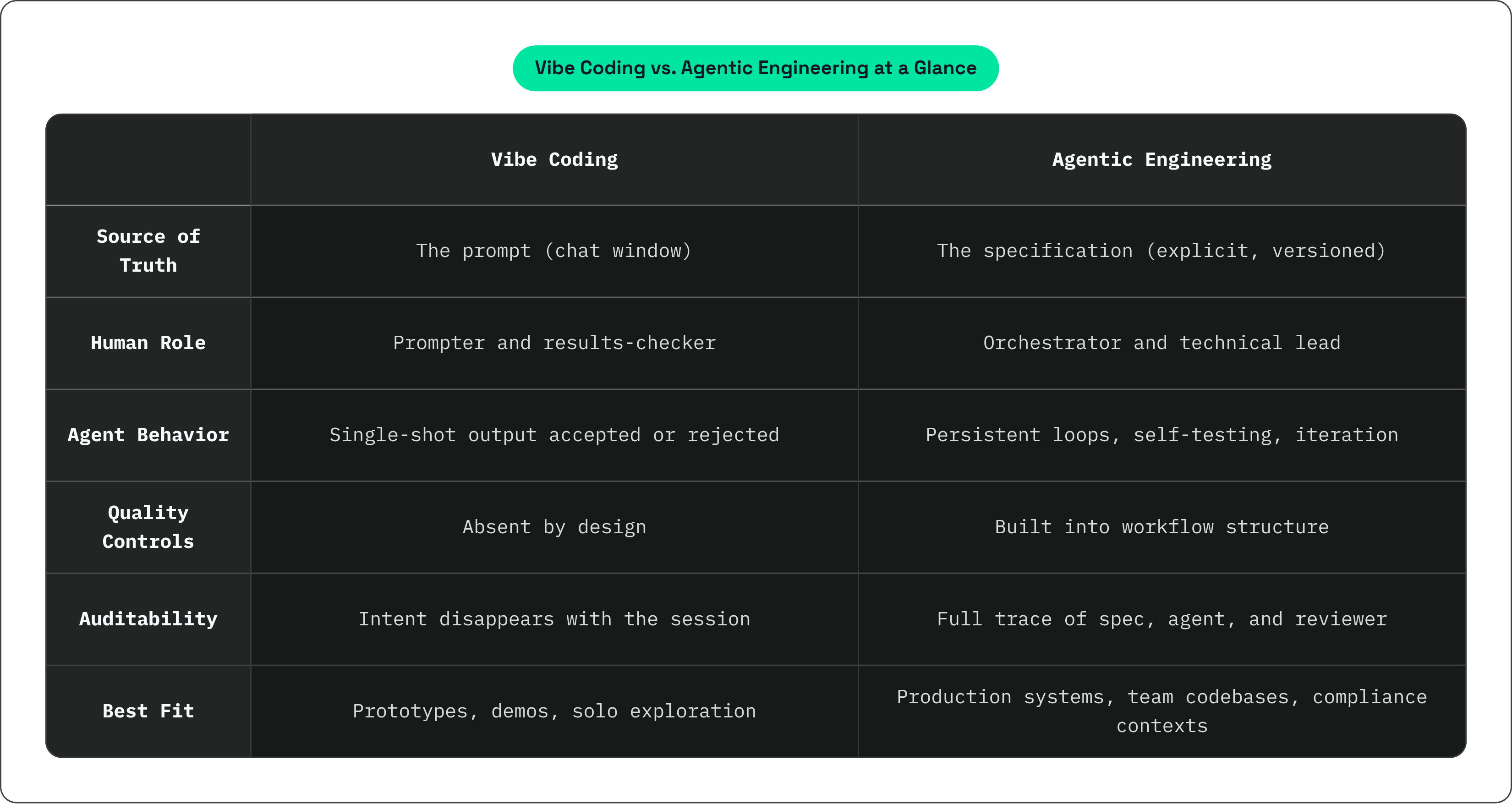
- The prompt is the source of truth. Not a spec. Not tests. The thing you typed into the chat window.
- The developer acts as prompter and results-checker, practicing prompt engineering rather than authorship. Not author.
- The process is reactive. You respond to what the AI produces rather than directing it toward a defined outcome.
- Quality controls are typically absent by design. That's not a bug in vibe coding. It's the point.
By mid-2025, 63% of active vibe coders were non-developers. People with ideas but no coding background. That statistic tells you a lot about the intended register of this approach: low-stakes, high-speed, disposable-or-iterate.
For prototypes, MVPs, demos, and solo exploration, vibe coding is genuinely useful. Speed of idea-to-artifact matters more than maintainability in those contexts. The problem isn't vibe coding itself. The problem is what happens when it doesn't stay in those contexts. Letting vibe coding drift into production is like letting a campfire drift into a forest — it's fine until it isn't, and by then it's very much not fine.
What agentic coding actually means, and how the term stabilized
On February 4, 2026, exactly one year after his original tweet, Karpathy named "agentic engineering" as his current preferred term. He explained it this way: "Agentic because you are not writing the code directly 99% of the time, you are orchestrating agents who do and acting as oversight. Engineering to emphasize that there is an art and science and expertise to it."
That's a meaningful shift. Same person, same tools, very different framing.
Forrester's definition fills in the structural detail: AI agents that plan, generate, modify, test, and explain software artifacts across multiple stages of the development lifecycle, working alongside humans with a degree of autonomy. The key word is "across." This isn't autocomplete. It's not a single-shot code suggestion you accept or reject.
Agentic engineering looks like this in practice:
- Agents operate in persistent loops, not one-off completions
- They break high-level objectives into executable steps, using the file system, terminal, and version control
- They test their own work and iterate until done
- The specification is the source of truth, not the prompt
The human role in this model, a human-in-the-loop pattern, is closer to a technical lead delegating to a capable junior engineer. You define goals, set constraints, review outcomes, and step in when the agent flags uncertainty. You're orchestrating, not typing.
That shift in role is what makes "agentic engineering" a different category, not just a fancier name for the same thing.
The three sources of truth that separate the two approaches
This is the cleanest way to explain the difference, and it holds up even when both teams are using identical tools.
In traditional coding, the code itself is the source of truth. It's what you read, version, test, and debug.
In vibe coding, the prompt is the source of truth. Intent lives in natural language, usually in a chat window that isn't versioned, isn't auditable, and disappears when the session ends.
In agentic engineering, the specification is the source of truth. Goals, constraints, and acceptance criteria are made explicit before agents execute anything.
Two teams can both be using the same AI coding tools and be doing fundamentally different things depending on which discipline they apply. The tool is not the differentiator. The source-of-truth practice is.
Why does this matter operationally?
- A prompt that exists only in a chat window cannot be audited, versioned, or handed to a new engineer, making auditability impossible by design
- A specification can be reviewed, challenged, and updated as requirements change
- Code ownership follows from source of truth. Vibe coding leaves ownership diffuse. Agentic engineering keeps accountability with the human team.
This is not a philosophical distinction. It shows up directly in debugging, onboarding, and incident response. When something breaks at 2am, the question is: what was this code supposed to do, and who decided that? Vibe coding often can't answer those questions. Agentic engineering is structured specifically so it can.
What the productivity research actually shows, and what it leaves open
Here's where things get genuinely interesting, and a little humbling.
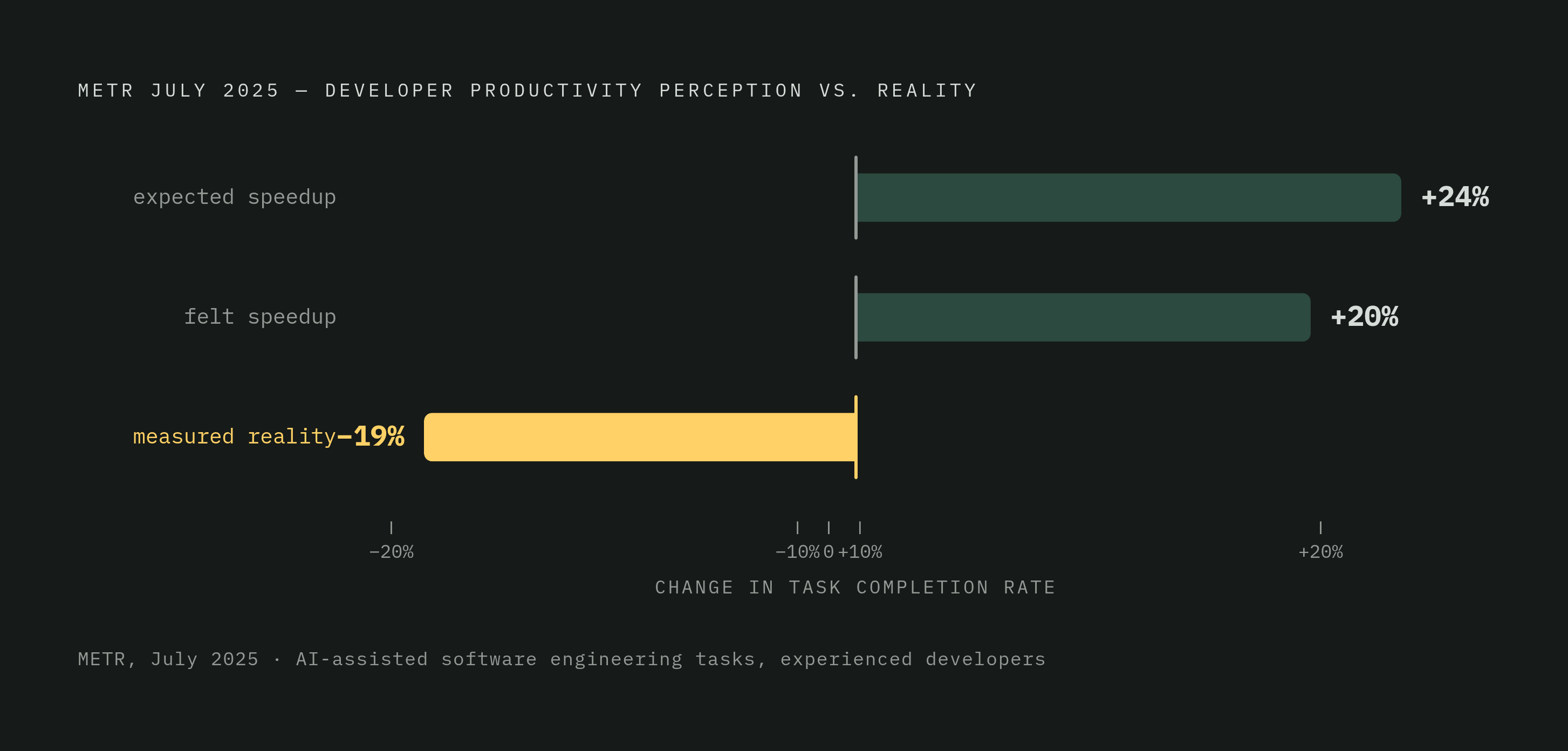
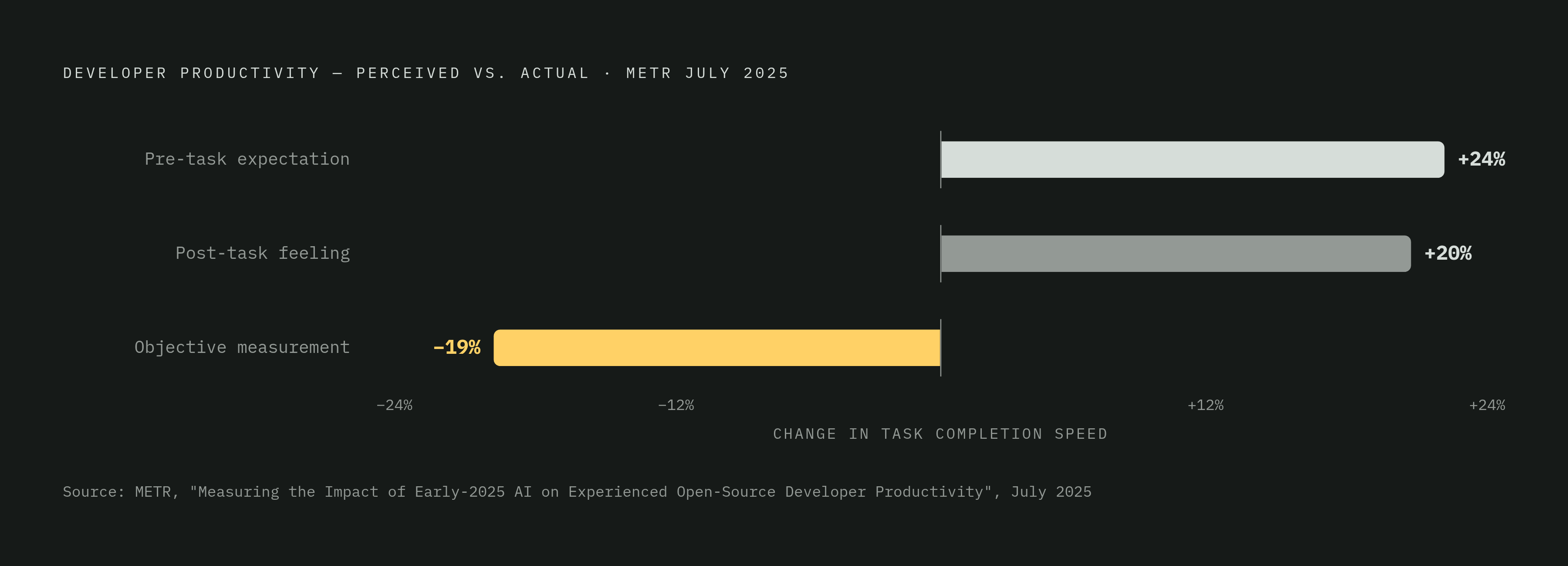
The most rigorous independent study to date (METR, July 2025) found that developers using AI tools took 19% longer to complete tasks than without. Direct inversion of expectations. But the more interesting part is the three-way split in the data:
- Pre-task: developers expected a 24% speedup
- Post-task: developers felt they'd gotten a 20% speedup
- Objective measurement: 19% slowdown
That gap between perception and reality is the thing that should keep team leads up at night. Developers felt faster while being slower. The study involved 16 developers across 246 tasks in mature repositories where developers averaged five years of prior experience. This was not a greenfield prototype situation.
Vendor-side research tells a different story. Microsoft and GitHub both report roughly 55% faster task completion in controlled settings. The divergence between those numbers and the METR result isn't a contradiction. It's informative. Lab tasks are bounded and well-specified. Real repositories are not.
A large dataset of self-reported developer experience (135,000 developers, 2025) puts average time saved at roughly 3.6 hours per week. Real, but modest.
DORA's 2025 findings add the important qualifier: individual throughput rises with AI assistance, but organizational delivery stability declines without strong engineering foundations underneath. Individual speed going up while system reliability goes down is not a trade most engineering leaders would take knowingly.
What none of this research fully captures yet is whether agentic workflows with tighter specification discipline produce different outcomes than the more vibe-adjacent usage that most of these studies were measuring. That's the open question. The data we have is useful but doesn't cleanly apply to teams doing agentic engineering well.
The specific failure modes that emerge when vibe coding moves into team settings
This is where abstract concerns become concrete problems.
Cornell University research analyzed hundreds of LLM-generated code snippets and found 25–30% contained serious security flaws across dozens of distinct vulnerability categories, including prompt injection and insecure output handling. Not theoretical flaws. The kind of flaws that ship.
And they do ship. In early 2025, apps built with the Lovable AI builder went to production with hardcoded database credentials in client-side code. Anyone who looked at the page source could find them. This is the kind of mistake a security review or SAST scan catches. But vibe coding workflows often don't have security reviews.
Amazon ordered a 90-day reset on code deployment controls after incidents in Q3 2025. Their SVP described "high blast radius changes" propagating broadly because control planes lacked safeguards. At least one incident was tied to their AI coding tool. This is Amazon. Not a small team moving fast.
Beyond security, there are subtler failure modes:
Ownership fragmentation. The committer is identifiable. But intent, generation path, dependency rationale, and review independence often are not. Responsibility spreads across whoever wrote the prompt, whatever model ran, whoever approved the PR, and whoever owns the service. Nobody is clearly accountable.
Coordination breakdown. Each developer's prompting style and model choice fragments the codebase in small ways that accumulate. Shared conventions and reviewable intent are the connective tissue that holds a multi-developer codebase together. Vibe coding systematically removes that connective tissue.
Cognitive debt. By September 2025, this term had emerged to describe systems that are technically functional but barely comprehensible. Changes get made cautiously. Incidents take longer to diagnose. The system works until something goes wrong and nobody is quite sure why anything is the way it is.
GitClear's longitudinal analysis of over 200 million changed lines (2020–2024) found refactoring collapsed from 25% of changed lines in 2021 to under 10% by 2024. Code duplication and churn rates accelerated. Developers were accepting AI output without applying the iterative improvement they'd apply to human-written code.
Meanwhile, trust in AI tools is actually declining. Stack Overflow's 2025 survey recorded only 29% of developers trusting AI tool accuracy, down eleven points from the year before. Teams are leaning on these tools more while trusting them less. That's a pattern worth paying attention to.
How agentic engineering's structure addresses what vibe coding leaves exposed
The key mechanism is the continuous feedback loop. Agents test their own work and iterate until done, rather than producing a single output for a human to accept or reject with minimal context.
Spec-Driven Development creates an audit trail by design. Teams can trace which agent generated the code, which human reviewed it, and which specification it was intended to satisfy. That traceability isn't a feature bolted on afterward. It's the architecture of how the workflow runs.
Guardrails are built into the process:
- Agents flag uncertainties and request human input for ambiguous requirements
- High-stakes actions (deploying to production, schema migrations) require explicit human approval
- This isn't the AI being paternalistic. It's the accountability structure working as designed.
Testing becomes more important in agentic workflows, not optional. The organizations getting this right treat AI-generated artifacts with the same or higher rigor as human-written code, embedding shift-left security practices directly into the agentic workflow. The agent generates. A human (or another agent, governed by a human) verifies against the spec.
Agentic engineering does not solve everything. Agents hallucinate. They introduce subtle defects. They can propagate errors faster than humans can when left unchecked. The difference is that the structure makes those errors detectable and attributable. That's what changes the outcome.
Gartner projects that by end of 2026, 40% of enterprise applications will be integrated with task-specific AI agents, up from under 5% in 2025. The organizations positioned to scale that safely are the ones that have already built review and governance into their agent workflows, not the ones that will try to retrofit accountability onto systems nobody fully understands.
How to decide which approach fits which context
The question isn't which approach is better. The question is which source-of-truth discipline the context demands.
Vibe coding fits when:
- You're solo prototyping, building a throwaway demo, or doing early product validation
- Non-developers are building internal tools with no downstream dependencies
- The artifact will be discarded or fully rewritten before it touches production
Agentic engineering fits when:
- You're building production systems with real users, SLAs, or compliance obligations
- Multiple developers need to review and attribute changes
- An incident would require tracing what changed, why, and who approved it
The transition point isn't a size threshold. It's when the cost of cognitive debt exceeds the cost of engineering discipline. For some teams that happens at a hundred users. For others it happens the first time a security vulnerability ships to a customer.
Teams can run both in parallel. Vibe code for exploration. Agentic workflows for anything that graduates to the main branch. But that separation requires deliberate gates, not assumed ones. Here's the practical checklist for that gate:
- Is there a specification the agent was working against?
- Can a reviewer reconstruct the intent without reading the full generation history?
- Are tests enforcing the spec, not just passing?
- Is there a named human accountable for the outcome?
If any of those answers is no, the work isn't ready to move out of exploration mode. Think of that checklist as a bouncer at the door of your main branch — if your code can't answer those questions, it doesn't get in.
What this distinction means for engineering roles as agent autonomy increases
GitClear's analysis of over 200 million changed lines found that 41% of code committed globally in 2025 was initially generated or suggested by AI. That number is only going up.
Tactical line-by-line coding is moving to agents. That's already happening. Human value is concentrating in three places:
- Specification quality. The precision with which goals and constraints are defined before agents execute anything. This is now a core engineering skill.
- Architectural judgment. The decisions that can't be delegated without losing accountability. Agents can implement an architecture. They can't own the tradeoffs.
- Review and governance. Distinguishing outputs that satisfy the spec from outputs that merely look like they do. This is harder than it sounds.
New roles are forming at that boundary. Knowledge architects. Agentic architects. Agent reliability engineers. The engineering equivalent of moving from individual contributor to technical lead, but with AI as the team being led.
The quiet risk is skill erosion. Heavy AI dependence weakens debugging, architecture, and problem-solving over time. Teams that vibe-code their way to seniority will execute fast but struggle with novel, complex, or high-stakes challenges that the agent can't resolve and nobody on the team has the fundamentals to untangle.
The cultural shift required is moving from "ship faster" as the primary measure to "ship with traceable intent." That's not a slowdown. It's a different definition of done. Teams that build the orchestration and governance muscles now are the ones positioned to scale agent automation as it becomes the default, rather than spending years retrofitting accountability onto systems that nobody fully understands and everyone is quietly afraid to touch.