Agent SDK Comparison for Coding Automation
Four criteria separate agent SDKs for production coding work.
Every major agent SDK dropped inside a single year, and most teams are still picking between them based on whichever one showed up on their Twitter feed last week. That's a bad way to choose infrastructure you'll be stuck with for two years. This piece runs the real options against four criteria that actually predict whether an SDK survives contact with a workflow that's gone past the demo stage.
The timeline alone is a little absurd. Open Hands, an open-source platform for running autonomous coding agents across your own infrastructure, was already in this space before the SDK wave arrived. OpenAI's Agents SDK landed in March 2025, Google's ADK in April, Anthropic's Claude Agent SDK later that year, LangGraph hit 1.0 in October. Multiple frameworks, one year, more credible options than the previous five years combined. Markets and Markets has the agent market at $7.84 billion in 2025, climbing to $52.62 billion by 2030, and that's not hype money, that's the kind of number that shows up when finance departments start asking for line items.
LangChain's 2025 State of AI Agents report found 57% of organizations already running agents in production, and the thing slowing everyone else down is quality, not cost. Pick the wrong abstraction layer and your output quality erodes quietly, long before anyone notices the bill went up too. The cost of picking the wrong abstraction layer tends to show up late and hurt more than expected, and nobody wants to be the team that finds out the hard way.
The four criteria that actually differentiate coding agent SDKs
Coding work isn't chatbot work. Tasks run long, state has to survive across sessions, and somewhere in the loop a human needs to actually look at the output before it ships. The whole thing has to talk to real tools, too: sandboxes, git, CI, IDEs. Compare frameworks without accounting for that, and you're comparing toys.
Four things actually separate these frameworks for coding work.
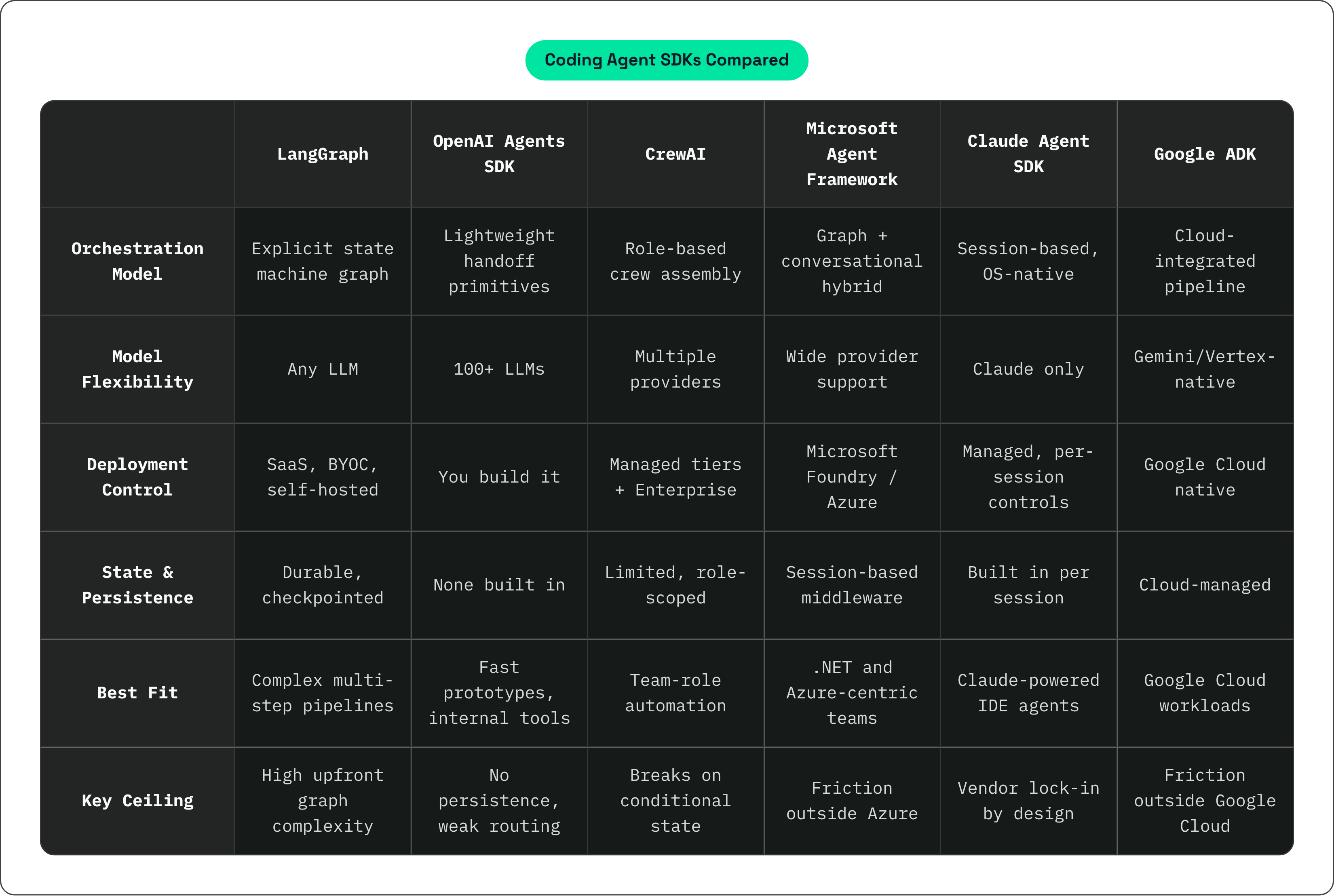
Model flexibility. Can you swap the LLM out, or are you married to one vendor whether you like it or not? This decides your cost ceiling and whether you're boxed into a corner two years from now.
Deployment control. Runs on your own servers, or does the managed version mean your code and traces sit in someone else's cloud? For regulated industries, this one's non-negotiable.
Orchestration model. Graph, conversation, role-based crew, or lightweight handoff? Whatever the framework's mental model is, that's what's easy on day one and what turns into a headache once the pipeline grows three more branches than you planned for.
Tool integration depth. How well does it plug into sandboxed execution, version control, CI, IDE plugins? Everything else is theory until this part works.
There's a fifth thing hiding under those four: how mature is this, actually? Stacking a framework that just hit GA against one that's eleven months old and still wobbling needs an asterisk, and I'll flag it where it matters.
One more thing before we get into it. Star counts and benchmark scores show up below, mostly for texture, because neither tells you much on its own. Stars measure timing and hype as much as quality; a framework launched during a slow news week looks weaker than one launched into a cycle everyone was already watching. Benchmarks get gamed, and they rarely look like your actual workflow. Use the numbers to get oriented, not to make the call.
LangGraph: graph-based orchestration for workflows that cannot afford to lose state
LangGraph crossed 126,000 GitHub stars by April 2026, pulling 34.5 million monthly downloads. Gartner found it behind 34% of agent-framework citations in production architecture docs at companies over 1,000 employees, first quarter of 2026, and that's not a toy project anymore, that's infrastructure people are betting quarters on.
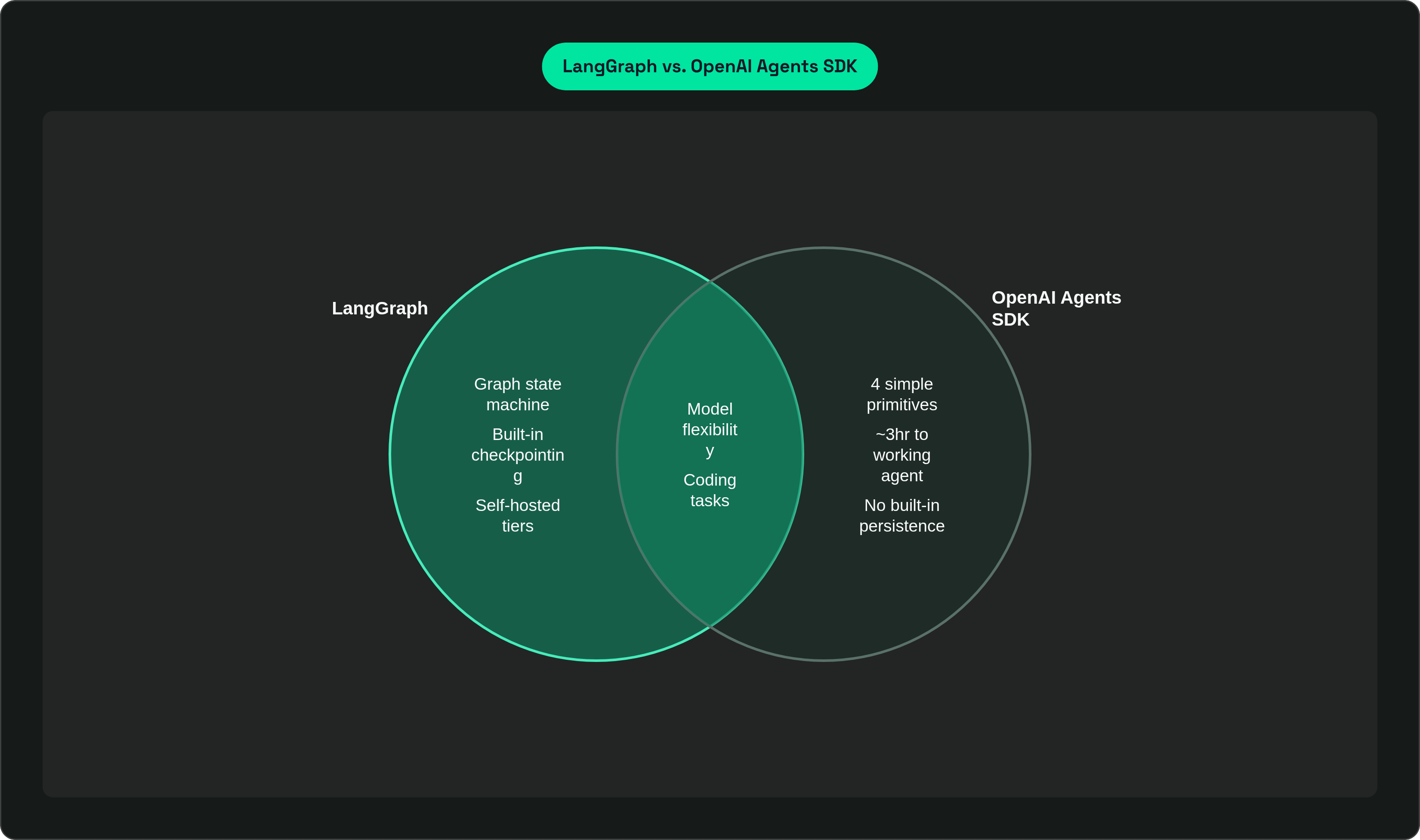
The orchestration model is a state machine, plain and explicit. Every node, every edge, every branch gets written down up front, nothing runs on a guess. Here's what that buys you: a ten-step code review pipeline that dies on step seven doesn't start over. Checkpointing saves state at every node, so it picks back up exactly where it stopped, no re-running the first six steps because step seven had an opinion about your test coverage.
Human review works the same way. Execution pauses, saves state, waits, and doesn't tie up a thread while it does, and ten seconds or ten hours, doesn't matter, it resumes exactly where it left off.
LangGraph 1.0 shipped in October 2025 and locked in four runtime pieces without breaking anything from earlier versions: durable execution, streaming, human-in-the-loop, memory management. That kind of stability is rare in this space, and most frameworks this young have already broken your code once by now.
Model flexibility comes built in, since the graph doesn't care whose LLM sits behind it. Deployment splits into four tiers: Cloud SaaS inside LangSmith, a free Self-Hosted Lite tier good for up to a million nodes, Bring-Your-Own-Cloud running in your own VPC, and Self-Hosted Enterprise. The LangSmith free tier caps at 5,000 traces a month with 14-day retention; Plus runs $39 a seat monthly for 10,000 traces. Data residency rules push you toward BYOC or Self-Hosted Enterprise, full stop, no negotiating.
TypeScript isn't bolted on as an afterthought here either. The @langchain/langgraph package matches the Python version feature for feature, state graphs, conditional edges, checkpointing and all, and it was pulling over 42,000 weekly npm downloads as of April 2026.
None of this comes free, though. The graph abstraction has real weight to it, and for a quick prototype or a simple pipeline, that weight doesn't pay for itself. Don't reach for this for a one-afternoon proof of concept; you'll spend more time drawing the graph than writing the thing it's supposed to run. But past a certain complexity, in multi-step coding pipelines where losing state mid-run actually costs you something, the math flips and LangGraph earns its keep.
OpenAI Agents SDK: fast path to a working agent, with clear ceilings
Released March 2025, the OpenAI Agents SDK crossed 26,000 GitHub stars and, despite the name on the box, works with more than 100 different LLMs. Provider-agnostic in practice, whatever the branding suggests.
Four primitives, and that's the whole design. Agents hold instructions and tools, Handoffs pass work between agents, Guardrails check inputs and outputs, Tracing watches what happened. That's it, and the philosophy here is get to a working agent fast, skip the whiteboard session where you diagram a state machine before writing a line of code.
The speed claim checks out. Analysis from openhelm.ai clocked average time to a working agent around three hours, a typical agent running roughly 180 lines of code, response latency around 2.8 seconds, handoff accuracy at 94% under benchmark conditions. For coding tasks specifically, Code Interpreter runs $0.03 a session, File Search costs $0.10 per gigabyte per day, useful for sandboxed execution, though the meter runs once you're doing this at any real scale.
Push past the prototype stage and the ceilings show up fast. No built-in persistence, so thread management is on you; a server restart mid-workflow means lost state unless you built the scaffolding yourself. Complex routing, conditional branches, retries, parallel subagents, all of it fights the framework instead of working with it, and the production track record is a fraction of LangGraph's.
Model flexibility's strong here. Deployment control is whatever you build, since there's no managed tier bundled in. The orchestration model is too light for a genuinely complex coding pipeline, but for prototypes, internal tools, coding assistants where speed of iteration beats long-term durability, it's a solid first pick, maybe the first one to try.
CrewAI: role-based abstraction that trades control for speed of assembly
CrewAI sits at 51,895 GitHub stars, 7,192 forks, 27 million PyPI downloads on the core package. According to pasqualepillitteri.it, CrewAI reached 2 billion agentic executions in the twelve months ending January 2026.
The pitch is roles instead of graphs. Define a researcher, a coder, a reviewer, group them into a crew, hand out tasks, let them sort it out among themselves. No state machine to draw. Teams report going from idea to production inside a week, and for coding automation specifically, a crew built from a code-writer, a test-generator, and a code-reviewer maps onto how a lot of real teams already divide the work.
CrewAI supports multiple LLM providers, so no vendor lock there. Pricing runs a free tier at 50 workflow executions a month, Professional at $25 a month for 100 executions plus one extra seat, Enterprise with SOC2, SSO, PII detection and masking, and uptime guarantees. Those execution caps on the cheaper tiers bite hard if you're running a pipeline continuously instead of in bursts.
The real ceiling is state management. Once your agents need to share complex state, branch on test results, or checkpoint mid-run, the role-based abstraction starts working against you. It's fast to assemble, easy to reason about, right up until the workflow logic turns conditional, and then the exact thing that made it easy is the thing boxing you in.
Microsoft Agent Framework: the enterprise path for.NET and Azure-centric teams
AutoGen sits at 55,300 stars and 8,300 forks, and it's in maintenance mode now: bug fixes and security patches, run by the community, nothing new coming. Its own README tells newcomers to go use Microsoft Agent Framework instead. It's in maintenance mode now, so that star count is measuring where people used to look, not where anyone's building now.
Microsoft Agent Framework got announced in October 2025 and hit GA in April 2026, built as the successor merging AutoGen's conversational multi-agent style with Semantic Kernel's enterprise features. It adds session-based state management, middleware, telemetry, type safety, and graph-based workflows for teams that want explicit control instead of loose conversation between agents.
Model support is wide out of the box: Microsoft Foundry, Azure OpenAI, OpenAI itself, Anthropic, Amazon Bedrock, Google Gemini, Ollama. Python and.NET both, and it's the only major framework with first-class C# support, which matters a lot if your team already lives inside the Microsoft stack and isn't going anywhere.
Deployment runs through Microsoft Foundry, with observability tooling integrated into the platform.
Here's the honest limit: step outside Azure, and the integration assumptions start adding friction instead of removing it. Inside Microsoft infrastructure, this shines, and the farther you drift from it, the less compelling the pitch gets.
Claude Agent SDK and Google ADK: specialized strengths for specific coding contexts
Anthropic's Claude Agent SDK, released June 2025, hit nearly 8,500 GitHub stars in eleven months. That pattern alone tells you who built this and who it's for.
The design leans into long coding sessions with deep OS access. Memory handling and spend controls are built in per session. Both feel built for continuous coding work, not one-off chat exchanges, and a 2026 comparison from fungies.io put task success at 84% on benchmarks.
The catch is tight coupling to Claude models. That depth of integration is the point, but it means model flexibility isn't really on the table here; if you need to swap the underlying model, look elsewhere. Where this SDK earns its spot is coding agents and IDE integrations where Claude's code reasoning is the actual product and locking into one vendor is a cost you're happy to pay.
Google's ADK, announced April 2025, sits at 20,000 GitHub stars and 3.3 million monthly downloads. It integrates tightly with Gemini and Vertex AI, an easy call if you're already running workloads in Google Cloud, friction for everyone else. The learning curve reflects those cloud assumptions, and teams outside Google's ecosystem will feel the friction.
Both frameworks follow the same shape: strong, sometimes excellent, inside their own ecosystem, boxed in on model flexibility by design. Neither one pretends otherwise. The lock-in is the pitch and the limit, same coin, different side.
Smolagents and the case for minimal frameworks in single-agent coding scripts
Smolagents, built around a code-first approach to tool use, is a lightweight framework from Hugging Face.
For debugging, that's a real win. Code is easier to read than a JSON blob, easier to step through line by line, faster to set up for a quick script. Coding automation is a natural fit here, since the agent's output already is code, and the execution trace looks like a normal Python script instead of a log file you have to decode.
This is the right tool for automation scripts, research workflows, single-agent jobs where a graph or a crew configuration would just add ceremony without adding anything you'd actually use. Smolagents was never built for multi-agent coordination, long-running stateful pipelines, or enterprise deployment, and it doesn't pretend to be. Reaching for it there is a mismatch on the user's end, not a flaw in the tool.
Small tool, right job, that's the whole trick. Bringing a chainsaw to cut a sandwich doesn't make you more capable, it just makes lunch harder.
Open-source, self-hosted agent platforms as an alternative to SDK-level choices
Everything above assumes your team is writing the orchestration logic by hand: wiring up nodes, or crews, or handoffs, one by one. For some teams, that's the wrong place to start.
Self-hosted, open-source agent platforms exist for teams that want the control of running their own infrastructure, full data residency, no vendor deciding where your logs live, without writing the orchestration layer from scratch every single time. Instead of picking an SDK and building a pipeline on top of it, these platforms hand you a working system out of the box, and you configure and extend from there.
The tradeoff points the other way from everything above. You give up some of the fine control you'd get from hand-coding a LangGraph state machine or a CrewAI crew, and in return you get something running sooner, with most of the infrastructure decisions already made.
Depends on the team, honestly. A group with strict data residency needs and a small engineering headcount probably gets more out of a self-hosted platform than out of hand-building a custom LangGraph pipeline, while a team running highly specific, conditional coding workflows still wants the control that only writing the orchestration yourself gives you. Pick based on what the workflow actually needs, not on which name showed up in your feed this week.