Multi-Agent Architecture Patterns for Engineering Teams
How to structure multiple agents so they actually work in production.
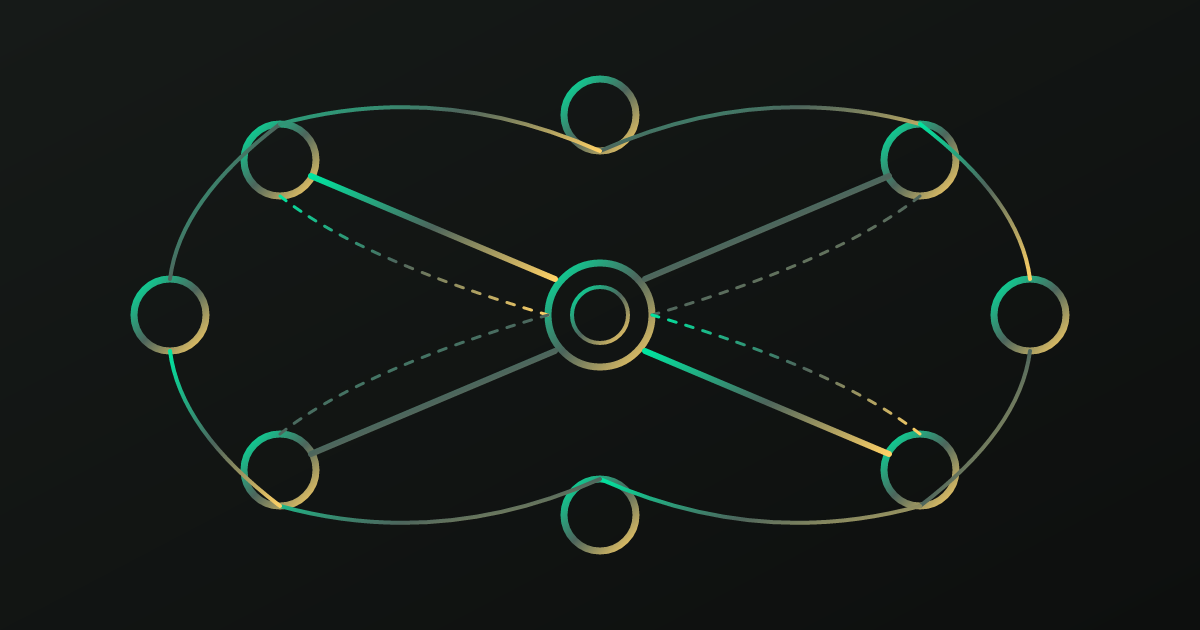
Multi-agent architecture is a small set of structural patterns, and most engineering teams pick one without ever comparing it to the alternatives. This piece is about which shape to build them into, not just whether to use multiple agents.
The research backing this up piled up fast, and so did the money behind it. O'Reilly Radar tracked agentic systems papers go from 820 in 2024 to over 2,500 in 2025. Gartner logged a 1,445% jump in multi-agent inquiries between Q1 2024 and Q2 2025. Companies running agents in production average 12 per org, and that's set to climb 67% in two years. This is production load now, and production load doesn't forgive a bad architecture the way a demo does. A demo just needs to work once, in front of the right people, at the right angle.
What multi-agent systems actually do better than a single capable model
A single agent handles a bounded task just fine. Ask it to specialize, run things in parallel, or stay reliable across a long chain of steps, and it starts to buckle. Kind of like one very busy person who eventually drops a ball no matter how many sticky notes they've got.
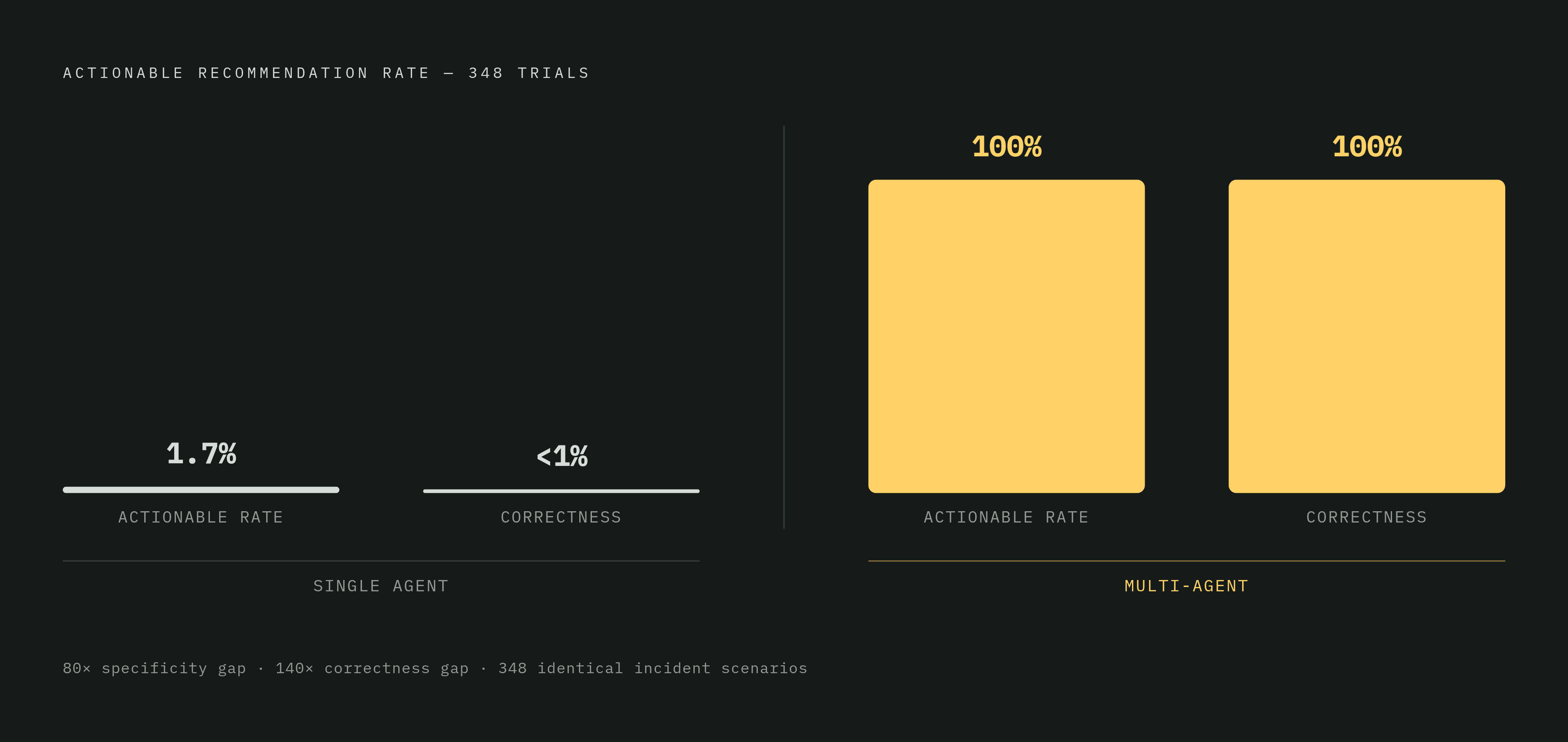
There's a comparison worth sitting with here: 348 trials, same incident scenarios, single-agent versus multi-agent. Multi-agent systems hit a 100% actionable recommendation rate. Single agents hit 1.7%. That's an 80x gap in how specific the actions were, and 140x in how often the answer was actually right.
The part that matters if you're the one running the business is the zero variance, more than the peak number. Consistent output is what lets you write a service agreement in the first place, and nobody signs one of those around a system that's brilliant on Tuesday and useless by Wednesday afternoon.
One bank split agents across documentation, generation, review, and testing during an early pilot, and cut development time by more than half. That gain came from parallel execution killing a sequential bottleneck, not from cleverer prompts. Which points to the actual mistake most teams make: when agents underperform, the first instinct is always to rewrite the prompt. O'Reilly Radar calls this the prompting fallacy, and it's basically yelling louder at someone who doesn't speak your language. The structure is the problem, more often than the words.
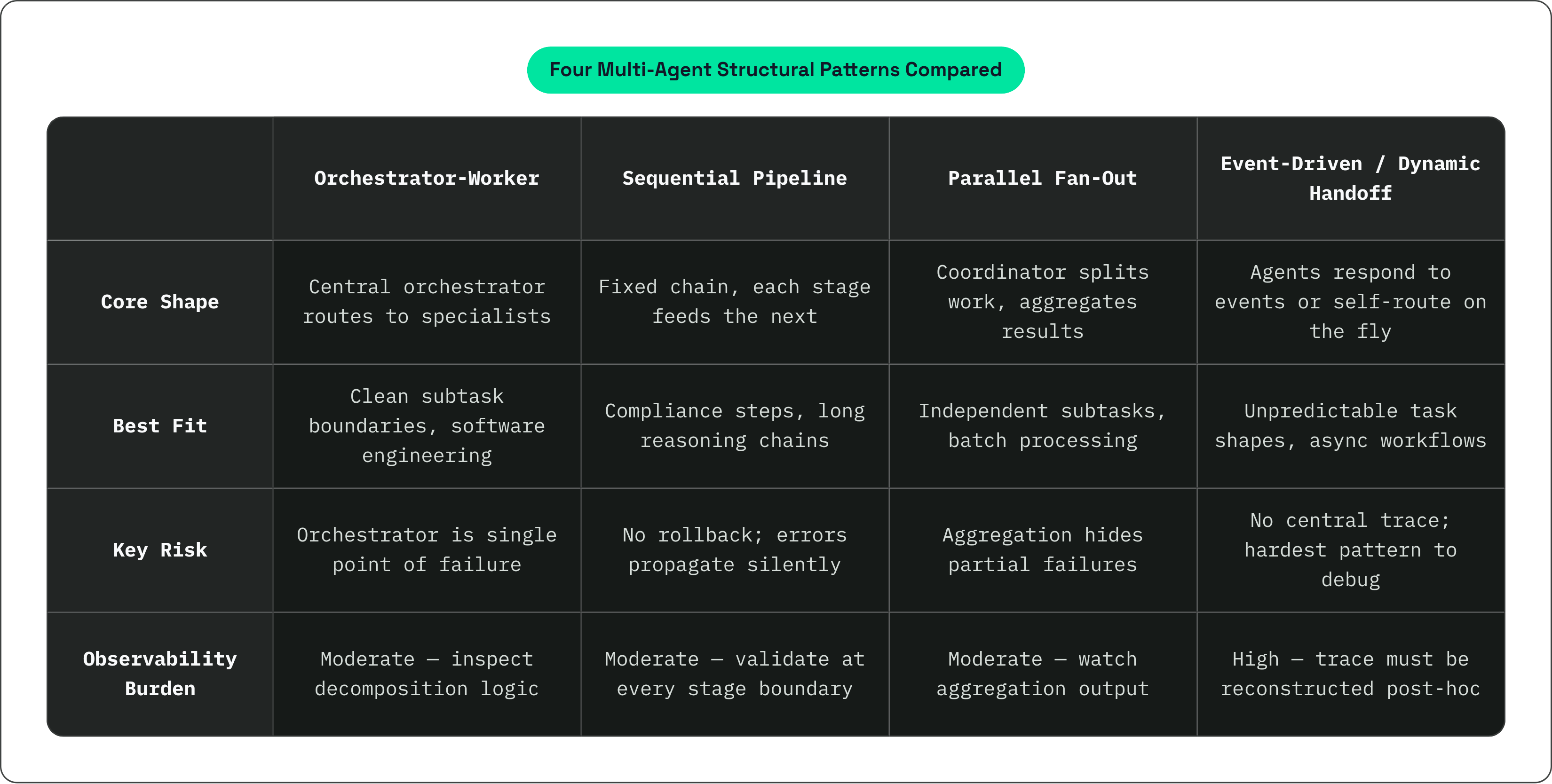
The four structural patterns that appear repeatedly in production
Quick gut check before we go further. If a "supervisor" agent still makes every decision and the specialists just carry out orders, that's one brain with a few extra sets of hands, more than a true multi-agent system in spirit. Most of what got labeled "multi-agent" through 2025 and into 2026 is this kind of delegated workflow, not true peer coordination, and that distinction matters for how you should read the wins below.
Whatever pattern you pick decides three things before a single line of business logic runs: where the observability boundaries sit, where failures get contained, and how much coordination overhead you pay on every task.
Four patterns cover most real deployments: orchestrator-worker, sequential pipeline, parallel fan-out, and event-driven or dynamic handoff. Debate and critique systems show up too, and they're real, but they work better bolted onto one of the four than standing on their own. Let's take them one at a time.
Orchestrator-worker: the right default for most software engineering tasks
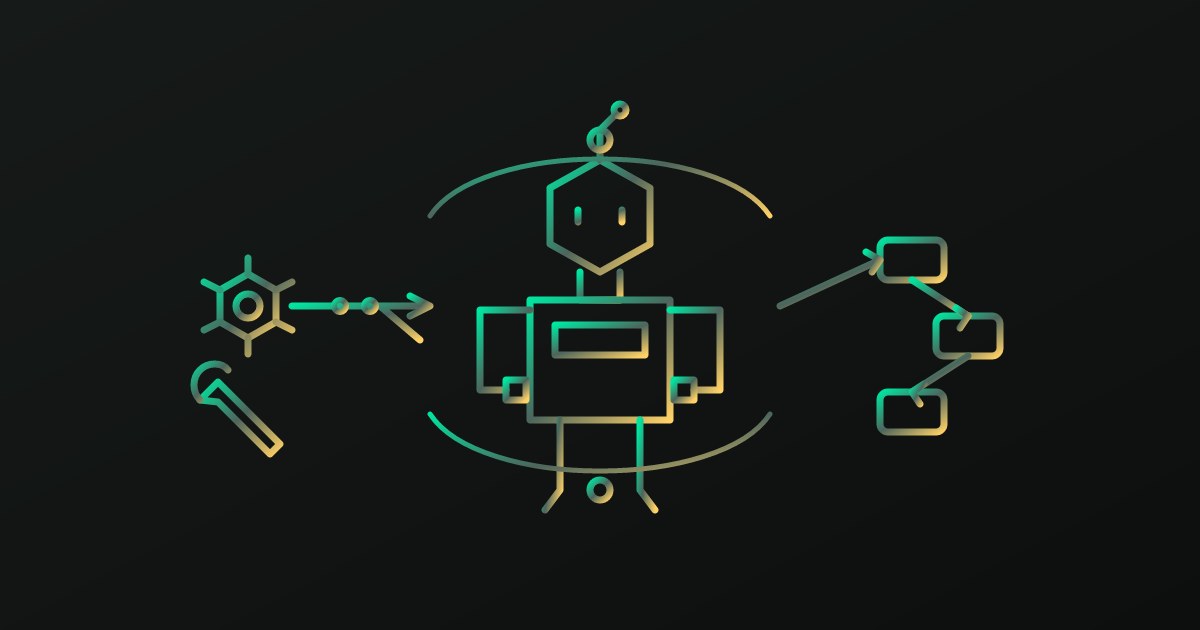
One orchestrator gets the task, splits it into pieces that don't overlap, hands each piece to a specialist, and stitches the results back together. That's the whole pattern, and it's less complicated than it sounds.
The cost setup is deliberate. Put a capable, expensive model at the orchestrator level, and cheap, task-specific models at the worker level. Teams doing this see costs drop 40 to 60% versus running one large model for everything. Same logic as not hiring a surgeon to change a lightbulb.
Wells Fargo is a good real-world case here. 35,000 bankers can now pull from 1,700 procedures in 30 seconds, down from 10 minutes. The orchestrator handles the routing, so no individual banker has to memorize which specialist covers what.
This pattern fits best when subtasks have clean edges and workers can run independently without constant back-and-forth. Where it breaks: the orchestrator becomes both the bottleneck and the single point of failure. Get the decomposition wrong, and every worker downstream executes flawlessly on the wrong problem, fast and confidently, which is somehow worse than just failing slowly.
So the decomposition logic has to be inspectable. Treat the orchestrator like a black box and you lose the ability to diagnose routing errors when they show up, and they will show up. This is also where model-agnostic deployment starts to matter. OpenHands, for instance, lets teams assign different models to the orchestrator and the workers without locking into one vendor's pricing, which keeps this pattern flexible instead of turning into a subscription you can't leave.
Sequential pipeline: when order of operations is the constraint
Here, agents run in a fixed line: Planner, then Researcher, then Writer, then QA, each one eating the last one's output. Communication usually runs through a message broker like Kafka or Redis Streams, so the broker is the coupling point, not a direct line between agents.
This shape fits distributed teams working across time zones, long reasoning chains where each stage genuinely needs the last one finished, and workflows with compliance checkpoints built into the process itself.
The catch: if step three produces garbage, step four inherits garbage, and there's no natural rollback. Unlike orchestrator-worker, nobody's watching the middle of the chain for bad output. So every stage boundary needs an explicit contract, a plain definition of what counts as acceptable, before the next agent is allowed to touch it.
Pipeline thinking also has a sneaky failure mode. It tempts teams into treating the whole chain as one workflow, which hides problems until they surface three or four steps later, nowhere near where they actually started.
Parallel fan-out: partitioning work when subtasks are independent
A coordinator sends out identical or partitioned subtasks to several workers at once, then aggregates once everyone's done. Picture ten people each reviewing a different chapter of the same manuscript at the same time, instead of one person reading the whole thing start to finish while everyone waits.
This differs from debate systems in one key way. Fan-out scales with the number of distinct subtasks, not the number of opinions on one question. Each worker is doing genuinely different work, not re-arguing the same one from a different angle.
It's a natural fit for parallel code review across modules, batch document processing, scanning data shards, or running independent test suites at the same time.
Where fan-out quietly fails is the aggregation step. If the reducer can't handle a partial failure or two conflicting outputs, the whole batch comes back looking clean while actually being wrong underneath. Cost also scales with volume in a way that surprises teams who only benchmarked a single task, since fan-out at scale multiplies token spend fast. It pairs well with orchestrator-worker, though, where the orchestrator decides when to fan a task out versus route it step by step.
Event-driven and dynamic handoff: when agents need to respond to what's happening, not what was planned
Two related setups live here. Event-driven systems have agents subscribed to event streams, waking up when something relevant fires. No fixed routing, no pre-planned order. That fits CI/CD triggers, incident response, repository monitoring, anything that's asynchronous by nature.
Dynamic handoff (sometimes called a swarm) works differently. Each agent looks at the task in front of it and decides, on the spot, whether to handle it or pass it to someone better suited. Only one agent is active at a time, and coordination just kind of happens without anyone directing traffic.
HCLTech reported 40% faster case resolution using dynamic handoff. The gain comes from skipping the round-trip to a central coordinator every time a decision needs routing.
The tradeoff is steep on the observability side, maybe the steepest of any pattern here. No coordinator means no single place holds the full execution history, so reconstructing what went wrong after a failure means piecing together a trace that was never centrally recorded to begin with. Event-driven setups bring their own headache too: agents can miss events, process them out of order, or double-process if the broker delivers at-least-once, so every consumer needs idempotency built in explicitly, not assumed.
Both approaches suit work where you genuinely can't predict the shape of the task ahead of time. They do demand more upfront investment in logging and tracing than anything else on this list, though. Continuous agent operation, the kind that keeps running across time zones without a human handing things off, is exactly where dynamic handoff earns its cost.
Where debate and critique systems earn their place — and where they don't
Same question, multiple agents, disagreement gets surfaced, and someone (or something) adjudicates. The goal is catching the mistake a lone agent would just nod along to.
The upside is measurable. The Reflection pattern alone can push coding benchmark accuracy from 80% up to 91%.
But five rounds with three agents means 15 LLM calls for one task, and latency and spend multiply with every extra round. This isn't something you run on every ticket that lands in the queue.
There's a sharper failure mode hiding underneath the benchmark gains, too: agents tend to converge on the majority view even when the majority is wrong, and a unanimous wrong answer is much harder to catch than one hedged, uncertain answer from a single model. Confidence isn't correctness. A room full of agents nodding along together can be just as wrong as one agent guessing alone, it just sounds more convincing.
Use it where being wrong is expensive and the volume is low: security review, architecture decisions, compliance checks. Skip it for high-volume routine work, where the extra rounds cost more than the accuracy bump is worth. Most teams that use this well treat it as a quality gate bolted onto an orchestrator-worker system, not as a standalone architecture in its own right.
How communication protocols shape what's actually possible across these patterns
Three protocols matter here, and they sit at different layers instead of competing head-on.
MCP, from Anthropic (November 2024), standardizes how agents reach external tools. That's the tool-access layer. It's grown to over 9,400 published servers, and monthly SDK downloads hit 97 million by March 2026, up from 100,000 at launch. That's the kind of curve that tells you the spec settled.
A2A, from Google (April 2025), handles the coordination layer, agent-to-agent communication. Over 150 organizations back it now, including Google, Microsoft, AWS, Salesforce, SAP, ServiceNow, and IBM, with enterprise adoption in the low double digits as of April 2026.
ACP, from IBM and BeeAI, merged into A2A under the Linux Foundation in September 2025. Worth knowing as history, but not something new deployments need to weigh anymore.
The way to keep this straight: MCP connects agents to tools, A2A connects agents to each other. Different problems, and most real systems end up using both. For teams starting fresh today, MCP is the practical first move; it's got the server count, a stable spec, and broad tool support already. A2A becomes relevant the moment agents from different vendors need to talk to each other directly.
Real deployments already show where this is headed. Salesforce's Agentforce exposes custom agents as A2A endpoints. SAP's Joule orchestrator hands off to partner agents across S/4HANA. Both are orchestrator-worker and dynamic handoff patterns, just stretched across company lines instead of staying inside one org.
The risk worth naming plainly: wire your orchestration logic tightly into one vendor's coordination layer, and adding agents from a different system later gets expensive fast. Staying model-agnostic and protocol-aware from day one beats betting the whole architecture on one company's roadmap.
The failure modes that show up regardless of which pattern a team picks
40% of multi-agent pilots fail within six months of going into production, and that failure rate isn't clustered in one pattern. It shows up everywhere, across every shape covered above.
The MAST-Data dataset (Cemri et al., 2025) looked at over 1,600 annotated execution traces across seven popular frameworks, including AutoGen, ChatDev, and CrewAI, and mapped 14 distinct failure modes across three buckets. Specification and system design failures cover bad task routing, weak error handling, resource contention. Inter-agent misalignment covers communication breakdowns, conflicting goals, coordination that just doesn't happen. Task verification and termination failures cover missing validation, missing quality checks, errors that propagate unchecked.
That propagation piece is what makes multi-agent failure different from single-agent failure. An unclear output from Agent A becomes a broken input for Agent B, and by the time anyone notices, the execution graph spans several agents, and tracing the root cause means walking backward through every one of them.
The hardest failure to catch is the quiet one: agents don't crash, they just produce subtly wrong output that sails through downstream validation and compounds into a final answer nobody flagged. Studies on ML systems broadly show most experience performance degradation over time; drift creeping into model behavior means a system that passed every test on day one can go sideways by month six without anyone watching it happen.
And the failure modes map cleanly onto the patterns covered above: pipelines propagate errors with no rollback, fan-out hides partial failures behind aggregation, dynamic handoff makes blame nearly impossible to trace, and debate systems can produce confident consensus on the wrong answer.
What observability actually requires in a multi-agent system
Log lines and basic error rates, the tools built for single-agent systems, don't cut it here. You need distributed tracing that follows a task across agent boundaries, not just inside one agent's own head.
The minimum setup looks like this: per-agent execution traces with timestamps, inputs, outputs, and every tool call logged; cross-agent correlation IDs so any single task can be reconstructed start to finish; output validation sitting at every agent boundary, not just at the end of the chain.
Skip any one of these and you're debugging a multi-agent failure with single-agent tools, which is a bit like hunting for a leak in a building's plumbing by only checking the faucet. The leak's in the walls somewhere, and tracing the whole pipe matters far more than admiring the tap.