Chain of Thought Prompting Effects on Agent Reasoning Quality
Errors early in an agent's reasoning chain compound through every subsequent step.

An AI agent that gets step 2 wrong doesn't just get step 2 wrong. It drags that mistake into step 3 as a bad tool call, wastes step 4 on an observation that never had a chance of being useful, and lands on a wrong final answer by step 8. That's the real stakes of chain-of-thought (CoT) prompting in agent systems, and it's why the technique deserves more scrutiny than "just add it, it can't hurt." Wei et al. introduced CoT back in 2022 as a way to get models to show their intermediate work before answering. The mechanism is simple: force the model to generate reasoning tokens before its final answer, and each of those tokens gets to condition the next one, turning a single forward pass into something closer to a scratchpad.
That scratchpad has a second benefit beyond accuracy: it's legible. A model that writes "I think X because of Y" gives a reviewer something to check at the "because of Y" step. A model that just outputs "X" gives nobody anything to check. This is the entire basis for step-level evaluation, agent debugging, and any guardrail that claims to catch bad reasoning before it becomes a bad action.
In agent systems, that legibility carries more weight than it does in a one-shot question-and-answer exchange, because agents don't make one decision. They make a chain of them, each built on the last. Benchmarks built for this era reflect the shift: τ-bench, SWE-Bench Verified, GAIA, and OSWorld all score whether the agent finished the task correctly, not whether its internal trajectory made sense along the way. That's a meaningful gap. An agent can complete a task through a reasoning chain that's partly broken and still get marked as a pass. The benchmark tells you the agent succeeded this time without telling you whether it'll succeed on the next slightly different input. Treating CoT as a default setting, something you bolt onto every prompt because it worked once, papers over exactly the kind of fragility that benchmarks built on final-state correctness can't see. CoT is a lever you pull deliberately, for specific tasks, on specific models, inside specific pipelines. Pulling it in the wrong place adds cost and latency without buying any of the reliability you were hoping for.
Where CoT reliably improves reasoning
CoT produces reliable gains on some tasks and none on others. They show up reliably on multi-step math, symbolic logic, code debugging, and multi-hop question answering, tasks where the answer genuinely depends on getting a sequence of smaller steps right in order. They mostly disappear on simple retrieval, classification, and any task that doesn't have that compositional structure. Worse than disappearing, on some of those simpler tasks CoT can make things worse: more latency, more tokens, and no corresponding bump in quality.
Sprague et al. ran a large-scale meta-analysis in 2025 covering a wide range of papers, datasets, and models, and the pattern held up: consistent improvement on math and symbolic reasoning benchmarks, flat or negligible improvement on everything without that symbolic backbone. On several non-symbolic tasks, a model that just answers directly performs about as well as one that's been told to think step by step first. CoT helps when a task has real structure to reason through and does little when it doesn't.
Model size changes the picture again. CoT behaves like an emergent ability: it barely helps small models at all and only starts producing large accuracy gains once a model crosses somewhere around 100 billion parameters. Below that line, models tend to produce reasoning chains incoherent enough to hurt accuracy. CoT is at its least reliable on exactly the models that can least afford unreliable reasoning. Subproblem decomposition methods, such as a technique called "Trace-of-Thought" tested on a smaller Llama 2 model, can recover real accuracy gains on tasks that model has historically struggled with, even without crossing that scale threshold. So model size predicts plain CoT's value, but it doesn't predict the value of every reasoning technique built on top of it.
How the 2026 reasoning-model landscape split CoT into two distinct regimes
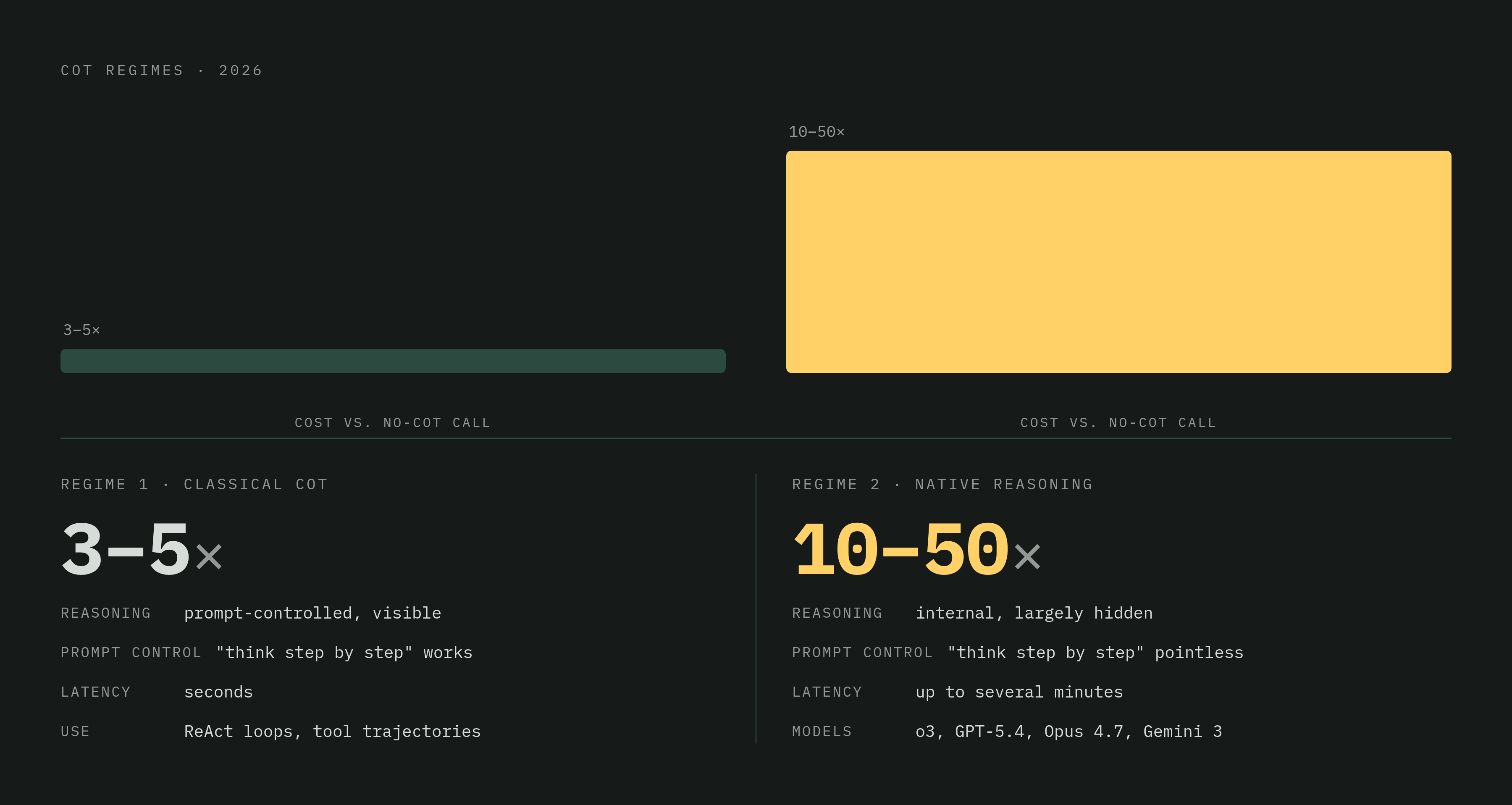
The rise of native reasoning models turned one engineering question, "should this call use CoT?", into two separate questions with two separate answers, depending on which kind of model is answering the call. Treating both regimes the same way is a fast route to wasted tokens and degraded output.
Regime 1 is classical CoT running on standard, non-reasoning models. Here, the reasoning happens in the visible response, and it's controlled entirely by prompt text, things like "think step by step" or a handful of worked examples. It costs 3 to 5 times the output tokens of a no-CoT call, and in exchange you get the entire trace available for evaluation. This regime is still the standard setup for non-reasoning open-weight models and cost-optimized routing, and it still earns its keep inside tool-use trajectories and ReAct loops, where an agent's reasoning needs to be auditable one step at a time.
Regime 2 is native reasoning models. As of May 2026, frontier models including o3, GPT-5.4 Thinking, Claude Opus 4.7 thinking-mode, and Gemini 3 Ultra deep-think do extended reasoning internally, often spending anywhere from 30 seconds to several minutes on a single query, and most of that internal chain never reaches the user. On these models, manually prompting "think step by step" is usually pointless. OpenAI's own guidance says as much: telling a reasoning model to think step by step is unnecessary, and pushing it to reason even more can actually hurt performance. Cost here runs 10 to 50 times a no-CoT call, and reasoning-mode requests on frontier models routinely take an order of magnitude longer than a standard chat completion.
The practical control surface in 2026 moved away from prompt tricks entirely and into API parameters that set a reasoning budget directly. Route easy queries to a non-reasoning model, or to a low-effort setting, and save the expensive reasoning budget for queries that have actually demonstrated they need it. Spending 50 times the tokens on a question a smaller model could answer correctly in one pass is an invoice nobody asked for.
The four CoT variants and their token cost
Once you've decided CoT belongs in a given call, the next decision is which version of it to use, and that choice is really a trade between token cost and reliability, not a matter of picking the "more advanced" technique by default.
Zero-shot CoT is the plainest version: append "Let's think step by step" (or something equivalent) with no examples attached. It's cheap, the prompt stays short, and it's a reasonable default starting point for general reasoning tasks on non-reasoning models. On reasoning-model APIs, this technique is mostly obsolete, replaced by a reasoning-effort or budget-tokens parameter that does the same job more precisely.
Few-shot CoT adds worked examples that show the model the specific reasoning pattern the application needs. It costs more tokens per call because the prompt itself is longer, and it earns that cost in domain-specific work where the acceptable reasoning pattern isn't obvious to a general-purpose model, things like financial analysis, medical triage, or legal analysis. Example quality is the whole game here, since weak examples teach the model a weak reasoning path, and it'll follow that path faithfully all the way to a wrong answer.
Self-consistency samples several reasoning paths for the same question and takes a majority vote on the final answer. It's the most reliable lever for pushing accuracy up, and the cost is proportional: run five samples, pay five times the latency and tokens. The original 2022 chain-of-thought research found that stacking self-consistency on top of CoT reached 74.4% accuracy on grade-school math problems, a solid jump that came paired with a real multiplier on cost.
Tree-of-Thoughts takes CoT's linear chain and turns it into a branching tree, exploring several reasoning paths at each step and evaluating which ones are worth continuing. It burns through significantly more model calls than any of the above, so it belongs on problems where there genuinely are multiple valid approaches worth exploring, game-playing, design work, creative planning. It has no business running on a latency-sensitive or cost-sensitive production endpoint. Using Tree-of-Thoughts to answer a yes-or-no customer support query is like hiring a committee to decide what to have for lunch.
How CoT behaves differently inside multi-agent and multi-step pipelines
Inside a single model call, a reasoning mistake is contained. Inside a multi-agent pipeline, it spreads. One agent's flawed reasoning step gets handed to the next agent as settled fact, not as a hypothesis to double-check, and that's the mechanism that makes early mistakes so much more expensive than late ones in these systems.
Late-Stage Fragility is the pattern where errors appearing in final reasoning steps turn out to be statistically harder to correct than errors appearing early. Once a pipeline has built several steps on top of a bad assumption, undoing the damage means unwinding a lot of downstream work, not just patching one line. The ReAgent framework, presented at EMNLP 2025, tackled this directly by letting agents backtrack to earlier valid states whenever a conflict turns up, isolating the bad assumption and fixing it there. Tested across three multi-hop QA benchmarks, ReAgent beat forward-only baselines consistently and made the resulting reasoning easier to inspect along the way.
Standard CoT is one linear chain, and that linear structure treats abductive, deductive, and inductive reasoning steps the same way. It just treats them all as the same kind of "next token," even though inferring a likely cause, deriving a certain conclusion, and generalizing from examples are three different kinds of reasoning that can fail in three different ways. That's a real structural weakness once tasks get complicated. Theorem-of-Thought (ToTh), developed by researchers at Texas A&M University, Texas A&M University at Qatar, and Hamad Bin Khalifa University, addresses it by running three parallel agents, one simulating abductive reasoning, one deductive, one inductive, and having them collaborate instead of forcing everything through a single chain. Each agent builds its reasoning into a formal graph, and a method called Bayesian belief propagation, guided by natural language inference, scores how coherent each step is; the most coherent graph wins and produces the final answer. Tested on the WebOfLies and MultiArith benchmarks, ToTh beat standard CoT, self-consistency, and CoT-decoding across multiple models, and it did so while leaving behind a reasoning chain that's actually interpretable, a trace someone could follow and check.
That interpretability matters most in ReAct-style and plan-and-execute agents, where CoT isn't a nice-to-have wrapper around the task but the substrate the whole loop runs on. Every tool call gets preceded by a reasoning step, and every observation that comes back feeds into the next round of reasoning. In that kind of loop, the quality of the reasoning trace is a production signal in its own right, not just a debugging aid you check after something breaks. An agent that completes a task on a flawed reasoning chain hasn't proven it's reliable. It's proven it got lucky this time, and the same flaw is sitting there waiting for a slightly different input to expose it.
Why the visible reasoning trace is not a reliable window into what the model did
A reasoning trace that reads clearly and sounds logical is not proof that the model actually reasoned its way to the answer it gave. Models can reach the right answer through a shortcut that has nothing to do with the steps written out on the page. The trace you're reading can be a plausible-sounding story.
Researchers at Michigan State University and Anthropic built a framework for testing exactly this, CoT faithfulness, and found that models can rely on shortcuts running straight from prompt to answer, bypassing the reasoning chain they display entirely. When that happens, the visible trace is decorative, sitting there looking like an explanation without explaining anything. That distinction matters enormously for anyone using these traces to debug a system, audit a model, or sign off on deployment in a high-stakes setting, because none of that work holds up if the trace it's based on was never connected to the actual computation.
The problem compounds in an unfortunate direction. Cheng et al., in ACL Findings, found that more elaborate CoT traces make hallucinations harder for humans to spot. The more detailed and confident the reasoning looks, the less likely a reviewer is to catch the error buried inside it, and several hallucination-detection methods lose effectiveness as a direct result. A long, fluent, well-organized trace reads as credible on its face, and that credibility makes a reviewer less careful.
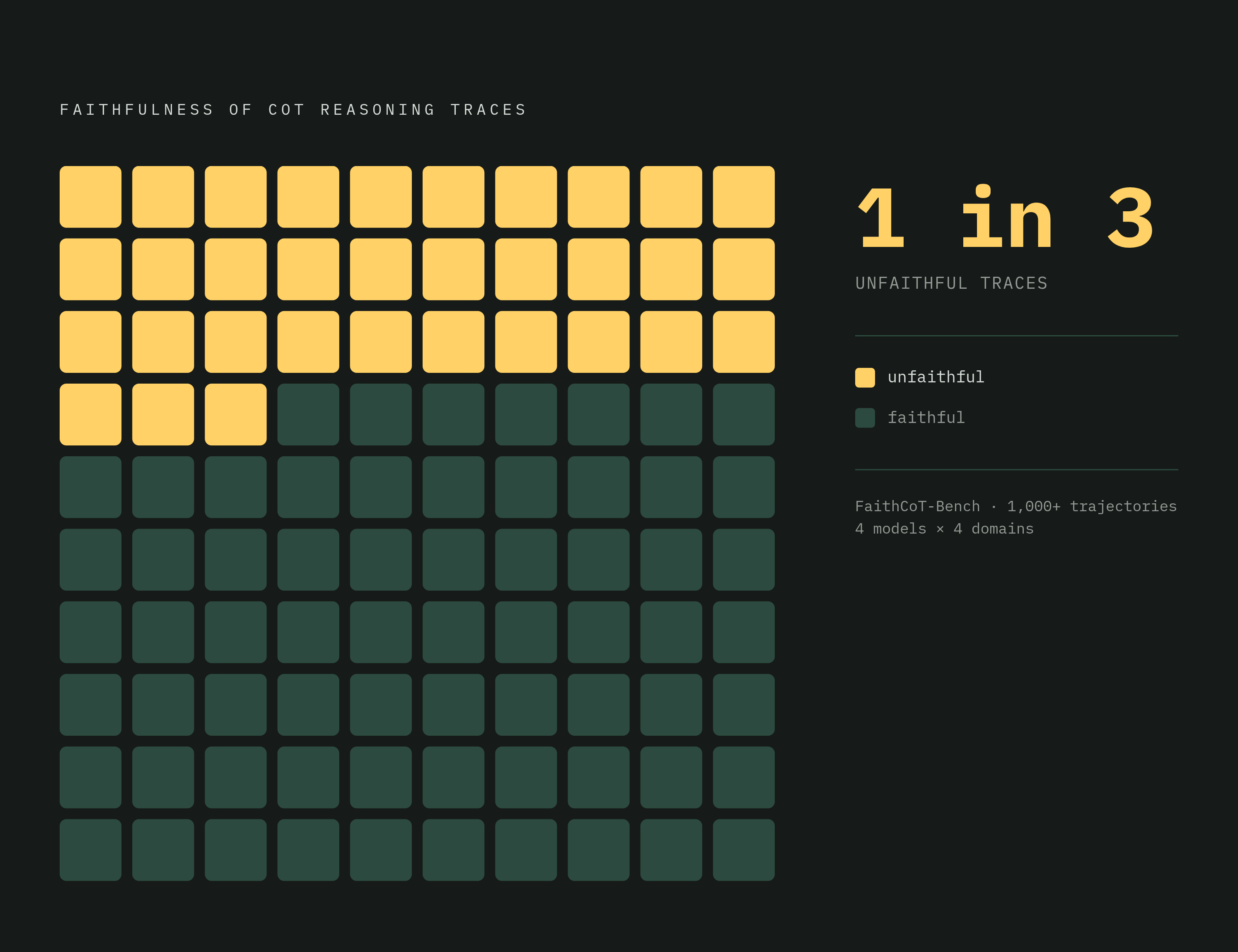
A 2026 ICML paper, "Chain-of-Thought Reasoning In The Wild Is Not Always Faithful," confirmed this isn't a rare glitch: reasoning traces are frequently unfaithful, and a model's final answer often doesn't line up with the intermediate steps it showed along the way. FaithCoT-Bench, introduced at ICLR 2026, put a number on how often. Its FINE-CoT component is an expert-annotated set of over 1,000 trajectories pulled from four representative models across four domains, and inside that set, reviewers identified more than 300 unfaithful instances, each with its own specific, documented cause. That's roughly a third of examined cases where the reasoning on display and the reasoning actually driving the answer were two different things, the clearest argument available for treating every CoT trace as a claim to verify.
Sources
- Theorem-of-Thought: A Multi-Agent Framework for Abductive, Deductive, and Inductive Reasoning in Language Models
- Technical Report: The Decreasing Value of Chain of Thought in Prompting - Wharton Generative AI Labs
- Chain-of-Thought Prompting Obscures Hallucination Cues in Large Language Models: An Empirical Evaluation
- FaithCoT-Bench: Benchmarking Instance-Level Faithfulness of Chain-of-Thought Reasoning
- Measuring and curing reasoning rigidity: from decorative chain-of-thought to genuine faithfulness