AI Coding Assistants With In-Browser Execution Environments
WebAssembly and Node.js emulation let coding happen entirely in your browser.

Most tools people call "AI coding assistants" don't actually run your code. They write it, then ship it off to a server somewhere to get executed, and send the results back to your screen. You write, run, and debug code inside the browser tab itself, and no remote machine is involved at any point.
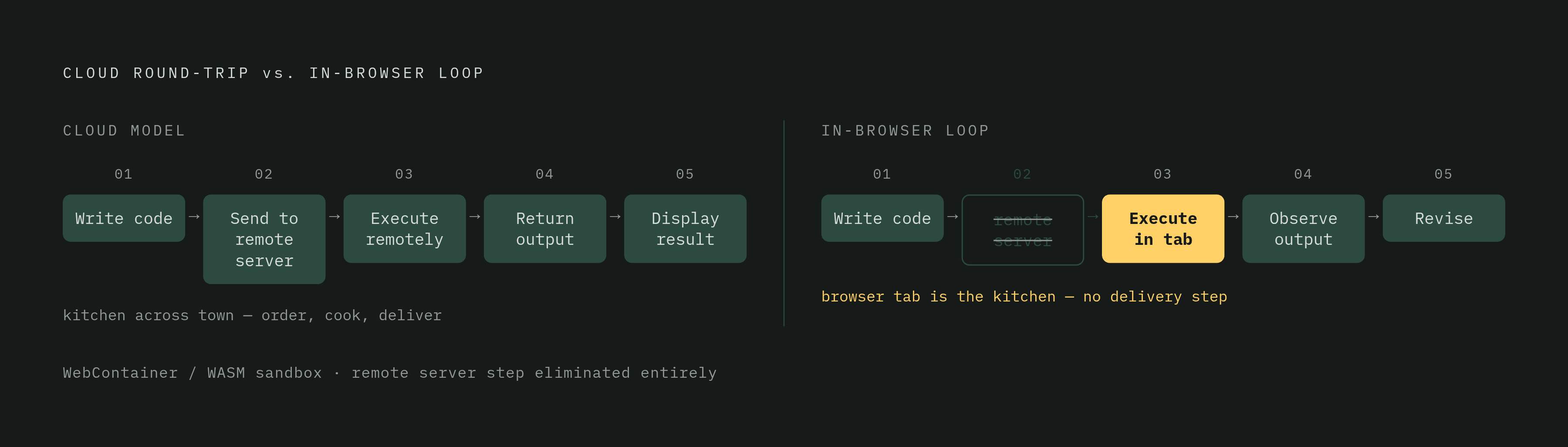
Picture the usual setup like ordering takeout. You place the order (write the code), it goes to a kitchen you can't see (a cloud server), and eventually a bag shows up at your door (the output). The browser, in that picture, is just the delivery app. It displays things, but it doesn't cook anything.
In-browser execution flips that. The browser tab becomes the kitchen. The code runs in the same process as the editor you're typing into, with no delivery driver, no kitchen across town, no waiting on traffic.
The trick that makes this possible is WebAssembly, usually shortened to WASM. WASM gives the browser a sandboxed environment, and it can run code close to native speed, down at the level of individual instructions, without needing the kind of OS-level access a normal program would need. It's a parallel track to how browsers normally work, built for speed and isolation at the same time.
Python got the same treatment through a project called Pyodide, which ports CPython (the standard Python implementation) into WebAssembly so Python itself can run inside the browser sandbox. Same mechanism, different language. That detail matters because it shows this is a pattern that extends beyond JavaScript to other runtimes, and it sets up everything that follows: what these tools can build, how fast they can iterate, and where they hit a wall.
How WebContainers and WebAssembly make full-stack in-browser execution possible
It took real work to get a browser tab to behave like a full development machine, and it wasn't quick. Turning a browser from a display window into an actual runtime meant solving problems at the operating-system-emulation layer, the unglamorous plumbing that has to exist before anything resembling an AI coding assistant could sit on top of it.
The core piece of that plumbing is something called WebContainers, built by StackBlitz. WebContainers emulate a full Node.js environment inside the browser tab: a working file system, a package manager, a dev server, all running locally, with no remote virtual machine standing in the background. The team behind it says the result is faster than a typical local setup, with native debugging support through Chrome DevTools and no installs needed, since every bit of code execution happens inside the browser's own security sandbox.
WebAssembly is what makes the sandbox itself possible. It provides isolation at the level of individual instructions, which is a different model from something like Docker. Docker containers share the host machine's kernel. WASM runs inside its own sandboxed virtual machine, and it leans on something called software fault isolation rather than the operating system's kernel boundaries to keep things separate. Same goal, different wall.
That distinction is what unlocks the AI loop. Once an AI agent can generate code and have it run immediately, inside the same browser session, watching the output as it happens, there's no round-trip to a remote server to execute, check, and report back. Write, run, observe, fix, all in the same tab, all in the time it takes to glance at a screen.
WebContainers took about four years to build. The hard part was never the AI layer. Getting a browser to behave like a full Node.js machine, reliably, securely, at speed, took years of unglamorous systems work before any AI model got anywhere near it.
What the AI agent layer adds to in-browser execution
A sandboxed runtime sitting in a browser tab is a neat trick on its own, but it doesn't become a distinct product category until you wire an AI agent directly into the execution loop. The agent writes code, runs it, watches what happens, and revises, all without a human needing to copy code into a terminal or wait on a build server somewhere.
That loop, generate, execute, observe, revise, repeat, all inside one tab, is the actual innovation. It's less like a calculator and more like a sous chef who tastes the sauce while cooking it, instead of sending a sample to a lab across town and waiting for the results.
Bolt.new is the clearest example of this pattern in production. It launched October 3, 2024, built by CEO Eric Simons. People involved in building it describe the AI model behind it, Claude 3.5 Sonnet, as what actually made the product work. The browser-based runtime existed already. What changed the equation was pairing it with a model capable enough to drive it.
That pairing does something a standard AI coding assistant can't do. A typical assistant suggests a fix and leaves the testing to you. An agent wired into an in-browser runtime can run a dev server, install a package, watch a runtime error appear, and fix it on the spot, all without handing the keyboard back.
Because nobody touching this needs to configure a local environment, provision a server, or type a single terminal command, the whole workflow opens up to people who've never written code in their life, not just professional developers. Bolt has talked about targeting what it calls the "next billion developers," meaning people building working software with zero setup and, often, zero prior coding experience.
The growth numbers back up that there's real demand here, not just a clever demo. Bolt posted rapid annual recurring revenue growth in its first months and had grown to millions of users globally by December 2025, about 14 months after launch. In March 2025, Bolt and Netlify announced jointly that Bolt users had deployed a large number of AI-generated websites on Netlify's platform in just five months, between November 2024 and March 2025. Those numbers are proof that the architecture underneath it solves a problem people actually have.
Where in-browser execution forces trade-offs
The same sandbox that makes in-browser execution fast and frictionless for prototyping also puts a hard ceiling on what can run inside it. WASM buys isolation, and isolation comes with limits. Complex, stateful applications have heavy backend logic and persistent data, so they generally can't run entirely inside a browser tab. They still need server-side components, which brings back some of the exact dependencies and risks the browser-native model was built to avoid.
Code quality runs into a similar wall. Generated code from these agents tends to be solid for a prototype or an MVP, but it isn't production-grade for complex systems. Database optimization, caching strategy, error handling at scale, security hardening against real attackers, these are places where the agent still needs a human with deep experience checking its work.
The editor itself has limits too. A browser-based editor doesn't match the speed or the plugin ecosystem of a desktop IDE that developers have spent years configuring to their liking. And users are tied to whatever platform they built on unless they export their code and move it elsewhere. That lock-in is baked into the architecture itself, not a business decision some product manager could reverse with a policy change.
The deepest limit is persistent state. Workloads that need server-side execution, with data that sticks around and hardware-level isolation, simply can't be handled by a client-side WASM model. That's the real boundary line: it marks what a browser-native tool can own outright, and what it has to hand off to something else.
Bolt's own roadmap reflects that boundary. Bolt V2, released in September 2025, added Bolt Cloud, which bundles in databases, authentication, file storage, edge functions, hosting, and analytics. That solves real problems for real users. But it also quietly moves part of the workload back onto server-side infrastructure. Building Bolt Cloud wasn't erasing the constraint. It was admitting it exists.
The limits of the security argument for browser-native execution
Running AI-generated code inside a browser sandbox genuinely shrinks a real attack surface. But it shrinks the surface for one kind of threat, not the one that matters most once an AI agent starts acting on its own. Treating the two as the same thing is where people get a false sense of safety.
The strongest version of the security case comes from NVIDIA, which documented how it used Pyodide to move AI-generated Python execution out of servers and into the browser through WebAssembly. Shifting execution to the client cuts server compute costs, and if the generated code turns out to be broken or malicious, the damage stays contained to that one person's browser sandbox.
This matters right now, not as an abstract concern. CVE-2025-53773 showed that a hidden prompt injection, planted in a source code file, a webpage, a GitHub issue, or any other content a developer might casually open, could trigger remote code execution through GitHub Copilot, with a CVSS severity score of 7.8. If execution stays inside a browser's process model, this kind of attack is limited, because the blast radius stays local.
WASM's isolation model differs from Docker in that it runs inside its own sandboxed virtual machine using software fault isolation, a different wall entirely that doesn't depend on OS-level kernel boundaries holding firm.
None of that touches the threat that actually worries security researchers about autonomous agents. Browser sandboxing stops malicious JavaScript from breaking out of its renderer process. It does nothing about prompt injection attacks that manipulate an agent's behavior at the semantic layer, so the attack happens inside the model's reasoning, before a single line of code ever executes. WASM isolation can't catch what happens before you even write the code it's isolating.
Microsoft's own security research into its Semantic Kernel framework surfaced two critical vulnerabilities, tracked as CVE-2026-25592 and CVE-2026-26030, both capable of allowing unauthorized code execution through injection attacks aimed squarely at agents. A browser sandbox narrows that opening. It doesn't close it.
The underlying reality: because agentic systems plan, write, and execute code on their own, every piece of code an agent produces has to be treated as a potentially hostile payload until proven otherwise. No sandbox, browser-based or otherwise, fully covers that semantic layer. Security here is a stack of separate concerns, and the browser sandbox only covers one layer of it.
How in-browser tools fit alongside server-side and agent-based environments
In-browser AI coding tools hold a specific, legitimate spot in the landscape: fast prototyping, low-setup environments, and non-developer users building real things for the first time. Given the architectural limits already laid out, that spot is a complement to server-side and infrastructure-connected tools, not a replacement for them.
The broader AI coding field splits into a few recognizable categories. Editor assistants offer inline suggestions inside a familiar IDE. Repository agents handle multi-file refactors across an entire codebase from a plain-language instruction. App builders go from a prompt straight to a running application, built for demos and early builds, with long-term production maintenance left aside. Review platforms sit on top of all of it, checking code before it ships. In-browser AI builders sit squarely in the app-builder slot. They are not repository agents, and they were never built to be.
That slot is where they shine: rapid prototyping with zero local setup, demos and early-stage MVPs, non-technical users assembling something that actually works, and classroom settings where the barrier to running a single line of code needs to hit zero.
Server-side and infrastructure-connected agents earn their keep elsewhere: persistent multi-file refactors across a mature codebase, production systems that can't tolerate guesswork, workflows that need to reach into internal systems like databases, CI/CD pipelines, Slack, or Jira, long-running autonomous tasks that keep working after you close the laptop, and the governance requirements that come with enterprise deployment.
There's a real gap between how widely these tools get adopted and how much they're actually trusted. Most developers ship AI-suggested code without fully reviewing it first, even while they express real doubt that AI-generated code is secure by default. That tension gets sharper in browser-based tools specifically, because the fast path from prototype to live deployment can squeeze out the review step that would normally catch problems before they ship.
The kind of tool that fills the gap browser-native platforms can't cover looks architecturally like the opposite of a WebContainer: an open-source, model-agnostic agent platform that an organization deploys inside its own infrastructure, giving teams direct visibility into what the agent is doing, letting it connect to internal tools, and letting it run continuously without the session limits a browser tab imposes. That's the shape of a tool built specifically for the workloads where browser-native execution runs into its ceiling.
Bolt's own trajectory points the same direction. In May 2026, Microsoft and Bolt announced an Azure partnership, and it brings enterprise procurement, Microsoft 365 integration, and deployment inside a company's own cloud tenant. It's an admission, from the platform itself, that serving those customers means reaching toward the server-side infrastructure the browser-native model was built to route around.