Trunk-Based Development With AI Coding Agents
AI agents need trunk-based development to stay synchronized with constantly changing codebases.
Trunk-based development is the branching model built for how AI coding agents actually work, and getting this one decision right matters more than any other pipeline choice a team makes once agents enter the codebase. An agent works from a snapshot. It reads the state of the repository at a single moment, then writes code against that moment as if it were permanent. Trunk doesn't hold still. Every day an agent's branch sits apart from trunk, the snapshot it's reasoning from gets a little more out of date, and the code it generates gets a little harder to fold back in.
Agents and human developers differ mechanically here: if a person works on a long-lived feature branch, they can sense drift. They pull from main, skim the changelog, ask a teammate what shipped last week, and adjust. An agent doesn't do any of that unless it's told to. It writes against the state it was handed and keeps writing against that state, so a branch that lives for days doesn't just get stale, it gets stale silently, with nobody noticing until the merge fails.
Long-lived feature branches were already a liability before agents showed up. They accumulate conflicts, they delay integration, and they run against the entire premise of continuous delivery. Agents make that liability worse by filling the branch faster. An agent can generate that volume in minutes. A branch left open for a week isn't accumulating a week's worth of human drift, it's accumulating a week's worth of agent output layered on top of it.
If you commit to main constantly, trunk-based development's core habit, an agent's working context stays as close to shared ground truth as the system allows. That's the whole value proposition. Code an agent writes against a fresh snapshot of trunk is usable. Code it writes against a snapshot that's a week stale is a liability wearing the shape of a contribution. A synthesis of evidence on the agentic software development lifecycle makes the underlying shift plain: generating code was once the bottleneck, and now it isn't. Integrating that code reliably is the harder problem, and trunk-based development is the structure that keeps integration lag as short as the pipeline allows.
None of that makes trunk-based development something you just plug in and use. The model is correct, but its benefits don't arrive automatically just because a team flips from feature branches to trunk. Realizing them requires adapting commit cadence, branch lifetime, and review infrastructure to the way agents actually generate and submit code, which is the rest of this piece.
Agent-generated commit volume strains TBD's assumptions
Trunk-based development was built on a quiet assumption: that commit volume and review capacity grow at roughly the same pace. AI agents break that assumption directly, because they generate mergeable code faster than human reviewers can read it, and that imbalance recreates the exact queue bottleneck trunk-based development was supposed to eliminate.
Call it the throughput paradox. Evidence on the agentic software development lifecycle shows code-generation gains outpacing release gains: writing code keeps getting cheaper, but proving that code deserves to ship keeps getting more important, not less. A team that measures success by lines written or PRs opened is measuring the part of the pipeline that was never the constraint.
Even a disciplined trunk-based shop feels this. The review gate that worked fine at human commit cadence, a few PRs a day from a few engineers, turns into a chokepoint the moment agents start submitting continuously. The gate itself hasn't changed. The volume hitting it has.
That volume is not theoretical. A field study of Microsoft's early-2026 rollout of Claude Code and GitHub Copilot CLI found that adopters merged substantially more pull requests than they would have otherwise. Agent use measurably increases output, but all of that output still has to flow through the same review infrastructure that existed before agents arrived.
The strain isn't only about speed, either. Research on AI-assisted open-source contribution found that developers see AI-generated code written by someone else as harder to maintain than code they wrote themselves, and reviewer burden remains a live concern across the field. That finding reframes the bottleneck. It's not just that there's more code to review. Reviewers trust agent-authored code less by default, so each piece needs more scrutiny per line, not less.
The obvious rebuttal is to hire more reviewers. But raising headcount only addresses half the picture, because volume is only one side of what agents change. The other side appears the moment more than one agent starts working on the same codebase at the same time: not too much code arriving one at a time, but multiple agents stepping on each other while they write it.
The parallel-agent isolation problem and Git worktrees as the practical answer
Running several agents against a single repository checkout produces file-level race conditions that branch names alone cannot stop. Two agents writing to the same working directory at the same time will silently overwrite each other's changes, corrupt build state, and do it in ways that have nothing to do with conflicting logic in the code itself.
Branch names only protect commit history. Git normally detects conflicts through its own mechanism, but concurrent writes to shared files fall entirely outside it, so the corruption isn't flagged as a merge conflict. It just happens.
Git worktrees are the practical fix the field has converged on. Give each agent its own worktree, its own working directory, on its own short-lived branch, but have every worktree share a single underlying object database. That setup eliminates file-level collisions without the storage cost and sync overhead of cloning the entire repository for each agent.
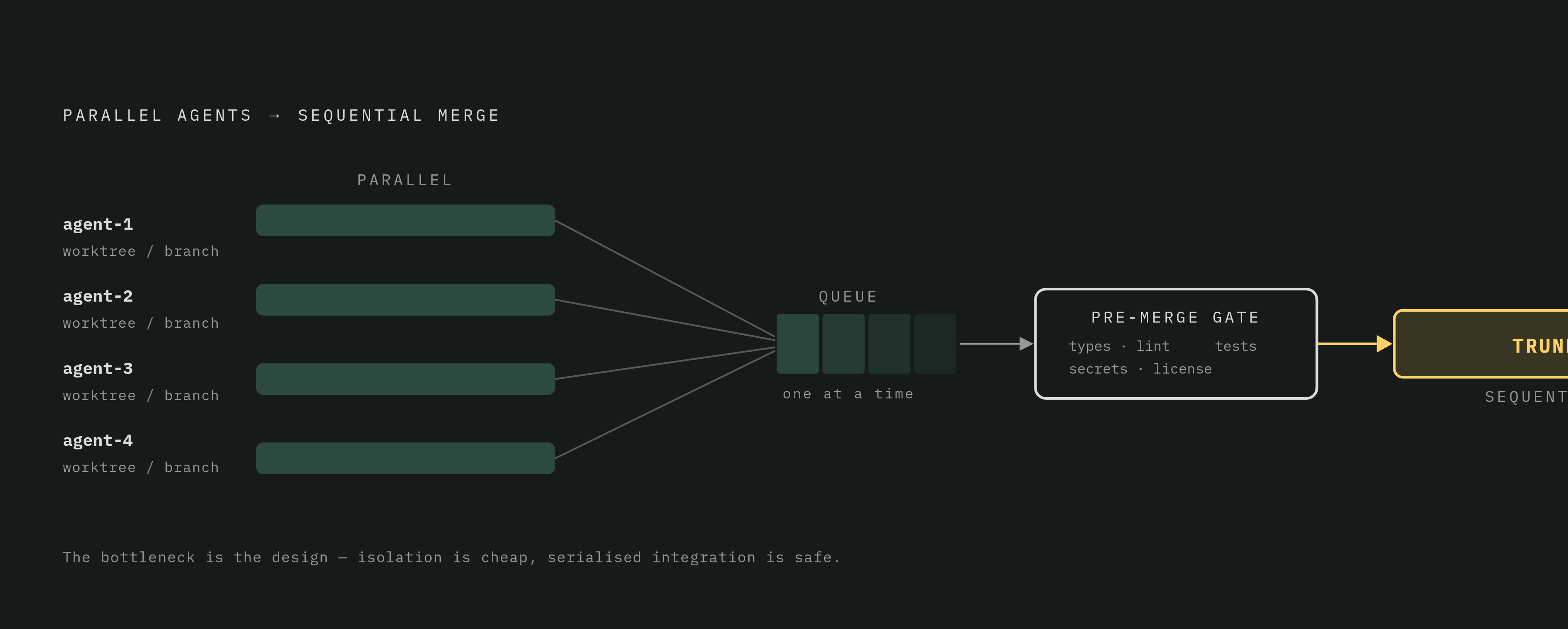
The orchestrator Bernstein illustrates the pattern concretely through its Janitor component, which gates changes before they land. Another orchestrator, Cosmos, follows a similar shape. Both point to the same resulting model: agents develop in parallel, each inside its own worktree, but integration back into trunk happens sequentially. Parallel development is local. Integration is sequential. That tradeoff isn't a workaround, it's the structural core of how this works.
Feature flags round out the picture. Work that isn't finished at the end of an agent session can still merge to trunk behind a flag, which keeps the integration continuous without exposing half-built functionality to users. That solves the obvious complaint that agent tasks rarely wrap up neatly inside a single session.
Worktrees solve filesystem isolation cleanly, but they don't solve everything else that comes with running agents in parallel, and the gaps that remain need mapping before any team assumes the isolation is complete.
Port Conflicts, Shared State, and Isolation Agents Cannot Sense
Worktrees isolate the filesystem. They don't isolate the runtime environment, and they don't tell an agent anything about its own situation unless a human configures that explicitly. Several failure modes follow directly from that gap.
Port conflicts are the simplest one. If two agents, each in a separate worktree, launch the same local dev server, both will try to bind the same port. Worktrees offer no protection against this because ports live at the operating-system level, not the repository level.
Shared external state is the next gap. Local databases, Docker containers, and caches stay shared across every worktree unless a team deliberately separates them in each agent's environment configuration. An agent that thinks it has a clean, isolated environment may be reading or writing to a database another agent is using at the same moment.
Some agents simply don't know they're in a worktree. An agent that wants to sync with the latest trunk might run a plain git checkout main, which fails, because main is already checked out in a different worktree. The resulting error message gives no hint about what actually went wrong, so these failures tend to eat far more debugging time than their cause deserves.
Conflict resolution itself still requires a human. The strongest orchestrators available today, Bernstein through its Janitor gate and Cosmos, surface conflicts back to a person or back to the agent session that caused them. Neither resolves concurrent edits on its own. They defer the decision. They don't make it disappear.
Underneath those failures is a coverage gap: tests rarely cover the interaction between two agents' concurrent changes, so a human still has to judge whether two pieces of work that each pass their own tests actually work together. Worktrees guarantee that the filesystem stays clean. They say nothing about whether the logic does.
The structural risk sits one level up from any of these individual failures. An organization without strong codebase modularity, without discipline in how it breaks tasks into pieces, and without review capacity scaled to match agent output, will use trunk-based development plus worktrees to pile up debt faster, not slower, while looking more organized the whole time. Agents don't distinguish between good practices and bad ones. They scale whatever process they're handed. None of these gaps are fatal.
Configuring commit cadence and branch lifetime so agents integrate continuously without conflicting
If you keep agent branches short by explicit policy, not by hope or convention, you make the single highest-leverage configuration decision for preventing context drift and conflict pileup before they start.
Set a branch lifetime rule: an agent branch should cover one coherent task and merge within hours, not days. The longer that branch stays open, the further trunk drifts underneath it, and the more wrong the agent's original snapshot becomes. This isn't a suggestion to aim for; it should be enforced the same way a linter rule is enforced.
Neither rule holds without task decomposition discipline behind it. A sprawling, poorly scoped task given to an agent will produce a long-lived branch no matter what the policy says, because the work genuinely can't be chopped up any smaller after the fact.
In the parallel-local, sequential-integration model, even when several agents finish at the exact same moment, their changes still hit trunk one at a time, and CI validates each one independently before the next lands.
The pre-merge gate layer that keeps agent output from accumulating silent quality debt
A pre-merge gate built specifically for agent output, covering type checking, lint, tests, secret scanning, and license checks, before merge rather than after, is what separates a trunk-based workflow that stays clean from one that quietly fills up with debt nobody notices until it breaks something.
Agent output needs this gate for a reason that goes beyond general code quality. Research on AI-assisted open-source contribution found that agents produce more redundant code than human developers do, and a Stanford dataset of agent coding sessions found that users corrected, interrupted, or otherwise pushed back on agent output in 44% of turns. The social check that normally catches a human's sloppy pull request, a teammate reading it and saying something, doesn't fire reliably when the author is an agent. The gate has to do that work mechanically instead.
Scaling agent review throughput without letting the PR queue reconstitute itself
Automated pre-merge checks handle volume well.
Automated gates, type checks, lint, secret scanning, license scanning, coverage thresholds, should absorb every deterministic, high-volume check, freeing human reviewers to focus on architecture, on interaction effects between changes, and on the cases where test coverage doesn't reach the seam between two agents' work.
PR labeling pays off here too. When every agent PR carries a tool and session identifier, reviewers can triage by risk instead of reading everything with the same level of care. A PR from an agent touching a well-tested module in a modular part of the codebase earns a lighter pass. A PR touching a shared dependency earns a harder look.
Research on AI-assisted open-source contribution found that agent-generated contributions are more likely to get merged when reviewer engagement is actually substantive. Reviewer quality on agent PRs matters more than reviewer headcount.
Scaling pressure compounds from an unexpected direction. The Microsoft field study found that first use of CLI coding agents spread mainly through social networks inside the engineering organization, and that retention tracked with coding activity rather than demographics. The teams most likely to run many agents concurrently are the most active engineering teams, which are also the teams where review queue pressure is already highest before agents show up.
For teams that need full visibility into agent behavior and execution before scaling any of this automation, and that want to choose their own model and infrastructure rather than being locked into a vendor's stack, a model-agnostic platform is an option that runs inside the organization's own infrastructure. They carry the audit logging and guardrails needed to make agent PRs reviewable at scale, which matters most for teams that need that control before they're willing to let the queue grow.
What teams need before trunk-based development with agents scales
Trunk-based development with AI agents scales whatever engineering practices you already have. It doesn't substitute for them. An organization that adopts this workflow without the right foundations will generate and integrate debt faster than it did before, not slower, because agents amplify whatever process they're handed, good or bad.
Codebase modularity is the gating prerequisite that everything else in this piece depends on. A codebase broken into clear, independent modules lets an agent's change stay contained, lets reviewers judge risk by which module a PR touches, and lets automated gates verify a small, well-defined surface instead of guessing at the blast radius of a change. Without that structure, every other practice covered here, short branch lifetimes, incremental commits, pre-merge gates, risk-based triage, loses most of its effect, because the underlying code offers no boundaries for any of those practices to work against.
Sources
- From Conversation to Contribution: Characterizing Coding Agent in Open-Source Software
- Adoption and Impact of Command-Line AI Coding Agents: A Study of Microsoft's Early 2026 Rollout of Claude Code and GitHub Copilot CLI
- Beyond Code Generation: Reliability, Verification, and Cost Economics in the Agentic Software Development Lifecycle