Runbook vs Playbook for Engineering Teams
Runbooks guide specific technical actions; playbooks govern decisions and roles across teams.
What a runbook is and what it is for
A runbook is a step-by-step guide for doing one specific job or handling one specific system event. Nothing more abstract than that. It tells the person on the keyboard which command to run, what output to expect, and what to do when that output looks wrong.
The word traces back to mainframe operations, where operators kept physical notebooks to walk through repetitive tasks without relying on memory. That habit never really died, it just moved into wikis, Confluence pages, and, on the more disciplined teams, version-controlled repos sitting right next to the code.
A runbook is not a flat checklist, and treating it like one is the first mistake most teams make. Anyone who has written one for a real system knows it branches. If the disk is nearing capacity, do this. If it climbs even higher, page someone. That's a directed graph of conditional actions and wait states dressed up as a document, even if nobody on the team would ever call it that out loud.
The audience for a runbook is exactly one person: whoever has their hands on the keyboard right now, possibly someone who was asleep four minutes ago and is squinting at a laptop from bed. That constraint rules out almost everything else. No architecture diagrams, no history lesson on why the service exists, nothing that doesn't help a groggy engineer decide or act in the next sixty seconds.
A state of software production readiness report found that only 42% of IT leaders call runbooks an important part of production readiness. Under half. That's a real gap, and it means a lot of teams running serious infrastructure are still improvising at 3 a.m. instead of following anything written down.
The practical headache is that runbooks go stale fast, because they're welded to infrastructure rather than to people. Every deployment is a small, quiet chance that yesterday's runbook is now lying to today's engineer. A renamed service, a moved endpoint, a deprecated flag: any one of these can turn a trusted document into a liability overnight.
The eight common types of runbook and the four on-call categories
Runbooks aren't one flavor, and Checkflow (August 2026) counts eight common types across IT operations. Incident response runbooks handle a specific alert firing. Change management runbooks walk through an approved change of a known type. Deployment runbooks cover shipping a specific app or piece of infrastructure. Disaster recovery runbooks bring specific systems back online after a failure. Maintenance runbooks handle the boring-but-critical stuff, patching and cert renewal, the tasks nobody wants to own. Onboarding runbooks provision access for new hires, offboarding runbooks revoke it when people leave, and monitoring and alerting runbooks respond to a defined alert condition.
Most teams only build the first two or three before something forces their hand, and that something is usually an outage that exposes exactly which runbook was missing.
On-call teams tend to slice things differently, into four operational buckets: diagnostic, remediation, deployment, and maintenance. Diagnostic runbooks answer "what's actually broken." Remediation runbooks answer "how do we fix it." The other two run on a calendar instead of an adrenaline spike.
SolarWinds frames automation in three tiers: manual, where a human does most of the work, semi-automatic, where a human does a little, and fully automated, where a human mostly just watches. Higher-risk actions should stay manual on purpose. Nobody wants a fully automated runbook that can delete a production database because a script misread a threshold, and that scenario is not hypothetical. It is the exact failure mode automation guardrails exist to prevent.
There's also a recognizable maturity ladder. Beginner teams keep text runbooks in a docs repo, manual steps done by hand every time. Intermediate teams add templates, versioning, and a few scripts to strip out the tedious parts. Advanced teams wire runbooks directly into alerting, with role-based access control, audit logs, and game-day validation to confirm the thing still works before anyone needs it for real. Most teams sit somewhere between beginner and intermediate. The ladder is a map of where to go next, not a grade on where a team already stands, and that's fine.
What a playbook is and what it is for
A playbook is a different animal. It's a strategic guide for a whole category of situation, the kind that's messy, high-stakes, and slightly different every time it happens. It defines roles, decision points, communication paths, and the sequence of judgment calls a team makes together.
What it deliberately does not do is script every keystroke. It can't, and shouldn't try. The moment a playbook contains an actual command to type, it has quietly turned into a runbook, and now it rots at the speed of infrastructure instead of the speed of the org chart. Those are two very different decay rates, and confusing them is how documentation goes bad without anyone noticing until the worst possible moment.
The audience test is the clearest way to check the work: a playbook is for the incident commander deciding what order things happen in, the comms lead drafting a customer-facing update, the manager deciding whether to pull an engineer off another project. It is never for the person with hands on the keyboard. Hand that person a playbook and watch them flip through it hunting for a command that was never going to be there, because that command belongs in a different document.
Because a playbook governs people and process rather than infrastructure, it lasts far longer, sometimes outliving an entire re-platforming effort. A runbook rarely survives that long, since infrastructure changes every Thursday and org charts change on a much slower clock.
A mature playbook assigns roles cleanly. An incident commander directs the response and decides on public statements. A scribe documents what's happening in real time. Subject-matter experts dig into the technical guts of the problem. A liaison keeps stakeholders updated so the technical team doesn't have to keep stopping to explain itself.
Several playbook types appear repeatedly in engineering orgs. A major incident response playbook defines who the Major Incident Manager is and how resolvers get mobilized. A disaster recovery playbook covers governance: who declares a disaster, who coordinates the response, which stakeholders get the phone call, how success gets measured, while the actual technical recovery steps live in a runbook elsewhere. A cyber recovery playbook covers decision authority for isolating systems, the notification chain for regulators and insurers, and forensic evidence requirements, again handing the technical execution off to a runbook.
Several scenario-specific security playbooks appear repeatedly in engineering orgs, each scoped to a distinct threat class: ransomware attacks, phishing attacks, cloud data breaches, and third-party vendor breaches. ManageEngine points out that playbooks sit at the center of SOAR platforms, orchestrating end-to-end response once an alert lands, enriching it, gathering evidence, and kicking off automated response workflows without a human touching every step.
The sharpest ways to tell the two apart when you're looking at an actual document
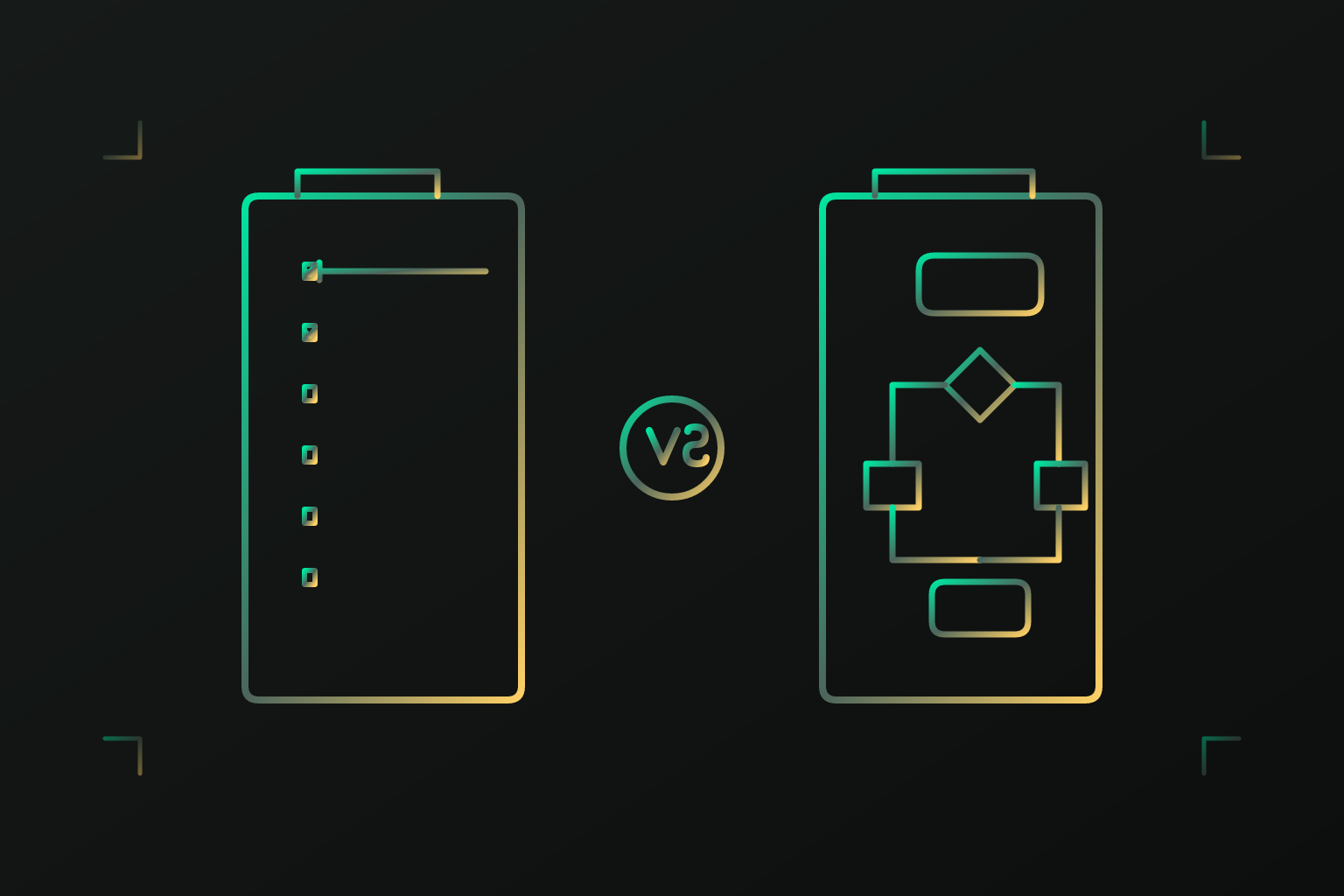
The cleanest way to hold this in your head: a playbook tells you what game to play, a runbook tells you how to run each play. Simple enough to repeat in a stand-up without eyes glazing over.
Three quick tests help in practice. Need to know what commands to run on a specific host? Runbook. Need to know who to notify and which channel to post in? Playbook. Onboarding a brand-new service into the monitoring stack? Neither. That's a standard operating procedure, a distinct category from the other two.
Looking at the document itself makes the tells obvious. A runbook is packed with commands, checklists, expected outputs, conditional branches, and one specific failure mode, usually fitting on a single screen without much scrolling. A playbook reads differently: roles, thresholds, escalation rules, communication templates, a scenario class instead of a single failure, running a few pages rather than a single glance.
Scope is the sharpest test of all. A runbook is welded to one system or one alert. A playbook covers an entire category of event, no matter which system happens to trigger it that particular week.
People conflate the SOP with the runbook constantly, and the two aren't the same thing. An SOP is a formal instruction for a routine business task, written for consistency and often written to satisfy an auditor. A runbook is really a technical SOP for one operational scenario, sometimes with conditional steps built in. Related family, different job.
If a document breaks every time the infrastructure changes, it's a runbook. If it only needs a rewrite when the team structure or the process itself changes, it's a playbook.
How runbooks and playbooks work together during an incident
In a well-built operational model, the playbook governs the response and the runbooks execute inside it. In a well-built operational model, they are a hierarchy: the playbook governs the response and the runbooks execute inside it. They're a hierarchy, and treating them as interchangeable is where most incident processes quietly fall apart.
When a P1 gets declared, the incident response playbook activates first. It defines which runbooks should fire, in what order, and who's responsible for triggering them. The runbooks then handle the granular technical work: the actual commands, the actual restarts.
All Quiet points to the table of linked runbooks as the single most valuable part of any playbook, and most teams forget to fill it in. A playbook without that table is a strategy document floating disconnected from the tools that actually fix anything.
Skipping either document produces one of two familiar disasters. Runbooks without a playbook: engineers know how to restart the database, keystroke for keystroke, but nobody knows who talks to customers, when to escalate to legal, or who handles the press inquiry that just landed in someone's inbox. Execution happens in a vacuum. In playbooks without runbooks, everyone knows their role, the IC is assigned, the comms lead is drafting a status page update, but the engineer actually investigating is improvising commands at 2 a.m. because nobody wrote the procedure down. The incident drags on far longer than it needed to, and it drags on for a completely preventable reason.
Incident.io puts median P1 mean time to resolution, without automation in the mix, somewhere between 45 and 60 minutes, with roughly 12 of those minutes eaten up purely by coordination overhead. Runbooks chip away at the technical minutes. Playbooks chip away at the coordination minutes. Different documents, solving different slices of the same clock.
Where each one lives affects how fast engineers find it mid-incident. Runbooks belong in code repositories or documentation platforms like Confluence or Notion, close to the engineers who write and update them. Playbooks belong in incident response systems like PagerDuty or Opsgenie, where they can be activated the moment an incident gets declared. Store both in the same drawer and you get exactly the confusion this piece is trying to clear up: which document does someone open first, thirty seconds into a page going off?
Both gaps, the missing runbook and the missing playbook, become visible at the worst possible moments: regulatory examinations, post-incident reviews, and M&A due diligence, where someone with a clipboard is specifically looking for proof that the team's process holds up under scrutiny, not just under pressure.
Which to build first
Build the runbook first. That's the right call in almost every case, not just the default recommendation from All Quiet (August 2026), because runbooks come from failures a team has already lived through. The raw material already exists in the incident history. Nobody has to imagine a hypothetical outage to write one, they just have to write down what actually happened last time and clean it up.
The exception is narrower but real. If more than one team already responds to the same incident, and the actual bottleneck is coordination rather than execution, build the playbook first instead. No runbook on earth fixes four engineers independently investigating the same symptom while nobody's talking to the customer.
A reasonable first month of work looks like this: one playbook covering the worst-case scenario a team can imagine, plus one runbook for each of the three alerts that fire most often. Four documents, and between them they cover a disproportionate share of what actually wakes people up at night.
Cortex advises keeping runbooks small and focused, with only the minimum information needed to finish the task, and that guidance gets ignored constantly under pressure to be "thorough." Scope creep turns a runbook into a 40-page document nobody opens when the pager goes off. Nobody reads 40 pages during an outage, they read the first screen and start improvising, which defeats the entire point of having written the thing down.
A solid runbook plans around a handful of components, including build and deploy context, prerequisites, the sequential steps themselves, relevant SLA or SLO metrics, alert documentation, and clear escalation or ownership contacts. Missing any of those means the document works fine right up until the moment it doesn't.
On staleness: review runbooks every time they get used, plus on a quarterly cadence regardless of use. Review playbooks after any incident where coordination visibly broke down, whether or not the technical fix went smoothly. Real testing is rarer than it should be. Research consistently finds that only a minority of organizations regularly test their incident response plans. Documentation that has never been tested hasn't been proven to work; it's just a document that hasn't had the chance to fail in front of anyone yet.
How AI agents change which parts of these documents humans still execute
AI agents are already inside runbook workflows, running diagnostics, surfacing recommended actions, and completing defined task sequences without a human typing each command. The human role is shifting from executing individual steps to governing the process as a whole, checking the agent's work instead of doing the work itself.
Cast AI (May 2026) describes the agentic version of a runbook this way: an AI agent that continuously watches cluster state, reasons about which remediation fits, executes a multi-step workflow on its own, validates that the fix actually worked, and only escalates to a human when it hits something genuinely new. Unlike a static script, it's making decisions along the way instead of following a fixed branch.
One pattern is using the agent as the runbook's executor rather than its author. The agent reads the existing runbook, pulls out the relevant deterministic steps, and surfaces them to the on-call engineer next to live telemetry. The human still makes the judgment call, but finding the right runbook, interpreting the symptom, and proposing the next move collapses down to seconds instead of minutes of scrolling through docs half-awake.
Agentic AI gets it right on its own roughly 30% of the time. That number alone should settle any argument about full autopilot: a senior human has to sign off on anything irreversible, and the human-in-the-loop model doesn't disappear here, it just moves up a level, from typing commands to approving them.
None of this makes the runbook and playbook distinction less important, if anything it gets sharper. Playbooks define the boundaries an AI agent is allowed to operate inside. Runbooks are where the agent actually does the work. Blurring the two under a banner of "automation" produces an agent with no clear fence around its behavior, and that turns a minor incident into a much longer story than it needed to be.
Open-source, model-agnostic agent platforms, OpenHands among them, let engineering teams run agents on their own infrastructure with the visibility and guardrails to actually govern what those agents do at the runbook level. Instead of accepting a closed vendor's fixed execution model, a team can pick its own model and decide, deliberately, how much rope an agent gets.
The shape that's emerging looks like this: agents collect information and reason about it, orchestration platforms carry out the execution, and human analysts approve the cases that are genuinely novel. Each layer maps almost exactly onto the runbook and playbook hierarchy this piece has been describing, just with a faster, occasionally opinionated machine sitting in the loop.