Scheduling and Prioritization of Agent Workloads
How smarter scheduling keeps expensive AI hardware from sitting idle while work piles up.
Organizations are running more AI agents than their infrastructure knows what to do with, and most of them are burning GPU cycles they never needed to spend. This piece covers the scheduling mechanics that decide what runs, in what order, and why: priority queues, preemption, gang scheduling, continuous execution. Not strategy, not "should you adopt agents," just the plumbing that keeps expensive hardware from sitting idle while a backlog piles up behind it.
Most people assume the bottleneck is model quality or GPU supply. It is neither model quality nor GPU supply. Deloitte's 2025 Tech Value Survey of nearly 550 US cross-industry leaders found 80% believe their organization handles basic automation well, but only 28% say the same about agent efforts. That wide gap looks like a readiness problem. It's a scheduling problem wearing a readiness-gap costume, and no amount of "AI readiness" training closes it until someone fixes the queue logic that produces it.
An H100 runs $25,000 to $40,000, and money on that scale rides on how these projects are scheduled. An H100 runs $25,000 to $40,000, and Gartner expects more than 40% of agentic AI projects to get cancelled by the end of 2027, citing poor enterprise readiness. Bad scheduling is a structural reason why, not a footnote.
What naive scheduling costs: illustrating how naive scheduling leaves GPUs idle
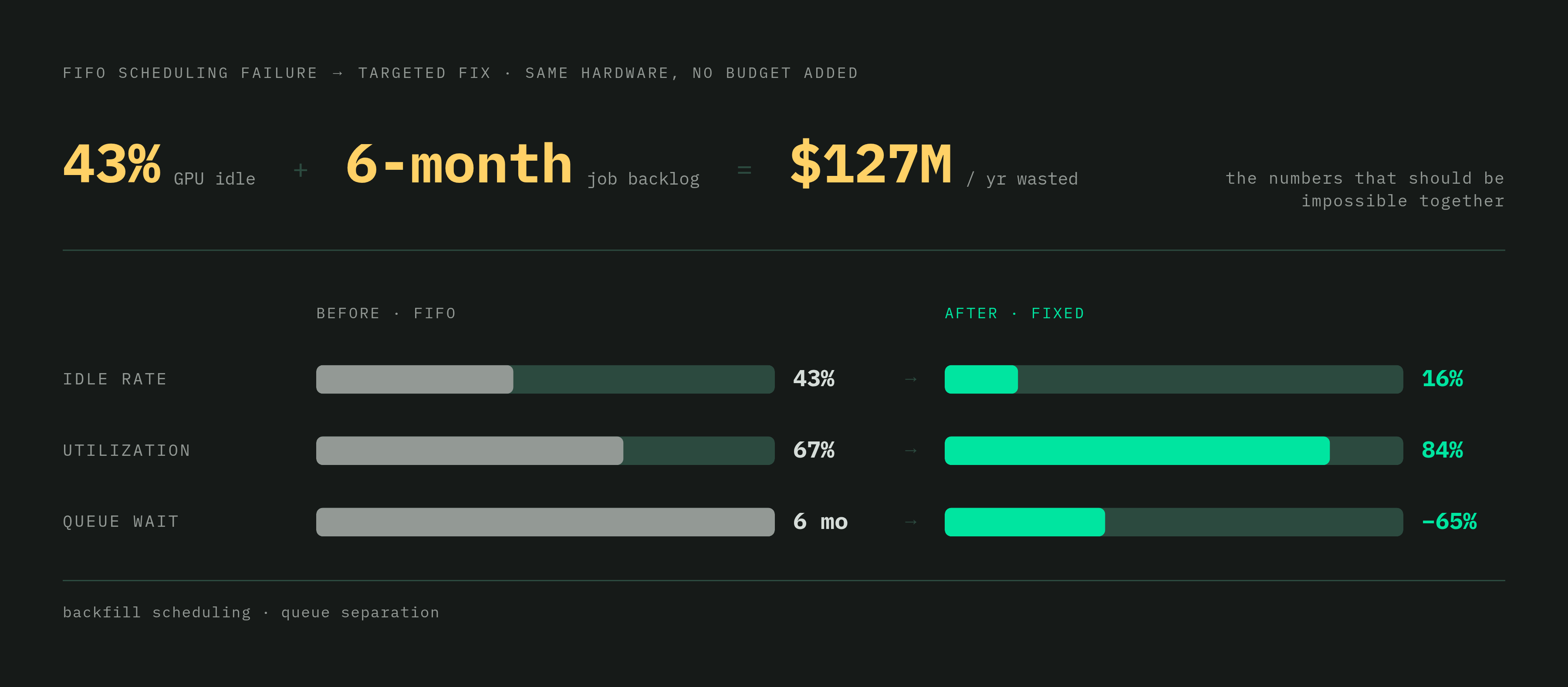
One widely cited case found GPU clusters sitting idle 43% of the time despite a six-month backlog of training jobs waiting to run. Read that twice: idle hardware and a six-month queue, happening at once, on the same clusters. Cost of the mismatch: $127 million a year in underutilized infrastructure.
The hardware wasn't broken. The cause was first-in-first-out scheduling, which processes arrivals in order regardless of job size, urgency, or geography, and calls that fair. FIFO doesn't know about time zones or the actual shape of the work.
That's the structural flaw. A long-running, low-priority agent job can plant itself in front of a short, high-value inference task, and the short task just waits. Latency stacks up, throughput collapses, and multiply that across five departments running five separate queues that don't talk to each other, and nobody can borrow idle capacity sitting right next door.
Fixing it isn't theoretical. A backfill approach took utilization from 67% to 84% in one reported case. Queue separation cut wait time by 65% in another reported deployment. Same hardware, same budget, dramatically more output. Every scheduling idea in the rest of this piece exists to answer that one FIFO failure mode.
Agent workloads versus the batch jobs schedulers were built for
Classical schedulers assume fixed input, fixed duration, deterministic output. Feed one a job, and it can predict runtime and resource draw before the job even starts. That assumption is baked into decades of scheduling theory, and agents break it on first contact.
A single agentic request might chain planning, tool selection, generation, verification, and refinement, looping back on itself along the way. That's a graph, sometimes one with no fixed exit point at all.
Three shapes appear constantly in production, and none of them play nice. Sequential chains mean a delay anywhere becomes a delay everywhere downstream, since each step depends on the last. Fork-join patterns run parallel branches at once, but all of them have to land before the job continues, so the join point turns into a bottleneck. Self-reflection loops have the agent checking its own work and rerunning itself. Nobody knows the duration going in, or how many passes it takes before the thing is satisfied with its own answer.
Speculative execution and redundant generation across prompts pile more weight onto this mess. Serving an LLM workload means optimizing a computational graph where every operator happens to be an expensive, stateful model call, not a cheap deterministic function you can predict and forget.
Classical DAG scheduling breaks because the same input can produce a different output each time, so "done" isn't a stable, checkable state the way it is for a batch job. Reasoning failures don't crash or time out. They produce a plausible-looking wrong answer, so retry-on-failure never catches them. Retries aren't idempotent either: rerun a failed step and it might burn different resources or land on a completely different answer. Retry budgets need actual thought behind them, backed by a clear policy for when and how to try again."
WorfBench research from Qiao and colleagues found even GPT-4 shows a 15-point gap between how well it plans sequential tasks versus graph-shaped ones. The agent itself isn't reliably good at structuring its own work, so the scheduler has to pick up the slack. No scheduler pulled off a shelf handles this out of the box. Somebody has to build for it, on purpose.
Work-conserving scheduling as the foundational design principle
Start with the simplest rule available: a work-conserving scheduler never lets a resource sit idle while there's work that could use it. That's the flat opposite of FIFO's passive waiting, where a GPU sits empty because the "next" job in line hasn't technically arrived, even while something ready to go sits three spots back in a different queue.
Research published in arXiv:2504.07347, from researchers at Cornell, Chicago, and Columbia, proved mathematically that a broad class of work-conserving algorithms hits maximum throughput, both for individual LLM requests and for agent workloads shaped like DAGs or fork-joins. The proof rests on a fluid-limit framework for multi-class batched processing under K-FCFS scheduling.
The practical verdict out of that paper: Orca and Sarathi-Serve are confirmed throughput-optimal. FasterTransformer and vanilla vLLM are not maximally stable, and the paper flags both for caution.
Work-conserving scheduling has limits, and pretending otherwise sets people up for disappointment. It maximizes throughput, full stop. It doesn't enforce priority order, it won't stop a low-priority job from starving a high-priority one, and it does nothing for distributed jobs that need multiple pieces to start at the exact same moment. Work-conserving is the floor. Everything else here gets built on top of it.
Priority queues and preemption: keeping high-value agent tasks from waiting behind slow ones
Without priority levels, a six-hour training job and a two-second customer-facing inference request land in the same queue, and the training job wins purely because it showed up first. That's a coin flip that always lands on "whoever got here earlier."
Priority-based scheduling fixes this directly. High-priority inference preempts lower-priority training the moment GPUs run tight, automatically, without an engineer getting paged at 2 a.m. to kill a job by hand.
NVIDIA's Run:ai platform handles this by letting priority and preemptibility get set per workload. Those settings decide scheduling order, how resources get handed out, and whether a running job can be interrupted when something more urgent enters the queue. Priority is a sequence: who gets served first out of the whole shared pool.
KAI Scheduler's documentation splits the mechanics into three pieces. Quota is the guaranteed baseline share a queue is owed no matter what else is happening. Queue priority decides who gets first crack at surplus once quotas are met. Over-quota weight decides how that surplus splits among queues sitting at the same priority tier, so a team with a heavier weight walks away with a bigger slice of whatever's left.
Fair-share quotas sit on top as the guardrail. They stop one team's agents from swallowing the entire resource pool during a busy stretch, so nobody starves just because someone else's project happens to be on fire that week.
Sorting agent workloads by tier is common practice, typically placing production inference highest, followed by deadline-driven training, then research and experimentation, with cost-optimized batch jobs at the bottom consuming whatever remains.
Watch for priority inversion: a low-priority job sits on a resource a high-priority job needs, and the scheduler has no mechanism to pry it loose. Preemption doesn't happen by accident. Someone has to design it into the system on purpose, or the entire priority scheme is just a suggestion nobody follows once things get busy.
Gang scheduling: why distributed agent jobs must start together or not at all
Picture a distributed Ray job that needs ten workers, but only six show up because the other four are tied up elsewhere. That job doesn't run slow, it stalls completely, sitting there burning resources while producing nothing, waiting on workers that might never arrive.
Gang scheduling closes that gap with one rule: every worker and actor in a distributed job launches together, or none of them launch. No partial starts, no stalls, no resources locked up for a job that's never going to finish assembling itself.
This matters enormously for multi-agent pipelines built on fork-join shapes, where every parallel branch has to be running before the join step can even begin. A partial start doesn't look like a failure at first glance. It looks like a slow job, right up until someone notices it's been "running" for six hours and produced nothing, because it's actually deadlocked, quietly billing someone's account the whole time.
NVIDIA announced native integration between its KAI Scheduler and KubeRay in October 2025 (NVIDIA Technical Blog, October 3), turning gang scheduling into a configuration setting inside Ray clusters instead of something teams had to hand-build every time.
Doing this right costs something structural: the scheduler has to reserve the entire set of resources a job needs before letting any part of it start. That's a real departure from greedy, first-come allocation, and the trade-off cuts the other way too. Reserved resources can sit idle while a job waits to assemble its full gang, and if jobs keep failing to assemble, gang scheduling can actually drag overall utilization down instead of up. Backfilling smaller jobs into that gang-wait window is the standard fix.
On the research side, DynTaskMAS (Yu and colleagues, 2025) built dynamic task graphs with asynchronous parallel execution and cut execution time by 21% to 33%. Structuring work to run in parallel wherever it actually can is the natural partner to gang scheduling's all-or-nothing rule.
Continuous execution and autoscaling: handling agents that don't respect business hours
Engineers clock out. Agents don't. A person context-switches between tools, takes lunch, goes home at six, but an agent has no equivalent stopping point. A scheduler that doesn't plan for that either over-provisions GPUs that sit idle overnight, or interrupts an agent mid-task because someone assumed the workday had ended.
Follow-the-sun scheduling is one answer. A team in one region uses the GPU pool during its business hours, hands it off to European teams as their day starts, who hand it off to American teams in turn. Google's version of this increased effective capacity by 37% without buying a single additional chip, same hardware, used around the clock instead of eight hours out of twenty-four.
Ray clusters paired with KAI Scheduler scale up automatically as resources free up or queue conditions allow borrowing into surplus capacity, then scale back down as demand drops. That's elastic compute tracking actual demand, instead of a fixed allocation someone guessed at during a planning meeting six months ago.
The mechanics split three ways in practice. Batch inference scales up when the queue backs up and back down once it clears. Online inference holds a steady baseline to keep response times inside whatever SLA got promised, then bursts when traffic spikes. Development workloads spin up on demand and tear down fast, so nobody pays for a GPU idling overnight because someone forgot to close a notebook.
Two cost levers deserve direct attention. Spot instances offer roughly 70% off for workloads that can tolerate interruption, which fits preemptible batch agent jobs well. And chargeback, where teams see and own their own GPU spend, cut demand by 25% at eBay. People use less of something the moment they can see the bill with their name attached to it.
None of this works without checkpointing. Training runs and long agent jobs need to save state as they go, so a spot interruption or a preemption doesn't wipe out six hours of progress and force a restart from zero. That's a requirement the application team has to build in from day one.
Continuous execution also forces a harder question: where, exactly, does a human need to step into this loop.
Where human-in-the-loop checkpoints fit inside a scheduling model
Some agent actions need a person to sign off before anything moves forward. That approval is, functionally, a synchronous pause dropped into a pipeline that runs asynchronously everywhere else.
The scale of this shift has become clear in production deployments, where agents have demonstrated they can act on a bad decision at real scale, fast enough that nobody caught it until after the fact, pushing organizations to add human-in-the-loop review as a risk control.
Treat this as a scheduling problem with governance strapped on. An agent parked waiting on human approval still holds its resource allocation the entire time it waits, and if the scheduler doesn't know that job is paused rather than active, it keeps that capacity locked away from other work that could use it right then. The fix: treat "pending human review" as its own queue state, with a timeout policy and a defined fallback if nobody responds in time.
Not every action deserves the same caution, either. Irreversible writes, external API calls, anything touching money: those need a synchronous human check before proceeding, full stop. Read-only research or a draft getting reviewed later can keep moving asynchronously without anyone standing over it.
Building this into the scheduler means tagging workloads with their human-review requirements right at submission, so the scheduler can estimate the likely wait and plan around it. It means releasing compute the moment a job enters human-review wait state, instead of leaving a GPU idle while someone reads an email at their own pace. And it means restoring context and resources cleanly once approval comes back, which is really just preemption running in reverse.
None of this works without visibility. An organization needs a real-time view of which agents are running, which are queued, which are stuck waiting on a human, and which are flat-out blocked. Without that view, "governing agent behavior" stays a phrase on a slide deck. With it, scheduling stops being background plumbing and becomes the thing that decides whether the whole agent fleet earns its keep.