Agent Handoff Between Human and Automated Steps
Three overlooked decisions determine whether human handoffs in AI support actually work.
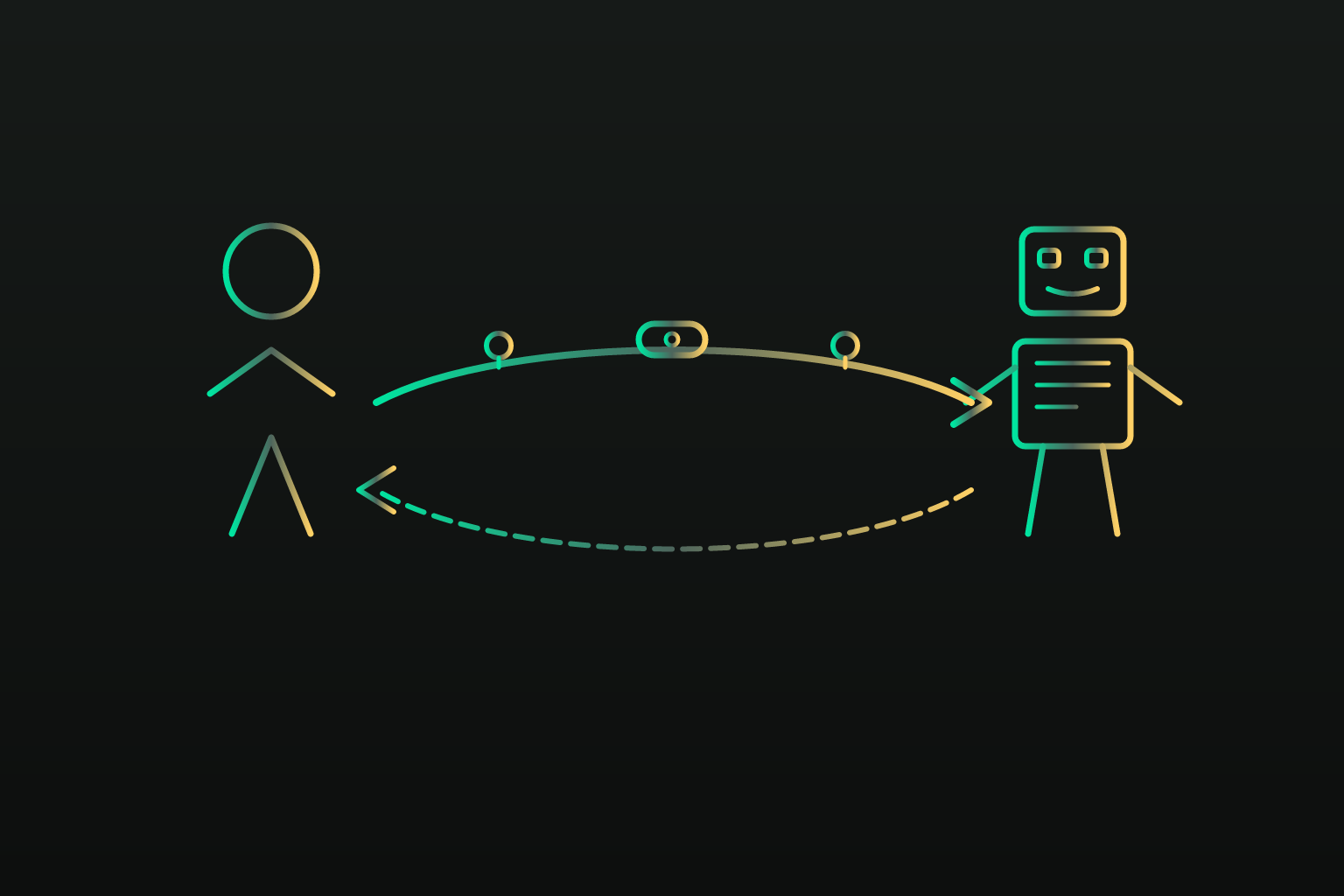
Handoffs fail for three reasons, and almost nobody diagnoses the right one. A support agent hands a customer to a human, the AI did its job fine, and the human has no idea what just happened. Now the customer's explaining their billing issue for the second time. That's not a training problem or a tooling problem. It's one of three specific decisions made badly, or not made at all.
Most teams spend months tuning the AI's responses and about ten minutes thinking about what happens when a human takes over. That's backwards. The handoff is where resolution rates, handle time, and satisfaction actually get decided, according to Cresta's guide on the subject, and the math on why is simple: a customer spends four minutes explaining a billing dispute to a virtual agent, gets escalated, and reaches a human staring at a blank screen. The automation worked exactly as designed. The handoff didn't. PwC's customer experience research found that 73% of consumers rank repeating themselves among the most frustrating parts of getting support. That frustration gets built, or avoided, at exactly this junction.
Here's what should change how seriously you take this. Gartner's September 2025 forecast says none of the Fortune 500 will have fully removed human customer service by 2028. Hybrid workflows, humans and AI working the same queue, aren't a bridge to some fully automated future. They're the destination. So handoff quality is a core requirement from the start, not something to defer. It's permanent infrastructure, and it needs engineering, not an afterthought.
Three decisions, made before the handoff ever happens, determine whether it succeeds: what triggers the switch, what context rides along with it, and how much the AI keeps doing after the human takes the wheel. Miss any one of the three and the other two barely matter.
The spectrum of human involvement that sits behind every handoff decision
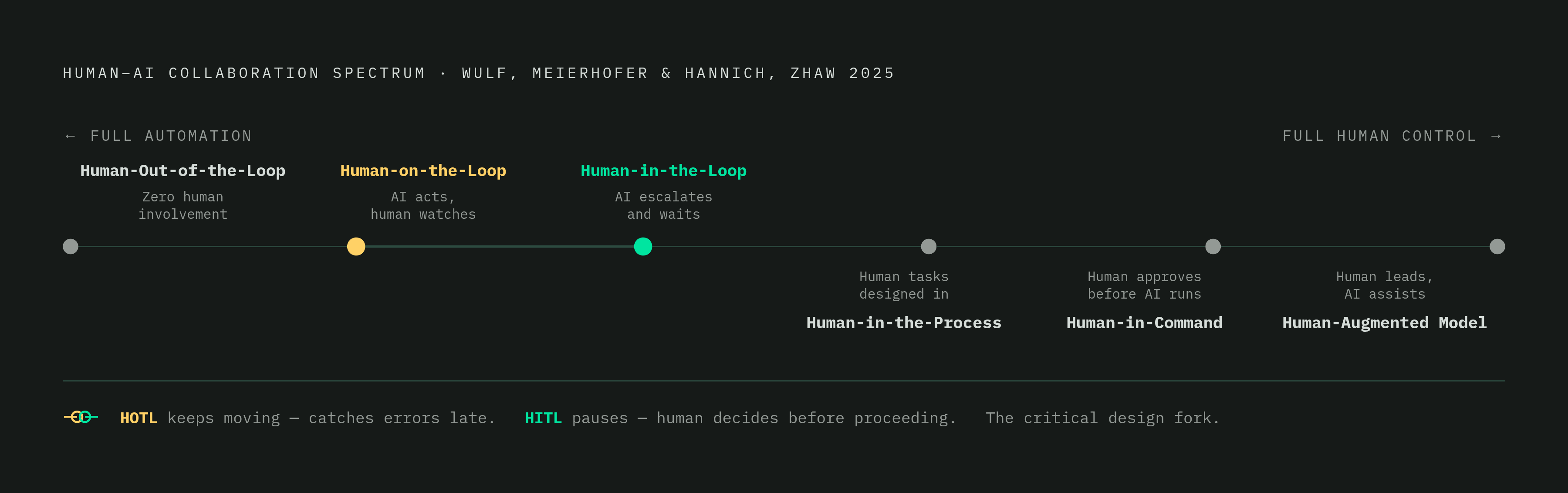
Handoff is a gradual transition. It's a dial, with a whole range of settings between "AI does everything" and "human does everything," and picking the wrong setting is the first way teams sabotage themselves.
Researchers at ZHAW Zurich University of Applied Sciences (Wulf, Meierhofer, and Hannich, 2025) mapped six modes along that dial. On one end sits Human-Out-of-the-Loop: full automation, zero human involvement. On the other sits the Human-Augmented Model, where AI plays backup and the human does the actual work. Four modes sit in between, and they're worth knowing by name because they show up constantly in real deployments.
Human-in-Command requires a person to sign off before the AI's proposal executes. Human-in-the-Process builds specific human tasks into the workflow by design, not exception. Human-in-the-Loop means the agent escalates when it hits uncertainty, then waits. Human-on-the-Loop means the AI just acts, and a human watches from the sidelines, stepping in only if something looks wrong after the fact.
That last distinction, HITL versus HOTL, is the one that actually matters for handoff design. One pauses and waits for a decision. The other keeps moving and hopes someone's watching closely enough to catch a mistake after it's already happened. Bet on HOTL for anything irreversible and you're not designing a safety net, you're designing a confession booth. Which mode fits a given task comes down to three things the ZHAW researchers point to. Task complexity, the risk riding on the outcome, and how reliable the system has proven itself to be. Those same three factors drive the trigger decision in the next section too.
A system that hands off proactively, before things go sideways, is succeeding on its own terms. It's demonstrating that it knows its own limits. Escalation rate is a design metric, not a confession. Teams that treat every handoff as evidence the AI screwed up tend to under-invest in making the handoff itself work well, which is exactly the trap worth climbing out of.
Decision one: defining triggers that fire at the right moment for the right reason
The question here is simple to state and genuinely hard to answer: which conditions should move a task along the spectrum, and who, or what, gets to decide?
Triggers split into two families. Explicit triggers are the easy ones. A customer says "let me talk to a person," and the system routes them, no argument, no delay. The principle is straightforward: hesitation here costs you the customer. Someone who feels trapped in a chatbot maze with no visible exit isn't likely to come back and try again.
Implicit triggers are where the real engineering happens, because the system has to infer something's wrong before the customer says so. A risk-tiered approach shows up consistently across the industry:
- Low risk: FAQs, order status, appointment reminders, anything reversible. Stays automated, no exceptions needed.
- Moderate risk: ambiguous cancellation requests, repeated login failures, a customer whose tone is clearly souring. These prompt clarification, or a live handoff if clarification doesn't resolve it.
- High risk: suspected fraud, payment disputes, legal threats, medical or self-harm signals, anything touching a vulnerable customer. Immediate human review, full stop. The AI doesn't get to make an irreversible call here just because its confidence score looks good.
- Behavioral red flags: an agent stuck in a loop, retrying the same failed action four times like a navigation tool that keeps recalculating the same wrong route.
Confidence thresholds add a second layer on top of the risk tiers. The AI scores its own certainty, and anything below a set bar hands off instead of guessing. But some categories, refunds, legal questions, billing disputes, get excluded from automation entirely regardless of how confident the model claims to be. Confidence is a useful signal. It's a terrible excuse to skip a safeguard, and any team leaning on it as one is going to get burned eventually.
A well-designed monitoring layer can catch behavioral red flags, excessive latency, repetitive actions, the digital equivalent of pacing back and forth, and trigger a handoff before the customer notices something's wrong, rather than after they've noticed and started typing in all caps.
Then there's the failure mode most teams get exactly backwards. If a human approves the same routine action 99 times out of 100 without changing a thing, that checkpoint is a rubber stamp. It's theater. It adds latency and trains reviewers to click "approve" on autopilot, which defeats the entire point of putting a human in the loop. Good trigger design means reserving human judgment for moments where human judgment actually changes the outcome. Everything else should just run, unsupervised, because supervision that never intervenes isn't supervision.
Autonomy, in this framework, gets earned rather than handed out. The underlying logic: once an agent's error rate on a specific action drops low enough, that action can graduate from requiring approval to running on its own, monitored after the fact. Trust builds action by action, not all at once on day one like a new hire getting the keys to the building before they've found the bathroom.
Multi-agent systems complicate things further. In swarm-style setups, agents hand tasks to each other based on runtime context, with no central dispatcher making the call. Trigger logic has to cover agent-to-agent handoffs too, not just agent-to-human. Research into multi-agent failure patterns finds that a significant share of failures trace back to specification ambiguity: agents misreading their own roles, or skipping a verification step they were supposed to run.
Decision two: what context must travel with the handoff and in what form
Most platforms solve context transfer by dumping the raw conversation log on the human agent and calling it done. That's not context. That's homework, and it's the single worst thing a handoff can do to the person receiving it.
BlueTweak states it directly: if the receiving agent has to read an entire transcript just to understand what's happening, the handoff already failed at its one job. The CCW Digital Market Study (2024) found that 73% of contact center leaders say their agents spend too much time hunting for information they need mid-call. The handoff package is exactly where that time gets clawed back, or lost for good.
A handoff package worth the name, drawing on frameworks from Cresta and callmissed.com, needs to carry:
- A clear summary of why the customer reached out
- What they already tried before this conversation started
- What the AI attempted, and what happened when it did
- The exact trigger that caused escalation, not a vague "complexity" flag
- The customer's sentiment at the moment of handoff
- Suggested next steps drawn from similar resolved cases
- Live CRM data, account history, and prior interactions, synced before the human agent opens their mouth
- Verified facts and detected intent pulled straight from the conversation
Cold transfer and warm transfer aren't opposites so much as settings on the same dial, one that should track the nature of the interaction. A simple question about order status can move through a cold transfer fine, as long as the context underneath it is organized. Anything with real complexity or emotional charge needs a fuller summary before the human jumps in. And anything sensitive, urgent, or regulated (fraud, a distressed customer, a legal question) deserves a warm transfer: the receiving agent gets briefed first, then talks to the customer, routed to a specialist rather than whoever's next in the queue.
Voice channels have their own version of this, sometimes called the whisper pattern. Before the customer connects, the receiving agent hears a private summary, the issue, what's been tried, the customer's mood, and only then does the call patch through. It exists because a voice agent has no minutes to spare skimming a transcript while a caller sits there expecting someone to already know what's going on.
On the technical side, OpenAI's Agents SDK (released March 2025) makes this explicit for multi-agent pipelines. Agents hand off control to each other and carry conversation context through that transition as a built-in part of the architecture. Agents hand off control to each other and carry conversation context through that transition as a built-in part of the architecture. The SDK ships with tracing built in, so the chain stays observable end to end instead of vanishing into a black box the moment control changes hands.
DoubleAgents, a study out of Columbia University (arXiv 2509.12626, combining a ten-person lab study with real-world deployment data), found that making an agent's reasoning visible to the human, not just its final answer but the path it took to get there, increased user comfort with task delegation. Telling a human "the AI flagged this as fraud" is a lot less useful than showing them why. Context transfer should carry the reasoning, not just the conclusion.
Coordination failure is another major category alongside specification ambiguity. Messages get lost. Handoffs loop back on themselves. Structured context packages, the same fields every time, in the same order, prevent this at the architecture level rather than hoping everyone remembers to fill in the blanks.
Decision three: how much AI involvement continues after the human takes over
Handoff doesn't mean the AI clocks out. Cresta's research points to real-time guidance continuing well past the point where a human takes the conversation: surfacing knowledge, suggesting responses, flagging behavioral cues the agent might miss.
This resembles the Human-Augmented Model from the ZHAW taxonomy, where AI plays a supporting role while a human does the actual talking. The AI shifts from driver's seat to backseat navigator. Still useful, just no longer in charge.
In practice, that looks like a handful of specific things running quietly in the background: relevant policy details or precedent cases surfacing on screen as the human types, suggested resolution paths based on how the issue got classified, sentiment monitoring that flags when a customer's getting more frustrated mid-conversation rather than just at the start, and draft summaries or case dispositions written by the AI, reviewed and submitted by the human instead of typed from scratch.
That last one has a concrete result behind it. Propel Holdings, a publicly traded fintech, cut its after-call work from 3 minutes down to 90 seconds, a straight 50% reduction, using Cresta's Agent Assist tooling, alongside a 58% chat containment rate. That's not a marginal tweak. That's an agent getting almost two minutes of their day back on every single call.
The DoubleAgents research shows this pattern playing out in coordination tasks specifically. The AI proposes a plan, flags the parts that need a judgment call, and hands those to a human, who approves, adjusts, or overrides. The AI's job doesn't end at the first handoff. It runs the whole length of the workflow, just in a supporting role rather than a leading one.
One question doesn't get asked often enough: which of these post-handoff AI behaviors does the customer actually see, and which stay invisible, running only on the agent's side of the screen? That's a trust question as much as a technical one, and it deserves a deliberate answer instead of an accident.
Strip AI support away entirely the moment a human takes over, and things get worse, not neutral. Agents working without any AI assist behind them lose the efficiency gains that a clean context handoff delivered at the start. Whatever speed gain came from a clean context handoff at the start erodes if the human's then left to work the rest of the case cold. The handoff changes who's accountable for the outcome. It shouldn't change whether the AI's still pulling its weight.
How the three decisions interact and where workflows break when one is missing
These three decisions don't operate independently, and that's what teams miss most often. A trigger that fires at exactly the right moment is worthless if it arrives with an empty context package, the human's still starting from zero. A complete context package handed to a human with zero AI support afterward still produces a slower, shakier resolution. And continued AI assistance after the handoff can't make up for a trigger framework that let the escalation happen forty seconds too late.
The failure rate backs this up. Roughly 40% of multi-agent pilots fail within six months of going into production, and the three root causes of multi-agent failure map onto the three decisions above. Specification ambiguity, agents misreading their roles, is a trigger definition failure. Coordination breakdowns, lost messages, circular handoffs, are a context transfer failure. Verification gaps, errors nobody catches before they compound, are a post-handoff oversight failure. Same three problems, different names, showing up in a completely different research context.
The amnesia problem names a specific pattern. Virtasant's research found that roughly one in three agents lacks the customer context needed to deliver a genuinely good experience. That reads like a context transfer failure on the surface, but it's usually caused upstream, by a trigger that fired without bothering to package up the context that existed at that exact moment.
Qualtrics ran a study in October 2025 that found nearly one in five consumers who used AI for customer service saw no benefit from it at all, a notably high failure rate for a technology still finding its footing in production. Blame the handoff before blaming the automation. The AI usually did its job fine upstream; it's the handoff sitting downstream that quietly breaks whatever good work got done.
HITL theater shows back up here too: when triggers get drawn too broadly, humans end up rubber-stamping routine approvals 99 times out of 100. That's not oversight, it's a rubber stamp with extra steps, and over time it trains reviewers to stop looking closely. Which quietly kills the one thing the checkpoint was supposed to protect.
Gartner projects agentic AI resolving 80% of common customer service issues without any human involvement by 2029, alongside a 30% cut in operating costs. That number only holds up if the remaining 20%, the hard cases, the ones that actually reach a human, get handed off well enough to keep customer trust intact. A broken handoff on the complicated 20% doesn't stay contained to that slice. It bleeds backward and makes people trust the automated 80% less too.
There's a simple test for whether all three decisions are actually working together: can the receiving agent pick up mid-conversation without the customer repeating a single thing they already said? If yes, the system's doing its job. If not, one of the three decisions broke somewhere upstream, and it's worth finding out which one before the next escalation makes the same mistake.
Building feedback from escalated cases back into trigger and context design
Every escalation is a data point, whether anyone treats it that way or not. Was this issue actually suited to automation? Did the human agent get enough context to act on it? Was the outcome handled efficiently once the human took over? BlueTweak's framing treats each escalated case as a question the system just answered, whether or not anyone's reading the answer.
A cluster of escalations around one specific topic is a flag. It means the automation's scope got drawn in the wrong place. eesel.ai's take on this: watching what actually gets handed off, and why, tells you where trigger thresholds need to move, often more clearly than any amount of upfront planning could.
There's a feedback loop worth building deliberately. The AI should learn from how humans resolve the tickets it escalated, the same way it originally learned from a knowledge base. eesel.ai frames this as closing the loop between human judgment and automated behavior, and that's a fair way to put it. The humans are the ground truth here. The system should be paying attention to how they actually solve problems, not running the same trigger logic forever because nobody bothered to update it.
None of this works without visibility across the full handoff, though. Cresta's research is direct: platforms that lose track of what happened at the handoff can't measure end-to-end resolution quality, and they definitely can't improve the automation over time based on it. Watching only the automated portion of the journey and calling it done is like grading a relay race by timing just the first runner and assuming the baton got there fine.
Sources
- AI-to-Human Handoff: Best Practices for Support Escalation in 2026
- AI to Human Agent Handoff Best Practices
- DoubleAgents: Human-Agent Alignment in a Socially Embedded Workflow
- AI Agents for Enterprise Workflows: 2025 Guide to Intelligent Automation
- AI Agent Human Handoff: CallMissed Escalation Guide for 2026
- eesel.ai