Edge Computing vs Cloud Hosting for AI Coding Agents
Choose your agent's home based on workflow clarity, not just where inference runs.
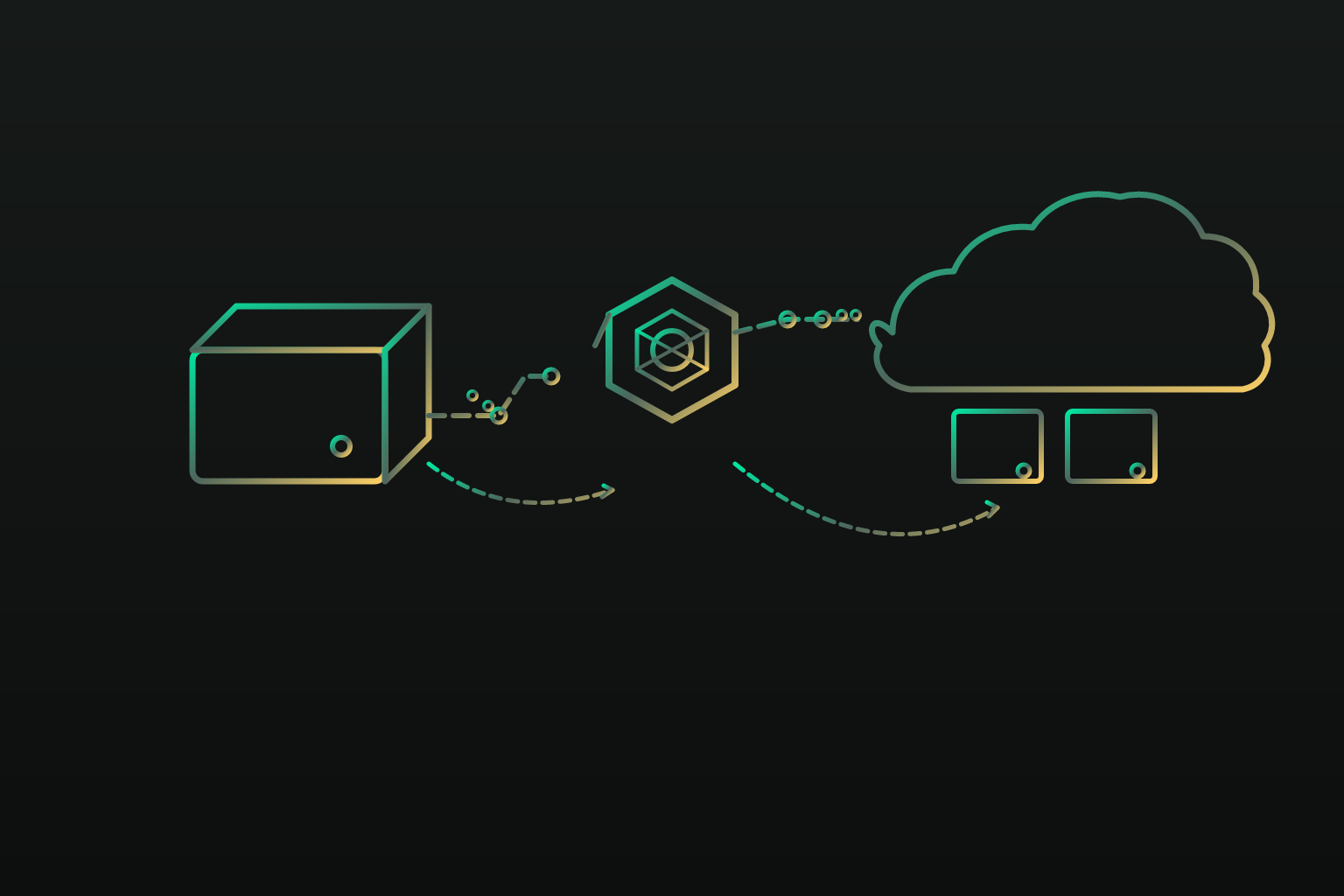
For AI coding agents, edge computing vs cloud hosting is chiefly an architecture decision. Interactive agents keep what a developer knows and how they judge the work inside the working loop. Cloud-autonomous agents turn specified tasks into measurable, reviewable output. The right deployment follows the workload, with review capacity and data rules deciding what is practical.
Why the edge-vs-cloud framing misleads teams choosing how to deploy coding agents
“Edge for latency, cloud for scale” is a useful infrastructure shorthand. It is also an incomplete guide to coding agents. The broader debate asks whether model inference should run on local hardware or in a remote data center, based on response time, privacy, and cost per call. The coding-agent debate asks whether an agent should work with a developer or accept a task and return a pull request.
A locally running agent can use a remote model, while an autonomous agent changes the workflow regardless of where inference happens. The dominant constraints are often how clearly someone specifies the task and how much generated code humans can responsibly review.
What interactive (edge/local) and cloud-autonomous agents actually are, and how they differ structurally
An interactive agent runs on the developer’s machine and starts from a prompt. It works with the credentials available to that developer, produces changes the developer watches unfold, and supports feedback measured in seconds. Its natural home is work that benefits from repeated clarification. The author remains inside the loop throughout the task. That proximity affects both how the code gets written and how it gets understood.
A cloud-autonomous agent runs in a remote disposable environment and starts from an issue or pull request. Its credentials can be scoped to the task, and its output is a pull request that someone reads cold. Feedback arrives in minutes. Google Jules illustrates this shape by cloning repositories into isolated Google Cloud VMs. The environment is separate from the developer’s machine, so the assignment must convey context that an interactive session can develop through conversation.
The boundary is not a product taxonomy. Claude Code and OpenAI’s Codex CLI run in a developer’s local shell, but they can also run headless in CI. Their position depends on how they are used. The structural distinction is who supplies context, what access the agent receives, and who understands the output when it arrives. Interactive work distributes review to the person watching it happen, while autonomous work concentrates review on people encountering the result afterward.
Where the general edge-vs-cloud inference tradeoffs do and do not carry over to coding agents
Local inference removes the network round-trip, which helps when a developer is waiting for a single completion. In that setting, sub-second feedback changes the experience. But a coding-agent task is a sequence of steps. With an individual Jules task taking up to 40 minutes, millisecond savings are not the main lever. Measuring only request latency is like judging a building project by how fast the lift arrives.
A Jetson edge device running a smaller model can take several seconds to decode a short sequence, while an H100 running a much larger model can do it in under a second. Hardware can outweigh physical proximity. Devices with sufficient unified memory run mid-range models acceptably in 2026, but the largest models still require cloud GPUs. HumanEval coding benchmarks show a meaningful gap between smaller edge models and larger cloud models, so local execution can involve a quality tradeoff for complex reasoning.
That quality distinction separates the agent’s working environment from its model endpoint. Architectural work may need an interactive workflow and cloud-scale compute at the same time. Cost also changes with the unit of work. An interactive subscription offers a straightforward fixed monthly calculation, while cloud pipelines can route triage to cheaper models, implementation to mid-tier models, and architectural work to frontier models, with a spread of roughly 5× across task types. That routing offers a different economic lever from a subscription, whereas the usual case for buying edge hardware for predictable, high-volume inference fits variable, bursty development work less neatly.
What interactive agents optimize for, and the class of work where that optimization is correct
Interactive agents fit work that is still unclear because the developer already knows things that a standalone assignment would need to spell out. The developer knows what the change is for and can clarify intent as the work proceeds. An idea for a change can take shape before there is a ticket for it. For exploration and architectural decisions, turning that moving understanding into a complete specification can be part of the work itself.
The feedback loop makes that context usable. A wrong turn can be interrupted and redirected in seconds, rather than discovered after an autonomous agent has produced a full pull request. Review also happens continuously because the developer sees how the result takes shape. The author has context for deciding whether the output matches the intent, though correctness still requires judgment.
Setup is similarly light, consisting of installation, authentication, and work rather than an infrastructure definition or evaluation harness. For teams below roughly 10–30 engineers, interactive agents are usually cheaper and simpler, and the governance gap is still one the team can manage. Work that calls for exploration still does so in a large organization, and mid-range local models can help with much of the interactive work that falls below the architectural-reasoning threshold. Where stronger reasoning is needed, the interactive workflow can remain appropriate even when the model requires cloud compute.
What cloud agents optimize for, and the review bottleneck that comes with that optimization
Well-specified, repetitive tasks can move through autonomous execution without a developer supervising each step. The organization also gains logged work whose cost, quality, and throughput can be measured and improved over time. That is a different advantage from a quick completion. It makes the work visible as a process rather than leaving it inside separate developer sessions.
However, generated output is not the same as delivered software. Ten cloud agents can create ten pull requests that humans must read cold. Those reviewers have not watched the change take shape, which helps the developer working with an interactive agent understand it. The scarce resource becomes informed human attention. An agent can finish its assignment while the organization still has most of the approval work ahead of it.
If review capacity stays fixed, more autonomous work can accumulate at the approval stage, delaying delivery. Assess cloud-agent capacity together with the capacity to review its output. Otherwise, the team has automated the writing and promoted the queue. The same separation between execution and approval also makes permissions, logs, and accountability central to the deployment design.
Governance and security exposures that differ between the two deployment shapes
Interactive and cloud agents expose different surfaces, and each comes with risks. A locally installed agent can inherit the developer’s full credential set and access the systems to which that developer is authenticated. Permissions and tool connections may differ from one member of a team to the next. Convenience expands the reach of a mistake. The organization may also lack the task-level audit trail needed to determine what happened and how far it spread.
Cloud environments offer sandboxing and task-scoped credentials, but isolation has limits. A trusted connection can give an agent an unintended route beyond the boundary the sandbox was meant to enforce. GitLab published a critical patch for its AI Gateway on October 2, 2026, addressing CVE-2026-90970. A crafted flow configuration could escape the prompt-template sandbox and run commands. The incident illustrates that cloud middleware is itself an attack surface.
The useful distinction is how well the organization can observe, restrict, and repair failures. Cloud agents can provide audit logs and scoped credentials per task, while local installations do not inherently provide the same standardized record or permission boundary. Neither location guarantees a good security posture. Self-hosted open-source agent platforms help with part of this problem by letting the organization control execution, the model endpoint, and credential scope. They can provide audit trails without requiring trust in a third-party cloud middleware layer, although control remains a responsibility.
How data sovereignty and compliance requirements constrain the deployment decision before any other factor
For regulated workloads, the first question is whether the data may reach the chosen inference endpoint at all. Performance and cost come later. Local processing can keep data within the required boundary and avoid the risk that comes from sending it to remote inference. But a local shell is not proof of local processing. The distinction between where the agent runs and where its model receives data is especially important for HIPAA, PCI, and financial records.
When cloud agents send data to remote infrastructure, the deployment needs an acceptable agreement, endpoint, and audit trail. AWS Kiro documents GovCloud inference routing through Amazon Bedrock, making its data path relevant to regulated teams that need cloud-autonomous execution. The endpoint is part of the architecture. A cloud label alone does not establish whether that path fits the workload’s obligations, just as a local label does not establish that data stays on the machine.
For regulated teams seeking cloud agents, the practical preference is a setup in which the organization controls execution and the model endpoint. That may mean a self-hosted open-source agent or a commercial agent routed through the organization’s own cloud account under existing data processing agreements. Model-agnostic, self-hostable platforms let teams do this without sending regulated data through a vendor’s shared infrastructure. These requirements can become decisive before headcount does. An auditor asking “which systems can your agents reach?” needs a documentable answer, which task-scoped credentials support more readily than a collection of laptop agents.
How to match workload type to deployment shape, and why most teams need both
Ambiguous tasks, exploratory changes, and architectural decisions suit an interactive workflow because important context remains in the developer’s head. Well-specified repetitive tasks and high-volume work fit autonomous execution because the team can spell out what needs to be done and hand it off. Audit requirements may also favor centrally controlled execution. Model quality is a separate filter, with the largest-model workloads requiring cloud-scale inference even when a developer remains closely involved.
The shift from interactive-first to cloud-first therefore has two triggers: scale can make the governance gap difficult somewhere between 10 and 30 engineers, while compliance can force the issue earlier. Neither trigger eliminates the need for exploratory work. Within cloud pipelines, teams can match compute to the work in the same way, routing triage to cheap models, implementation to mid-tier models, and architectural work to frontier models.
Teams that want this architecture without assembling it from scratch can benefit from model-agnostic platforms that run in their own infrastructure and support both interactive and autonomous operation. Their specific value is control over workload routing, model endpoints, and execution without being locked into a vendor’s deployment shape.