AI Powered Coding Assistants vs Autonomous Coding Agents
Assistants speed up coding; agents handle multistep tasks with testing and revision.
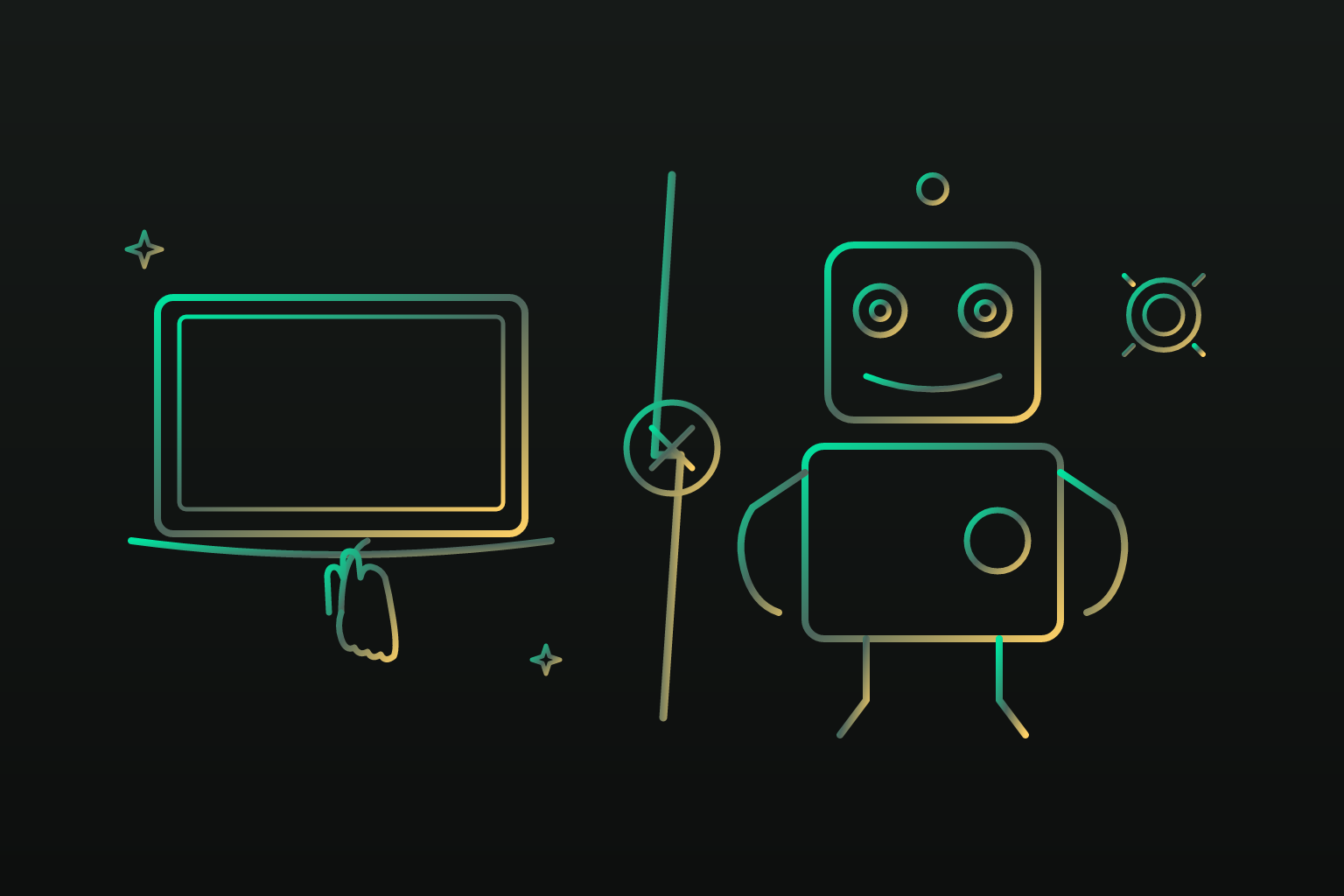
AI powered coding assistants and autonomous coding agents help engineers with different kinds of work. Assistants help developers write code faster, while agents take on multistep work that includes testing and revision. They are not competing rungs on one ladder. The useful choice is where to put each tool, and what controls its scope requires.
Why AI coding assistants and autonomous coding agents are not the same category of tool
Marketing language around assistants and agents has deliberately blurred the boundary between them. Both write code, and both fit into a developer’s workflow, so the confusion is understandable. A tool that suggests the next line and one that coordinates a repository-wide change need different instructions, permissions, and review.
Gartner’s 2026 market overview draws that boundary explicitly. It defines enterprise AI coding agents as autonomous or semiautonomous solutions that discover and use relevant context, translate human intent into multistep plans, and execute and verify those steps across code, tests, and related engineering artifacts. That definition excludes conventional assistants. The sequence from completion to conversation to agentic execution added scope and speed. An agent is not autocomplete with a promotion.
What each tool actually does under the hood
An assistant predicts the next line or block as a developer types, or answers a single chat prompt. It works within a file or short context window and does not keep state from one step to the next. The developer supplies the sequence of decisions. For a task such as adding email validation to the signup endpoint, the developer opens the relevant code, requests or accepts suggestions, and decides what to test and change next.
An agent receives that same task as a goal. It can inspect the application structure, identify relevant files, propose a plan, edit across files, run tests, diagnose failures, and revise before presenting a diff or pull request. The defining feature is the feedback loop. Repository search, file access, terminal execution, build systems, test runners, and version-control operations let it act on what it finds. Services outside the agent can connect through protocols such as MCP to give it access to more tools.
Execution also splits into synchronous and asynchronous work. A synchronous agent operates in an IDE or terminal while the developer watches, answers questions, and gives feedback. An asynchronous agent runs in a cloud or isolated environment while the developer does something else. Its branch, pull request, or test output gets reviewed later. The unit of work has changed from a prompt response to a session that may last minutes or hours.
Where human oversight actually sits in agent workflows
Autonomy is how much work can get done between the decisions people still make. Stack Overflow’s May 2026 pulse survey found that most people who responded still rarely or never let agents run entirely on autopilot. Most blocked unapproved system changes and preferred predictable single-agent setups over multi-agent configurations. Delegated engineering with controls is the better description.
If review remains, how is that different from using an assistant? With an assistant, the developer decides each next step. With an agent, that developer can evaluate a completed diff or pull request. The developer can still set points where the agent needs approval as it works.
The paper Agentic Coding Needs Proactivity, Not Just Autonomy identifies a further distinction. It argues that agents should notice changes that matter before a developer asks, link signals from different tools, and decide when to interrupt. That is a demand for better judgment about when to act. More autonomy alone does not answer it.
The three-tier structure that maps tools to the right layer of the workflow
Tier 1 is the editor assistant, built for line-level speed and immediate feedback. GitHub Copilot’s inline suggestions, Tabnine, and Amazon Q inline completions represent this layer. The scope is a single file or short context window, without persistent state. Latency is the point here. Waiting for a repository-wide investigation would be poor service when the developer needs help finishing a function.
Tier 2 is the autonomous agent, built for repository-level depth. It keeps state throughout a session and uses tools to manage multi-file changes with little guidance at each step. SWE-bench Verified’s standardized leaderboard placed leading agents in the mid-seventies in early 2026, while some self-reported scores reached the high seventies to low eighties. Those results show substantial repository-level capability, though not a production guarantee. Teams that need control can use model-agnostic, open-source frameworks that keep the agent harness separate from the model, so they can run it on their own infrastructure with the model they choose.
Tier 3 is the platform agent, where the scope expands to a governed software delivery pipeline. Isolation, persistent workspaces, cost predictability, audit trails, and CI/CD integration become central requirements. The task is no longer just writing code. Gartner’s recognition of OpenAI Codex as a Leader in the 2026 Magic Quadrant for Enterprise AI Coding Agents highlighted Codex-specific strengths including approval gates, RBAC, customizable policies, OS-level sandboxing, and auditable workspace governance.
Open-source platforms deployed on an organization’s own infrastructure offer another way to provide that governance. The organization can choose the model, inspect execution, and enforce its own controls without vendor lock-in. A mature setup can use an assistant for daily edits, an agent for refactors or test generation, and an optional platform agent in CI/CD to enforce policy and capture audit logs.
What productivity gains actually look like in practice, and where they concentrate
Anthropic’s customer case tells how Doctolib used Claude Code to replace its visual regression testing tool, reducing the time required from weeks to hours. The gain came from completing a coordinated body of work. Doctolib also integrated agent work into its CI pipeline through a staged approach. That moves the discussion from personal convenience to work removed from the team’s calendar.
McKinsey’s 2026 Global Survey shows a different consequence of that expanded scope. It found that 32% of respondents reported their organizations had made a procurement decision against purchasing one or more software products because they could now build the equivalent internally with agentic coding tools. It shows that agents have changed which options organizations consider feasible.
The same survey found that high-performing organizations were substantially more likely than others to report scaling software coding agents, and even more likely to report scaling other agentic AI. The pattern suggests that systematic adoption can yield more than isolated individual use. Scope helps explain where the gains concentrate. Assistants compress a developer’s immediate task, while agents can take over longer sequences whose manual coordination would otherwise remain with the team.
The security and quality trade-offs that appear when agents write more code
Veracode’s 2026 GenAI Code Security Report found that roughly 44% of AI code generation tasks added a risky security vulnerability to the code. It also found that the average security pass rate across models remained essentially flat between its first and second reports. More generated code has not brought a matching improvement in security performance. That finding covers code generation by agents and other tools, but the more work agents can do, the more work people need to check.
Giving agents access to tools adds a security risk beyond faulty code. In CVE-2025-53773, malicious prompt injections came through material such as source code comments, project files, GitHub issues, or web content. The distinction is important because agents consume context and can act through tools. Text in a repository can contain instructions that should not be trusted. The ability to read more context therefore needs controls over what the agent is permitted to do with it.
Benchmark success does not remove that need. Top-performing agents score far lower on SWE-bench Pro, a harder, contamination-resistant benchmark, than they do on standard benchmarks. A strong leaderboard result cannot stand in for evaluation of an actual change. Tests, correctness, and security remain separate questions that the delivery process has to answer.
The risk-adjusted case therefore depends on the harness as well as the model. Approval gates, automated security scanning in CI, and human review of diffs are standard controls for keeping generated changes from moving unchecked into production. A well-designed platform enforces review and records an audit trail by default. A poorly governed one lets the model commit directly to main. Speed without those controls is merely a faster route to the incident channel.
Why most enterprise agent pilots stall before reaching production, and what clears the path
The main obstacle between an enterprise pilot and production is usually not whether the agent can write code. It is whether the surrounding infrastructure meets security and compliance requirements. Data residency may mean that code has to stay in a specific environment, while isolation must keep agents from having direct access to production systems. Every action needs an audit trail. Humans also need approval gates through which they can block or roll back agent actions.
Organizations that clear this gap treat the harness as the primary procurement decision. They assess which platform shows what the agent is doing and gives them controls to stop it. They also begin with scoped, low-risk tasks such as documentation updates, test generation, and dependency upgrades before delegating feature work. Doctolib’s CI pipeline integration represents that staged approach. The rollout expands with the operating process.
Organizations track how many pull requests there are, test pass rates, security scan results, and lead time for changes before and after they start using agents. Those measures help teams tell how much work is done and how much has only been generated, while showing its quality and how fast it gets delivered.
Enterprises that need strict controls can use self-hosted, open-source agent infrastructure to solve the problem of where to run agents. Code can remain within the organization’s required environment rather than pass through a vendor’s hosted platform, and teams can inspect every layer of the execution stack. Model choice remains separate from platform choice. This can meet residency and isolation needs without negotiating custom enterprise agreements, provided the deployment implements the required controls.
How to decide which tool belongs where in a real engineering workflow
The practical choice starts with task scope and the team’s ability to govern execution. An editor assistant fits a single file or short, well-defined function when immediate feedback is more useful than deep investigation. It also fits teams not yet ready to instrument and review agent output. In regulated environments, assistant-level tools can help when getting approval for autonomous execution would take a long time.
An autonomous agent fits work that crosses files, needs repository-wide context, or requires repeated writing, testing, and revision. The task should have a clear goal, defined acceptance criteria, and an existing test suite the agent can run. The team should also have pull request review, automated security scanning, and approval gates before merging. Legacy refactors, test generation, dependency upgrades, documentation updates triggered by code changes, and feature implementation from a detailed specification fit this pattern.
For enterprises, the next decision is where that agent runs and who can inspect its execution. Model-agnostic, open-source platforms suit teams that need their own infrastructure, model choice, and governance rather than a vendor’s hosted environment or pricing model. Most teams in 2026 can realistically use both categories, matching immediate help and long-running work to different tools. Where no multistep feedback loop is needed, an assistant is faster and simpler. Where it is needed, an agent is the structural fit, subject to those controls.
Does the task require the agent to act, observe results, and correct its own work across multiple steps?