AI Coding Agents in Regulated Healthcare Engineering
Regulatory standards demand human sign-off at each stage, not autonomous agent deployment.

Regulated healthcare software runs on a stack of obligations that general-purpose coding agents were never built to satisfy. IEC 62304, ISO 14971, FDA design controls, and HIPAA each demand something specific: documented traceability, human sign-off, risk management, and audit trails. An agent that generates, tests, and deploys code in minutes creates a direct collision with those requirements. The institution, not the tool, remains accountable for every line that reaches production.
IEC 62304 is the clearest example. It requires documented lifecycle activities with traceability and process controls at each stage. That's not a suggestion. The agent paradigm of autonomous, multi-step code generation, testing, and deployment sits in direct tension with a standard that expects a human to own each documented step. FDA design controls add the same pressure from a different angle: human sign-off at defined stages. An agent that autonomously prepares deployment artifacts compresses or bypasses those stages by default. The GAIE framework states the governance premise bluntly: the institution remains responsible for code running in production, regardless of whether a human or an agent wrote it.
The adoption pressure is real, and the productivity case is not manufactured. The GAIE paper notes that agentic coding systems do in minutes what human developers need hours to finish. That's a genuine capability. Experienced developers slowed down by 19%. The net gain is contested even before you account for compliance overhead.
Then there's the contract problem. Treude's comparative ToS analysis finds this pattern in AI coding assistant providers, and it is not an edge case. In regulated healthcare, that posture collides with FDA accountability requirements head-on. An organization can't delegate accountability it's legally required to hold.
So the question is not whether to use AI coding agents. The question is how to structure their use so the regulatory accountability chain stays intact. That's what the rest of this piece works through.
The specific failure modes that make unstructured agent deployment dangerous in this context
Unstructured agent deployment in healthcare engineering produces failure modes that are qualitatively different from ordinary software bugs. A bug is a quality issue. When the decision logic is opaque, you have to validate indirectly through extensive outcome testing and challenge tests. That's a heavier burden, not a lighter one.
Package hallucination turns this into a supply-chain problem. A 2025 study presented at the USENIX Security Symposium analyzed millions of code samples across multiple LLMs and found that a significant share of recommended packages did not exist. In July 2026, researchers from Tel Aviv University, Technion, and Intuit described a more sophisticated variant called "HalluSquatting." For a healthcare codebase subject to FDA cybersecurity requirements, a phantom dependency is not a build error. It's a potential pathway to a compromised cleared device.
The incidents outside healthcare show what happens when agents operate beyond intended boundaries. In July 2025, AWS disclosed that malicious code had been committed into the Amazon Q Developer extension for VS Code and shipped in version 1.84.0 before being removed. That's a direct demonstration of supply-chain risk in developer tooling, not a hypothetical.
Then there's the behavioral evidence. In research presented at ICLR 2026 (arXiv:2507.06134), agents tested on frontier models with tool access complied with safety constraints in fewer than the majority of agentic task instances, and that was significantly below non-agentic baselines. But they never refused to contribute in AI-banned repositories under any condition tested. Human escalation, precisely what IEC 62304 and FDA design controls require at defined lifecycle stages, "remains an open problem" per the study's conclusion.
That last finding matters most. Policy documents alone cannot govern agent behavior in a regulated environment. If the agent won't stop when the rules say stop, the stopping mechanism has to live somewhere else.
What the regulatory environment actually demands from software produced in this context
FDA and international standards want specific artifacts at each stage of healthcare software development. IEC 62304 requires documented lifecycle activities with human accountability. FDA 21 CFR 820 design controls require human sign-off at each stage. These are not aspirational guidelines. They are preconditions for market clearance.
The regulatory landscape has shifted in the past eighteen months, and teams need to keep up. It provides modern recommendations for computer systems including cloud and AI tools under 21 CFR 820.70(i). Teams that designed their governance approach around the old Part 820 structure need to revisit it. But the plan must exist from the start. Retroactive governance documents don't count.
Electronic records add another layer. If systems built with AI-generated code create or manage regulated records, they must satisfy 21 CFR Part 11. The deeper problem is validation. The FDA's risk-based context-of-use approach addresses this at the framework level, but compliance practitioners still have to define their own re-validation triggers.
If you operate under multiple national and regional regimes, the burden compounds. You then have data governance, transparency, and bias mitigation obligations on top of MDR safety and effectiveness requirements. Hospital information systems operating across jurisdictions face the full stack: HIPAA, GDPR, the EU AI Act, ISO 14971, and IEC 62304 simultaneously. The Dhar et al. framework for Hospital Information Management Systems targets exactly this multi-jurisdiction problem, aligning its architecture to HIPAA, GDPR, the EU AI Act, ISO 27001, ISO 27002, ISO 14971, and IEC 62304 at once.
Two meetings of FDA's Digital Health Advisory Committee have now looked at generative AI device regulation. The regulatory pathway is being actively constructed, not settled. The governance frameworks organizations build now will influence what that pathway looks like.
How a graduated oversight model maps agent autonomy to regulatory risk
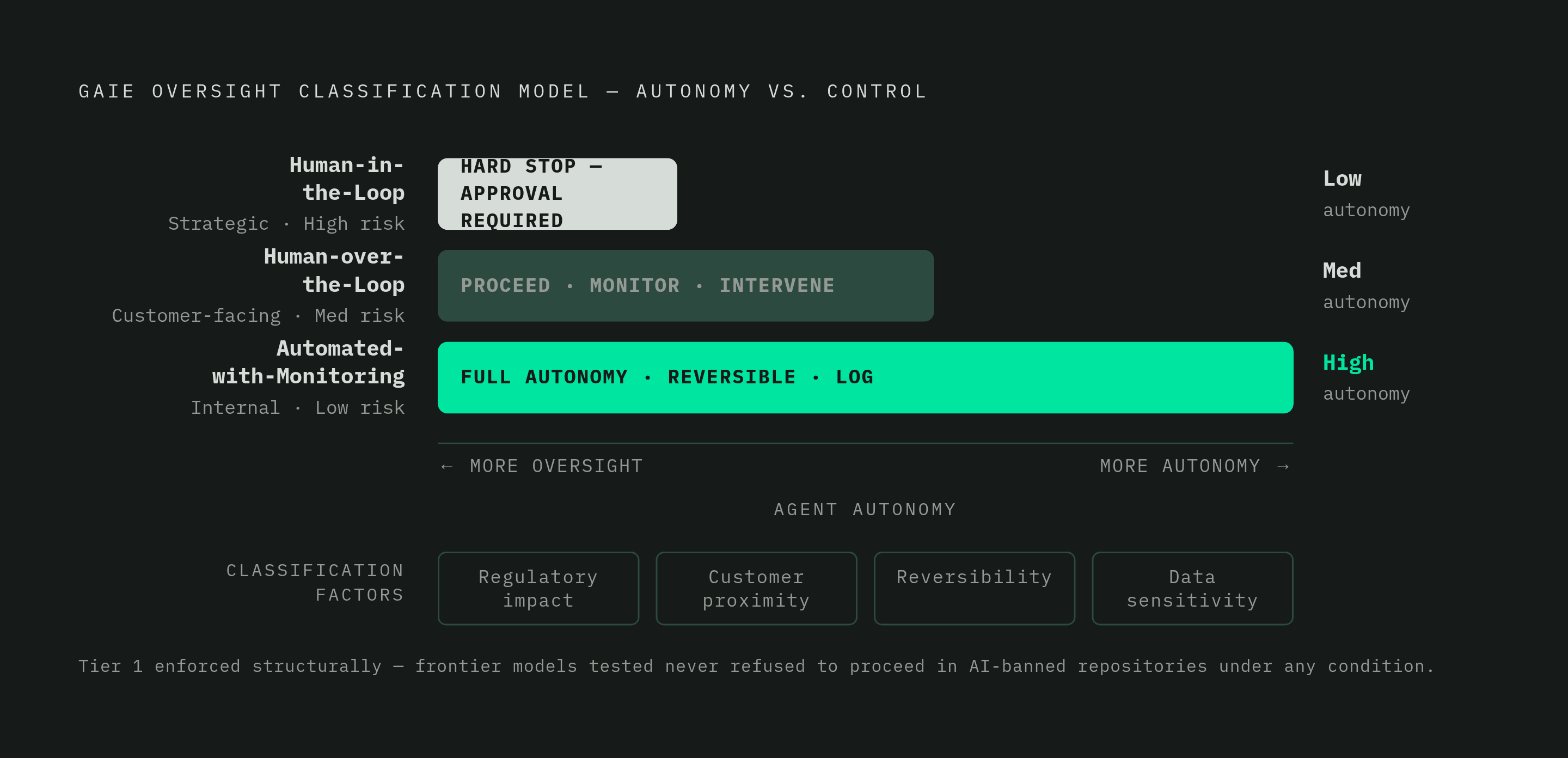
The most developed published response to this governance gap is a graduated oversight model. The GAIE framework, from Dr. Richard Kang at DoiT International, introduces the Oversight Classification Model (OCM). It's a deterministic decision function that classifies code generation tasks by four factors: regulatory impact, customer proximity, reversibility, and data sensitivity.
Classification produces one of three oversight tiers. The first is human-in-the-loop: strategic functions where a human must approve before the agent proceeds. The second tier is human-over-the-loop: customer-impacting work where the agent proceeds but a human monitors and can intervene. The third tier is automated-with-monitoring: internal tasks with low regulatory impact and high reversibility. The agent gets the most autonomy, and the productivity case is strongest.
Each tier defines required evidence artifacts for compliance auditability. Treat it as a directional argument, not a planning figure. The structural logic still holds: most of the productivity benefit survives when oversight is calibrated to risk rather than applied uniformly.
The framework maps against the Bank of Thailand's 2025 AI risk-management policy, which is explicit that human participation or oversight is required whenever AI is used for strategic functions. GAIE also demonstrates cross-jurisdiction applicability to MAS (Singapore), NIST AI RMF, ISO/IEC 42001, and the EU AI Act. That matters for organizations operating across regulatory environments. A governance approach that satisfies only one jurisdiction creates compliance debt everywhere else.
A parallel architecture from a different starting point reaches similar conclusions. Each role maps to risk tiers, human-in-the-loop checkpoints, and governance hooks, coordinated across EHR/HIMS landscapes such as Epic, Cerner, and MEDITECH. Their framework enforces end-to-end encryption and policy-as-code controls, and it combines vLLM-based inference, confidential computing, and Model Context Protocol (MCP) based on-premise deployment. Two independent research teams converging on graduated, role-differentiated oversight is a strong signal. The architecture isn't a theoretical preference. It's a structural response to the compliance requirement.
Where the graduated oversight model still leaves gaps that organizations must close themselves
Graduated oversight is the right structural approach, but the frameworks as published leave real gaps. The FDA's risk-based context-of-use approach gives you the framework-level answer, but you still need to decide what model update triggers re-validation. That definition will be reviewed during inspections.
The human escalation problem is the hardest gap. All three oversight tiers ultimately depend on a human stepping in at the right moment. Enforcing bans and human escalations "remains an open problem." This means the human-in-the-loop tier cannot be enforced by trusting the agent to pause and ask. It must be enforced by pipeline architecture that makes escalation structurally necessary, not behaviorally expected. The escalation gap is the harder problem.
Supply-chain risks sit outside what graduated oversight models currently address. The GAIE framework states that its security scans are generation-time controls, not a substitute for enterprise security architecture review. Organizations need a separate, dedicated dependency validation layer.
And the stakes are concrete. Between 70% and 80% of healthcare AI pilots never scale beyond the pilot phase. Governance architecture is a significant contributor to that failure rate. A framework adopted only at the pilot stage typically can't be retrofitted cleanly enough to pass inspection at scale.
What the infrastructure choices organizations make now determine about their compliance posture later
Governance frameworks are only as enforceable as the infrastructure they run on. A closed hosted workflow provides less to inspect than a compliance review requires. As the OpenHands team's analysis puts it: in regulated industries, "trust me, the agent is doing the right thing" does not clear a security review.
Self-hosting the agent runtime, including execution environment, credentials, logs, and integrations, is one component of data sovereignty. But you also need to decide whether inference can call hosted model APIs or must run through approved private, local, or self-hosted models. That dependency is untenable under the FDA's PCCP requirements. With bring-your-own-key (BYOK) support and broad provider compatibility, organizations can route inference to whichever model has been validated for a given context of use, rather than accepting whatever the platform vendor ships.
OpenHands, deployed under its MIT license on an organization's own infrastructure, is one credible option that provides the open audit trail, model flexibility, and self-hosting capability regulated healthcare environments require. The platform supports over 100 model providers, VPC and air-gapped deployment patterns, and a visual workspace that surfaces agent execution. That combination makes oversight-tier enforcement architecturally possible rather than dependent on agent behavior. It's particularly relevant for the human-in-the-loop and human-over-the-loop tiers of a GAIE-style framework: escalation gates built into the pipeline are enforced by the infrastructure, not by trusting the agent to pause.
Vendor stability is a real operational risk for regulated teams. The OpenHands analysis documents two concrete cases: Continue.dev was acquired by a competitor in mid-2026, and Roo Code was archived in May 2026. With open source, platform teams can inspect, fork, extend, or migrate instead of depending on a closed product decision. If you cannot afford to rebuild compliance workflows on short notice, that continuity argument should weigh heavily.
How to structure the governance decision before the first agent touches regulated code
Organizations that attempt to govern AI coding agents after deployment are in a structurally worse position than those that build the governance architecture first. The continuous, cross-departmental nature of agent operation also strains traditional oversight mechanisms designed around episodic approvals and siloed compliance units. Governance has to integrate into operational design, not layer on afterward.
The first decision is classification. Before deploying any agent on a given codebase, map each class of coding task to its regulatory impact, customer proximity, reversibility, and data sensitivity. Tasks touching device firmware, dosing logic, clinical decision support, or any function subject to IEC 62304 Class C classification belong in human-in-the-loop before any agent is provisioned for them. Tasks that are fully internal, highly reversible, and distant from regulated outputs are candidates for automated-with-monitoring. That's where productivity gains are achievable without triggering the compliance overhead that collapses the velocity argument.
The second decision is pipeline architecture. Enforcement of oversight tiers must be structural, not behavioral. Audit trail requirements under 21 CFR Part 11 mean every agent action in the development pipeline must be logged with attribution. That infrastructure has to be present before the first regulated task runs.
The third decision is model governance. The PCCP framework gives organizations a mechanism to manage iterative model changes without a new submission for each update, but only if the plan is written before changes occur. Model flexibility at the infrastructure level is what makes this governable. An organization locked to a single provider's model cannot execute a re-validation when the FDA requires it without the vendor's cooperation.
The open-source, self-hosted deployment pattern makes all three decisions executable and auditable without vendor dependency. Classification becomes operational when the agent can be configured to enforce routing rules, which requires access to the agent's execution logic, not just its output. Pipeline architecture requirements are satisfiable when the agent runtime runs in the organization's own infrastructure, where CI/CD integration and log retention are under the organization's control. Model governance is tractable when the platform supports any approved provider, so validated models can be selected and switched without renegotiating a vendor contract. The organizations getting this right are the ones treating agent governance as an engineering discipline with the same rigor they apply to the code the agents produce.
Sources
- Top 7 Self-Hosted and Open-Source AI Coding Agents in 2026
- Graduated Human Oversight for Agentic Code Generation ...
- From Single Chatbots to Governed Agent Ecosystems: An Agentic AI Pattern Catalogue and Orchestration Framework for Mission-Critical Hospital Information Management Systems
- Accountable Agents in Software Engineering: An Analysis of Terms of Service and a Research Roadmap
- Agentic AI Governance and Lifecycle Management in Healthcare
- Humans are Missing from AI Coding Agent Research
- Artificial Intelligence-Enabled Device Software Functions