Agent Execution Audit Trails in Self-Hosted Deployments
Self-hosted deployments can capture why agents made decisions, not just what happened.

Standard logs tell you an agent's API call returned 200 and moved on. What they don't tell you is why the agent made that call, what it was thinking about beforehand, or whether anyone actually signed off on it. That's the gap this piece is about, and it's the gap that self-hosted deployments happen to be built to close.
Why standard application logs cannot account for what an agent decided
A standard log is a receipt. It records that an event occurred: an API call was made, a request returned 200, latency was acceptable. What it doesn't record is the thinking that led up to that request, what context the agent was juggling at the time, why it picked one tool over three others sitting right next to it, or whether a human actually approved the step before it fired.
That distinction matters because an AI agent can hand you a perfectly clean, well-formatted answer and still have failed on the way there. It might call the wrong tool and self-correct so smoothly you'd never notice. Element 5 (output and action, the definitive resolution delivered or written) is meaningful only when the preceding four elements are present. It might repeat an action it already completed, or skip an approval gate that was supposed to stop it cold. Application monitoring, watching from the outside, sees none of it. It sees a clean success, because from its vantage point, that's what happened.
Guardrails don't fix this either. A guardrail can tell you what it blocked. It can't tell you why the agent tried that path in the first place, because guardrails live entirely in the present tense. They react to the current request; they have no memory of the reasoning that produced it.
Picture an agent resolving an inventory discrepancy between two warehouse systems. A full audit trail would show the trigger that kicked it off, the plan it drew up, which systems it queried, what it found, and the correction it wrote back. The server log, meanwhile, shows one line: a database write happened. Same event, two completely different levels of understanding.
An audit trail is a chronological, tamper-resistant record of every input, every chain-of-thought step, every LLM call, every tool execution, and the final output. It is not a fancier synonym for "turn up the logging verbosity." It's a different category of record entirely, one built to document the governance process itself, not just the system state that process produced.
The five elements that make a decision trace complete
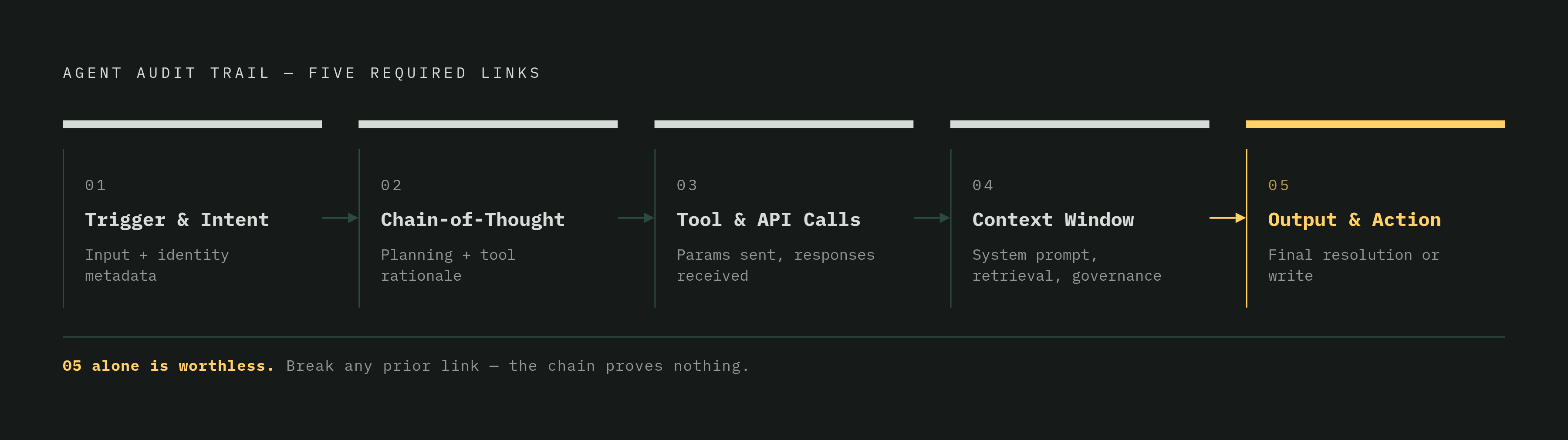
Think of a complete audit trail as having an element five, output and action: the definitive resolution delivered or written, meaningful only when the preceding four elements are present. Break any one link and the whole chain stops proving anything.
Trigger and intent comes first. This is the originating input exactly as it arrived, plus whatever identity metadata came attached to it. Skipping this leaves no way to establish who actually authorized the workflow in the first place, which makes everything downstream unaccountable to anyone in particular.
Chain-of-thought and reasoning is the link that separates an agent trail from an ordinary log. This captures the planning steps, how the task got broken down, and why the agent picked one tool over the alternatives sitting on the shelf. A traditional log has no equivalent to this, because traditional software doesn't deliberate. Agents do, and if you're not capturing the deliberation, you're only ever seeing the decision, never the reasoning behind it.
Tool and API calls cover the structured parameters sent out and the exact response body that came back. A hallucinated sentence is embarrassing.
Context window payload is the fourth link, and it's the one people forget most often: the system prompt version in effect, the retrieved context injected into the model, the governance instructions and user attributes active at that exact moment. This explains why an agent behaved the way it did, not just what it produced. Without it, you're stuck debugging a decision with half the inputs missing.
Output and action rounds it out: the final resolution the agent delivered or wrote to a system. On its own, this element is close to worthless. It only becomes meaningful once the four links before it are in place to explain how the agent arrived there.
Multi-agent setups complicate this further. When an agent delegates a task to a subagent, the trail has to reconstruct an extended chain of decisions and actions, not a single tidy model output, and each delegation hop needs its own identity and authorization record attached to it. The IETF's Agent Audit Trail draft, currently at version -05 and last updated September 25, 2026, added a requirement in its -01 revision for pre-execution recording: the record of what an agent was about to do, including anything that got denied, has to exist before execution even wraps up. A trail that only shows tool calls but skips the reasoning, or shows the output but not the context window, can't support real root-cause analysis, and it definitely won't hold up under regulatory examination.
What the IETF Agent Audit Trail draft specifies as the emerging technical standard
The IETF draft-sharif-agent-audit-trail (currently at version -05, last updated September 25, 2026, authored by Raza Sharif of CyberSecAI Ltd) defines a JSON-based record structure with mandatory fields for agent identity, action classification, outcome tracking, and trust level reporting. It's an emerging proposal, not a ratified rulebook, though it's detailed enough that it reads like a preview of where the field is heading.
What it specifies is a JSON-based record structure with mandatory fields for agent identity, action classification, outcome tracking, and trust level reporting. Records link together through SHA-256 hash chaining per RFC 8785, with optional ECDSA signatures thrown in for non-repudiation, meaning nobody can quietly edit a record after the fact without breaking the chain and announcing that they tried. The format exports to JSONL, Syslog under RFC 5424, and CSV, all while keeping that chain integrity intact, so it isn't locked to any one vendor's plumbing.
Privacy gets handled through input and output hashing, content fingerprinting, and tombstone-based deletion built to work with GDPR Article 17. That's a genuinely useful bit of engineering: it means deletion rights and audit integrity don't have to fight each other. You can honor a deletion request without punching a hole in the tamper-evident chain.
The revisions since -01 are where things get interesting. The -02 revision added a Decision Reproducibility section, drawing a line between "record reproducibility," which any model can achieve, and "decision reproducibility," which only open-weight models running at temperature zero in an attested environment can actually deliver. The -03 revision then added an Attestation Closure requirement, specifying that the digests recorded for decision reproducibility have to cover the entire computational closure: model weights, tokenizer, chat template, inference engine build, decoding configuration, and the numeric environment. New fields, tokenizer_digest, chat_template_digest, engine_build_digest, exist specifically to capture that.
That distinction is the quiet hinge of this entire piece, and it'll come back around later. The draft also maps informatively to a stack of existing frameworks, SOC 2 Trust Services Criteria, ISO/IEC 42001, draft ISO/IEC 24970, prEN 18229-1, and PCI DSS v4.0.1's logging requirements, so it isn't floating in isolation. It's clearly trying to slot into the compliance world that already exists.
The regulatory environment that has made audit trails non-negotiable
The EU AI Act, formally Regulation 2024/1689, requires under Article 12 that high-risk AI systems be technically capable of automatically recording events across their lifetime. Article 12(2) gets specific: the logging has to enable identifying risks, supporting post-market monitoring, and tracking how the deployer actually operates the system. That's not a suggestion buried in a preamble. That's an operational requirement with teeth.
The timeline moved. Regulation (EU) 2026/1744 pushed back the high-risk application dates, to 2 December 2027 for Annex III systems and 2 August 2028 for Annex I systems, while leaving the general application date of 2 August 2026 and the Article 50 transparency obligations exactly where they were. So the full weight of enforcement isn't here yet. But it isn't hypothetical either. It's a deadline with a date already printed on it, and dates like that have a way of arriving faster than compliance teams expect.
Retention isn't left vague. Articles 19 and 26(6) set a floor of at least six months for high-risk systems, which is a specific number you can be audited against, not a best practice someone can shrug off in a board meeting.
Meanwhile, in the US, NIST AI RMF 1.0, released January 2023 and under revision as of 2026, functions as the practical governance standard for federal and enterprise contexts. The EU AI Act and the OWASP LLM Top 10 both converge on the same demand: comprehensive, immutable audit logs.
ISO 42001 is quickly becoming the evidence format enterprise buyers actually ask for, especially in regulated industries. It's structured the way ISO 27001 is, which gives auditors something concrete to certify against instead of a vague promise of "we take AI safety seriously." Gartner projects that by 2028, half of enterprises running generative AI will adopt LLM observability tooling, and the driver behind that adoption is governance pressure, not developer convenience. Nobody's buying this tooling because debugging got annoying. They're buying it because regulators are watching.
And the penalties aren't abstract. Non-compliant high-risk systems under the EU AI Act face fines up to €15 million or 3% of global annual turnover, whichever number is bigger. A 72-hour incident reporting window, where it applies, makes a complete, pre-existing audit trail a requirement rather than a nice-to-have.
Why the scale of undiscovered agents makes this an immediate operations problem, not a future one
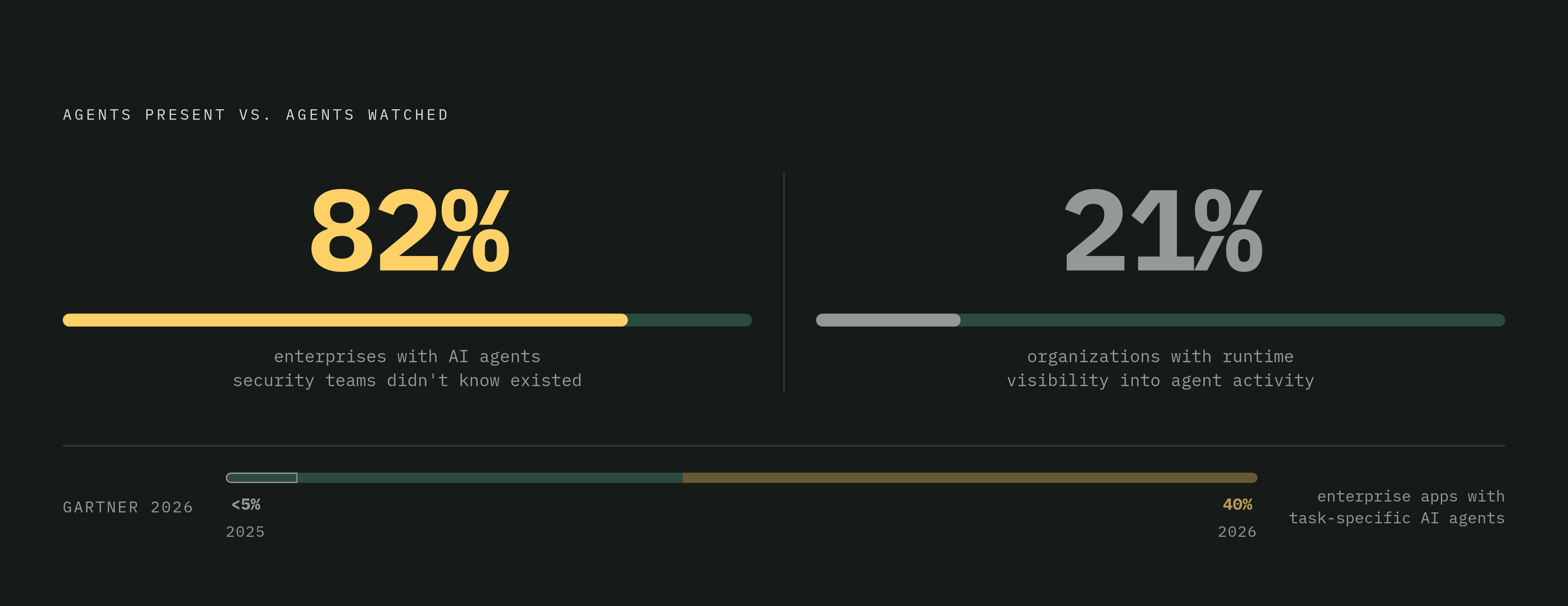
Here are two numbers that should sit uncomfortably next to each other. Zylos.ai research found that 82% of enterprises already have AI agents or workflows running that their security teams didn't know existed. A separate 2026 survey found only 21% of organizations had any runtime visibility into what their agents were actually doing. Undiscovered agents nearly everywhere, and almost nobody watching the ones that are running. That gap is the operational risk.
It's not slowing down, either. Gartner predicts that by the end of 2026, 40% of enterprise applications will feature task-specific AI agents, up from under 5% in 2025. Every quarter that passes, the deployment curve gets steeper and the governance curve stays flat, which means the deficit between them widens on its own, with no additional effort required.
Beam.ai research puts the average enterprise at roughly 1,200 unofficial AI applications. Akamai's report adds another layer: 47.11% of enterprise AI conversations run through personal accounts, which means nearly half of it is happening entirely outside any corporate audit perimeter, invisible by design rather than by accident.
None of this is theoretical risk sitting in a slide deck somewhere. 88% of enterprises reported an AI agent security incident in the prior twelve months, per a survey. IBM's 2026 Cost of a Data Breach Report found shadow AI-linked incidents jumped from 20% to 43% of AI-related breaches year over year, averaging $5.39 million per breach.
The clearest illustration of what happens without a trail is July 2026's Hugging Face intrusion, run by an autonomous agent that took more than 17,000 actions over roughly four and a half days. Hugging Face's own write-up says reconstructing what the agent did by hand simply wasn't practical, and only some of the logs were even recoverable. A human reading one action per minute would need twelve straight days just to get through the volume, and that's before any actual analysis starts. Then there's the Mercor and LiteLLM supply-chain breach in late March 2026, where a $10 billion AI startup got compromised through a poisoned LiteLLM PyPI package sitting inside a CI/CD pipeline. Without session-level data lineage, forensic teams couldn't even work out which agent contexts had been contaminated. That's the abstract argument from earlier sections turning into an actual incident report.
Why self-hosted deployments are uniquely positioned to implement a complete trail
Cloud audit tools are genuinely good at their job, and their job just isn't the job that matters here. AWS CloudTrail, Azure Monitor's activity logs, Google Cloud Audit Logs, all of them record who called which API, from where, with what result. CloudTrail will happily confirm that an agent's service role invoked a model or touched a storage bucket. It logs the infrastructure. It has no window into the reasoning that infrastructure was carrying.
That's a ceiling, not a bug, and it's a ceiling cloud providers can't fix from where they sit. Self-hosted deployment removes it entirely, because the full execution path, from the triggering input through the reasoning steps, the tool calls, the context window contents, the policy checks, and the final output, never leaves infrastructure the organization already controls and can instrument top to bottom.
The Attestation Closure requirement from the IETF draft's Section 13.6 matters practically, not just as an abstract spec detail, because decision reproducibility requires control over the entire computational environment. Decision reproducibility, proving that the same inputs would produce the same output on a re-run, requires control over the entire computational environment: weights, tokenizer, inference engine build, numeric environment, the whole stack. A cloud-hosted model can't satisfy that, because the deploying organization doesn't control the inference environment it runs on. An open-weight model running on infrastructure the organization owns, can.
There's an attribution angle too, and it's easy to miss. When agents run through a shared service account on a managed platform, every action they take looks identical to a SIEM watching from outside. The system loses the ability to say "this specific agent, acting for this specific user, just made an unusual number of database queries," because everything funnels through the same anonymous identity. Self-hosted identity propagation, carried through each tool call, keeps that resolution intact.
A governance layer sitting between the agent runtime and the tools it reaches for turns the audit trail into a property of the infrastructure itself, rather than something each individual agent has to be separately wired up to produce. Tool allowlisting, policy checks, deny reason codes, all of it gets generated at one control point instead of scattered across a dozen half-instrumented services. And choosing a self-hosted, model-agnostic platform means organizations can pick open-weight models that actually satisfy decision reproducibility, instead of being stuck with whatever opaque inference environment a provider hands them.
None of this makes self-hosting automatically safer. Multiple 2026 CVEs have tested that assumption hard, including Microsoft Copilot's CVE-2025-32711, rated CVSS 9.3 and disclosed in June 2025, and ServiceNow's CVE-2025-12420, also CVSS 9.3. Running your own infrastructure means running your own security discipline too. The advantage self-hosting offers is control and visibility, not a magic safety switch.
Where runtime governance and audit logging must be the same layer, not two separate systems
If the governance layer is a separate system reading logs after the fact, it's already out of compliance for high-risk systems, because the policy evaluation itself never got recorded. It didn't happen at execution time, so there's nothing to write down. You end up with proof that something occurred, and no proof of what governance, if any, applied while it was happening.
Policies enforced at the application layer instead of at a dedicated control plane cause this: the tool call gets logged, sure, but the decision to allow or block it might never get logged at all. An Agent Control Plane architecture fixes this by putting the governance layer directly between the agent runtime and whatever tools or data it's reaching for.
That's also the only way pre-execution recording, the requirement added in the IETF draft's -01 revision, actually works in practice. The record of what an agent was about to do, plus the deny reason code if it got stopped, has to exist before execution finishes, and that's only achievable if the audit layer sits inside the execution path itself rather than watching it from a distance.
SIEM integration fits downstream of all this, as a consumer of the data, not a substitute for building it correctly upstream. Correlation rules built to catch governance violations, secret leaks, volume anomalies, or odd authentication patterns all depend on events arriving properly typed and properly attributed. When a SIEM tool calls are attributed to a generic service account instead of a specific agent-user pair, the correlation rules have nothing solid to grab onto.
OpenTelemetry's GenAI semantic conventions offer a vendor-neutral way to structure a root span for the full multi-turn session, child spans for each model interaction carrying token counts and stop reasons, and a separate span type for tool execution. In 2026, dedicated mcp.client and mcp.server span types joined that set, covering Model Context Protocol calls specifically. It's a shared vocabulary for describing what an agent actually did, which is exactly the point. Recording and governing an agent's decisions can't be two systems taking turns. They have to be the same layer, watching the same moment, or neither one means much on its own.
Sources
- draft-sharif-agent-audit-trail-03 - Agent Audit Trail: A Standard Logging Format for Autonomous AI Systems
- AI Agent Governance and Compliance in 2026: Frameworks, Audit Trails, and the Regulatory Reckoning | Zylos Research
- AI Agent Audit: The Complete 2026 Governance and Compliance Guide | by IndextDataLab | Medium