Agent-Driven Automated Code Review Workflows
AI agents now catch twice as many code bugs as static analysis tools.
Code review has a supply-demand problem, and it's getting worse. AI now writes a big chunk of the code entering production (Microsoft put the number at 20-30% of its repositories in April 2025; Google's Sundar Pichai cited roughly 30% on a late-2024 earnings call), and that code carries more issues than the human-written kind, not fewer. CodeRabbit's 2025 incident analysis cites research putting AI-generated code at 1.7 times more issues than code written by people. So the review queue is growing faster than reviewer capacity, and the stuff piling up in that queue is, on average, worse.
The 2025 DORA report puts a number on the tension underneath all this: AI adoption correlates with higher delivery throughput, but it has a negative relationship with delivery stability. Teams ship faster and break more. Manual review, done the old way, one human reading every diff, can't keep pace with that math. Search interest in "AI code review" is up 310% between mid-2025 and Q1 2026, and most of the people searching for it aren't the engineers writing code. They're engineering managers. That's not curiosity. That's an organizational alarm bell.
What separates an AI agent reviewer from the linters and scanners already in the pipeline
Every team already has linters, static analyzers, and security scanners bolted into its pipeline. Nothing new there. Those tools are rule-bound: they check syntax against a pattern list, flag known bad shapes, and stop. They don't know what the code is trying to do. They just know what it looks like.
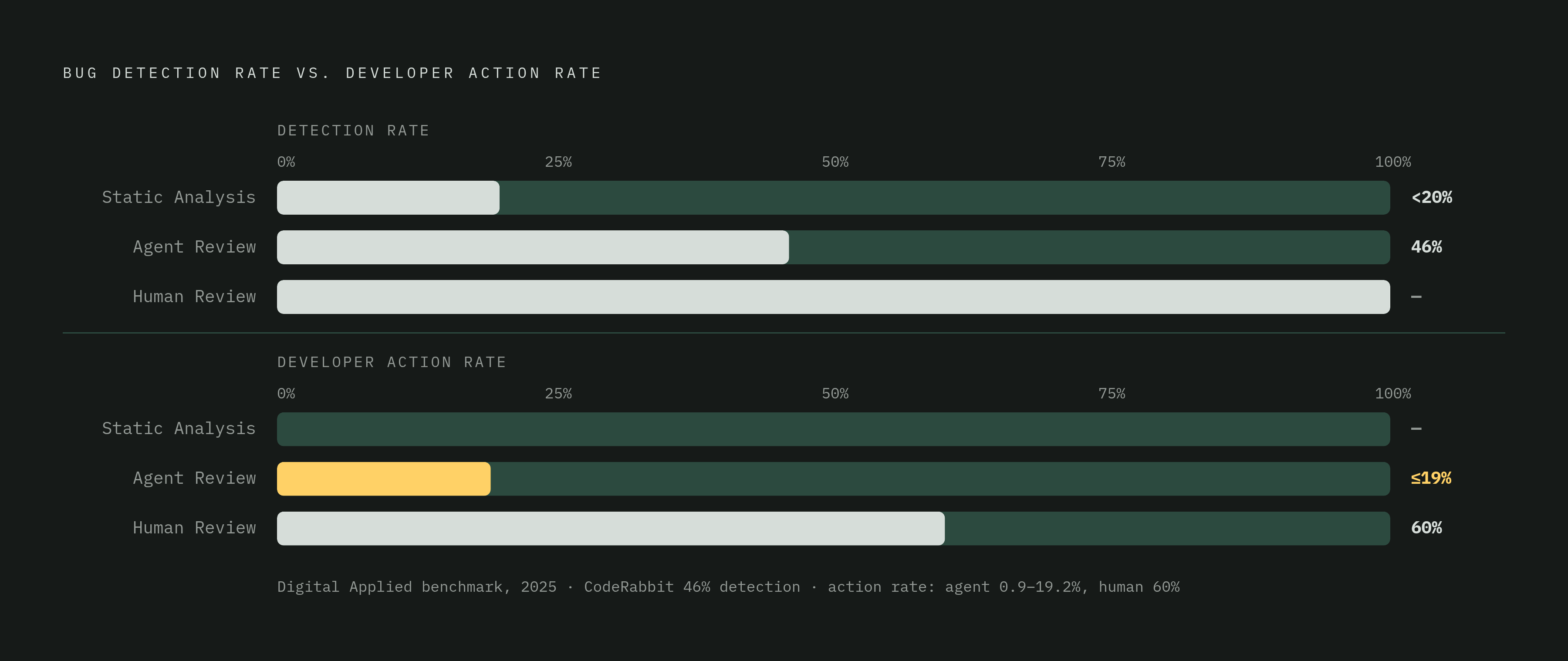
That's the wall traditional static analysis keeps hitting. Recent 2025 industry benchmarks put static analyzer bug detection under 20%, while agent-based reviewers reach 42-48%. The gap between a small tuning improvement and a different category of tool catching a different category of problem is the real story here.
An arXiv survey (2603.15911) frames the distinction well: agents integrated into code review can read a repository, plan a sequence of actions, and interact with development tooling directly, rather than just matching a diff against a ruleset. A linter checks whether you used a semicolon correctly. An agent can look at your database migration, notice it doesn't match how the calling function uses the field three files away, and flag that the two don't line up. One reads syntax. The other reads intent, or something close to it.
None of this means the ceiling is high yet. Current models handle small, contained edits far more reliably than sprawling changes that touch a lot of context at once. A one-function bug fix is a different animal than a refactor touching twelve files, and the tools know the difference even if the marketing doesn't always say so.
The three layers where agent review actually happens
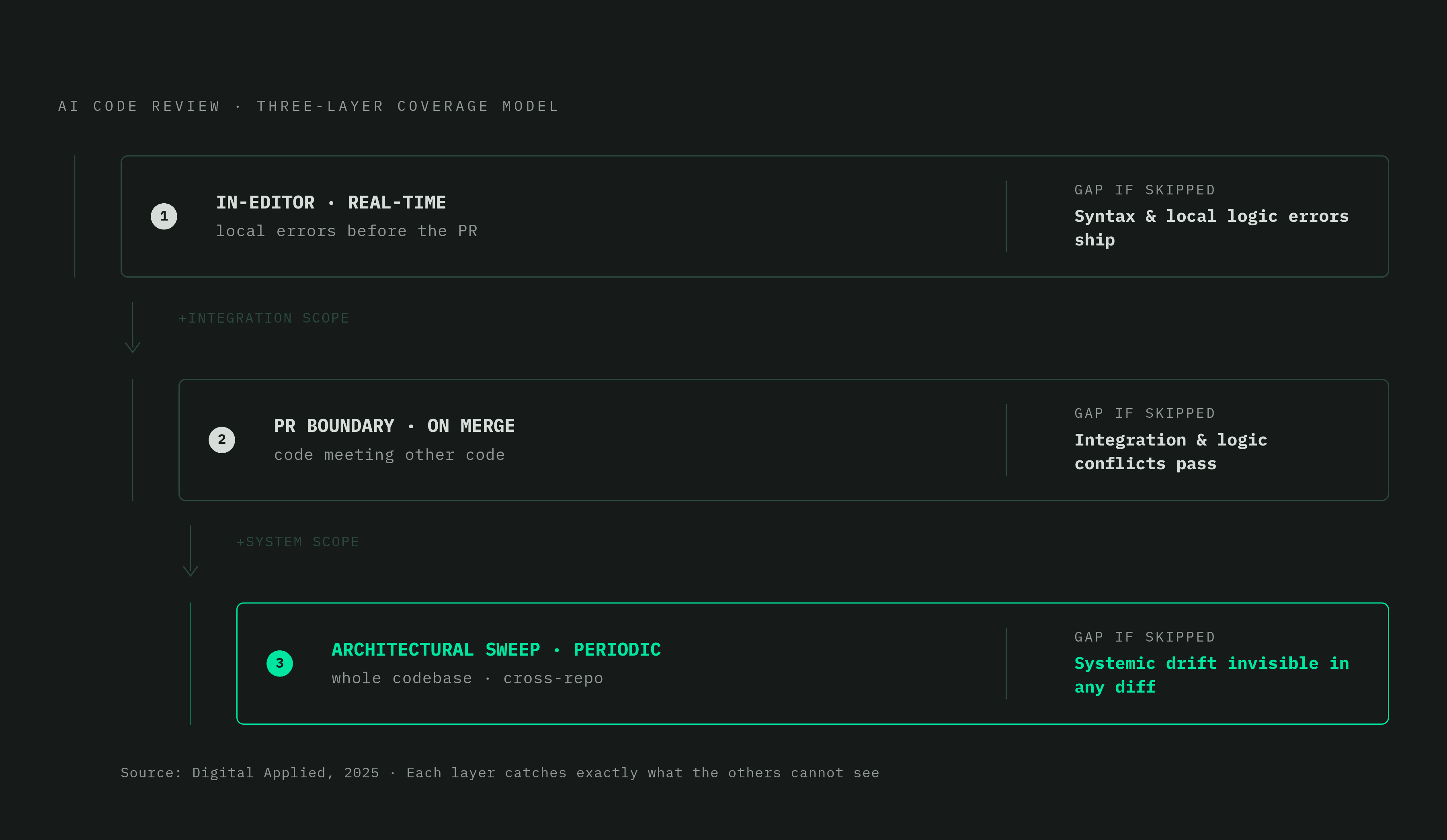
Digital Applied's 2025 guide breaks practical agent review into three layers, and the framing holds up well in practice.
Layer 1 sits inside the editor itself: real-time feedback as the code gets typed, catching local errors before they ever reach a pull request. Layer 2 kicks in at the PR boundary, tools like GitHub's Copilot code review or CodeRabbit analyzing a change at the PR boundary, catching integration problems and logic errors that only show up once code meets other code. Layer 3 runs deeper and less often: periodic architectural sweeps across a whole codebase, or across many repos, looking for the kind of systemic drift that never shows up in a single diff.
Each layer catches a failure mode the other two miss entirely. A team running only surface-level review will never catch the slow architectural rot that Layer 3 is built to find, and a team running only architectural scans will drown in local bugs that never should've made it past the editor. They're not competing tools. They're complementary, and skipping one leaves a specific, predictable gap.
Some agentic setups now run a self-review loop before a PR ever reaches a person. GitHub's Copilot coding agent reviews its own changes with Copilot code review before a developer is brought in. The human reviewer starts from a cleaner baseline, not a blank one.
Open-source, model-agnostic platforms like OpenHands can be deployed inside a company's own infrastructure. That matters for teams who want to pick their own model and control exactly where the agent executes, rather than accepting a vendor's defaults.
How the leading agent review platforms work and where they differ
GitHub Copilot Code Review went generally available on April 4, 2025, and crossed a million developers within roughly a month of its public preview. It runs fast (under 30 seconds typically) and labels every comment High, Medium, or Low severity. It's a hybrid system, blending LLM judgment with deterministic tools like ESLint and CodeQL, not a pure language-model guess.
As of July 29, 2026, agent skills and MCP support went generally available across Copilot's Pro, Pro+, Business, and Enterprise tiers. Agent skills let Copilot pull in a team's own internal tools and coding standards mid-review. MCP server connections bring in read-only context from issue trackers, documentation, and service catalogs, so the review isn't happening in a vacuum. Developers can hand fixes straight to the coding agent by mentioning @copilot in a PR, and it applies the suggested change as a new pull request. As of January 2026, Copilot had over 20 million all-time users and 4.7 million paid subscribers. Internally, Microsoft runs it across more than 90% of its own pull requests, over 600,000 PRs a month, which is presumably where a lot of the product's design decisions came from.
CodeRabbit has around 140,000 paid users and the highest install base on GitHub. A free tier for open-source repos helped it spread fast among OSS maintainers in 2024 and 2025. It installs with one click, comments inline, supports conversational back-and-forth on individual comments, and adapts to a team's style after a handful of reviews. Teams adopting it have reported meaningful reductions in review cycle time. Pricing in 2026 runs $15 per developer per month for the Lite tier, $30 for Pro. In Digital Applied's 2025 benchmark, it hit 46% bug detection accuracy, the highest of the tools tested there.
ByteDance's BitsAI-CR offers the most detailed public look at what agent review looks like at genuine hyperscale. Deployed in production for several months, it served over 12,000 weekly active users across roughly 10,000 engineers. It runs a two-stage pipeline: RuleChecker does the first pass looking for issues, then ReviewFilter checks those findings for precision before anything reaches a human. The comments it generated reached 75.0% precision, and for Go, ByteDance's dominant language, they had an "outdated rate" of 26.7% (comments that no longer applied by the time anyone read them). It also runs what the team calls a data flywheel: feedback loops and evaluation metrics feeding back into the system to improve it over time. This one's less a tool to buy and more a blueprint for teams building their own internal review system from scratch.
Graphite takes a different angle entirely: instead of adding a review layer, it changes what enters the queue in the first place. Its core feature is stacked pull requests, breaking large changes into small, atomic PRs that build on top of each other, each one small enough to actually review properly. It's addressing the problem upstream rather than downstream.
Qodo supports on-premises deployment for enterprises that can't send code outside their own walls. It also does multi-repo analysis, useful for catching breaks that span more than one codebase.
OpenHands, the open-source option, is model-agnostic: pick your own model, run it in your own infrastructure, and it keeps working around the clock without needing a coffee break. That matters most for organizations that want to own the pipeline outright and skip vendor lock-in.
A research direction worth watching is a 2026 approach for Python projects that generates review comments using Retrieval-Augmented Generation, pulling from a vector database of a team's own historical review comments. The idea is that agent review gets sharper the more institutional memory it has access to, rather than starting fresh every time.
What the empirical evidence says about agent review quality, and where the gap is
The vendor pitch and the research data don't fully agree, and the gap is worth sitting with. An MSR '26 study (Chowdhury et al., using the AIDev dataset of 3,109 unique PRs) found that PRs reviewed only by code review agents merged at a 45.20% rate, a full 23.17 percentage points below PRs reviewed only by humans, which merged at 68.37%.
The same study looked at signal versus noise in agent comments, and the picture isn't flattering. 60.2% of closed, agent-only-reviewed PRs fell into the 0-30% signal range, meaning most of the comments generated weren't useful. Twelve of the thirteen code review agents studied averaged a signal ratio below 60%. And developers know it: an earlier large-scale analysis cited in the same paper found that developers acted on human review comments 60% of the time, but acted on agent comments somewhere between 0.9% and 19.2% of the time. The discrepancy is too large to attribute to rounding. That's most agent feedback going straight into the void.
Some vendors claim their agents can handle 80% of PRs without any human touching them. The merge-rate and abandonment data above makes that claim hard to square with reality, at least for now.
The productivity picture is similarly split, and that split deserves to be stated rather than smoothed over. A METR randomized controlled trial from July 2025 found experienced developers were 19% slower using AI tools on complex, architecturally dense open-source tasks, largely because they spent the saved time re-verifying what the AI suggested. Meanwhile, other studies have found faster task completion on well-defined, contained tasks where developers review output carefully rather than accepting it blindly. Put those two findings side by side and the pattern is clear: agent review speeds things up on small, well-scoped changes, and slows things down, or worse, on big, tangled ones. Workflow design has to bend around that split, not ignore it.
How human oversight actually operates inside agentic review workflows
A study using the AIDev dataset of GitHub repos with at least 100 stars (Duma et al., EASE 2026, arXiv 2605.02273) found that most AI-generated PRs get no review at all. When they are reviewed, the back-and-forth is dominated by AI agents, not people. Where humans do show up, they're often not evaluating code so much as steering the agent, giving it commands and corrections rather than reading line by line the way a traditional reviewer would.
That's a real shift in what "review" even means. Human-authored PRs still tend to get direct, human-only review. AI-generated PRs more often get an automation-mediated back-and-forth instead. A separate Cornell/UCSD study (Huang et al., arXiv 2512.14012, based on field observations of 13 developers and a survey of 99, conducted August through September 2025) found that experienced professional developers don't just accept whatever an agent hands them. They treat the tool as a collaborator, maintaining oversight over the agent's output rather than delegating judgment entirely. The same study found roughly half of professional developers now use AI tools daily, but the experienced ones treat the tool as a collaborator, not a replacement for their own judgment.
The practical upshot: "human in the loop" doesn't mean what it used to. It's shifting from a person reading every line to a person directing an agent's behavior, and that means the old review metrics, comment counts, approval rates, don't measure what they used to measure. Teams need to be deliberate about where human judgment still has to sit: architectural calls, security implications tied to business context, logic that crosses system boundaries. None of that shows up automatically just because a human's name is attached to the approval.
The controls that make agent review behavior visible and predictable at scale
Scope matters more than most teams assume at first. Configuring an agent to run only on certain file types, certain events, or certain repos (Qodo's on-premises model is one working example) keeps it from flooding low-risk changes with noise nobody needed.
Read-only access is a quiet but important guardrail. Copilot's MCP server connections are limited to read-only calls during review, which caps how much damage an agent could do even if something went sideways. Embedding a team's actual coding standards into the agent, the way Copilot's agent skills feature (GA as of July 2026) allows, cuts down on generic, low-value comments, because the agent is reviewing against what the team actually wants rather than a generic best-practice list.
Feedback loops matter too. BitsAI-CR's data flywheel shows how tracking which comments engineers act on, and which they dismiss, lets the system get sharper over time instead of static. Teams adopting any of these tools should build some version of that tracking themselves, even informally: what got fixed, what got ignored, and why.
Audit trails matter for a different reason: accountability. With something like 44% of teams now running an AI reviewer on at least some of their pull requests, organizations need a record of what got flagged, what got waved through, and what shipped anyway. Open-source deployment, OpenHands again being the clearest example, gives an organization the ability to actually inspect what the agent is doing and fold it into existing security and compliance processes, rather than trusting a closed platform's word for it.
And the quality of agent review is only as good as what feeds it. Abstracta's Quality Intelligence framing puts it cleanly: a weak ticket becomes a weak prompt, and a flaky test suite becomes a weak feedback loop. Fix the review layer all you want, but if the requirements and tests upstream are sloppy, the agent inherits the sloppiness.
Designing the workflow layers for your organization's risk profile
Not every team needs all three layers running at once. Match the investment to actual risk: how much code is shipping, how often, and what happens if a defect slips through to production.
Agent review does its best work on small, well-described, bounded changes. Huang et al.'s interviews with experienced developers back this up directly: they trust agents on well-scoped tasks and don't on complex ones. That's an argument for structuring PRs to be small on purpose, which is exactly what Graphite's stacked PR model is built around.
For teams generating a lot of machine-written code at high velocity, the self-review loop, agent reviews its own patch before a human ever sees it, raises the floor on what reaches a person. That frees up human attention for the work an agent genuinely can't do.
Draw the line clearly. Agents are well-suited to syntax, style, common bug patterns, null checks, naming consistency, and test coverage gaps. Humans need to own architectural decisions, security calls that require business context, logic that cuts across systems, and anything touching a contract other teams depend on.
Enterprises with strict data residency or compliance requirements should weigh on-premises or open-source deployments seriously; a closed SaaS platform might not clear the governance bar no matter how good its detection numbers look. The AI code review market itself is projected to grow from $6.7 billion in 2024 to $25.7 billion by 2030, so the tool landscape is only going to get more crowded, not less.
None of that growth does the work for you, though. Agent review value doesn't switch on by itself the moment a tool gets installed. It scales with how clear a team's own standards are, how good its test suite is, and how deliberately it decides what an agent gets to touch and what stays a human's call.
Sources
- Best AI Agent for Coding? First Check Your Quality Intelligence | Abstracta
- These Aren't the Reviews You're Looking For How Humans Review AI-Generated Pull Requests
- From Industry Claims to Empirical Reality: An Empirical Study of Code Review Agents in Pull Requests
- Professional Software Developers Don't Vibe, They Control: AI Agent Use for Coding in 2025
- Enhancing Code Quality at Scale with AI-Powered Code Reviews - Engineering@Microsoft
- AI Code Review Automation: Complete Guide 2025
- Why the Internet Kept Breaking in 2025
- verdent.ai