AI Code Editors With Local Execution Support
Local models now deliver usable coding assistance without sending your code to the cloud.
"Local execution" sounds like a single idea. It is actually three different ideas wearing the same name tag, and most tools only wear one or two of them at once. The first is inference locality: does the model's math run on the developer's own chip, or does a prompt travel to a server somewhere and come back? The second is tool execution locality: when the AI wants to run a command, edit a file, or poke around the filesystem, does that happen on the machine in front of the developer, or in a sandboxed copy sitting in the cloud? The third is agent orchestration locality: when a task gets broken into steps and handed off across a longer session, does that choreography happen on hardware inside the company's own network, or on a vendor's infrastructure?
A tool can mix and match these three in ways that aren't obvious from the marketing page. One editor might run inference locally but still ship every file read and shell command through a cloud sandbox. Another might keep inference in the cloud while executing commands directly on the developer's laptop. The combination, not the label, determines what actually leaves the building and what stays put.
By 2026, the market split along exactly this line. Meanwhile, a separate and increasingly mature ecosystem handles inference, tool calls, and agent orchestration entirely on hardware the developer or their employer controls. Three things pushed that local-first side from hobbyist curiosity to a real option: open-weight coding models got good enough to be useful, runtimes like Ollama and LM Studio made them easy to run, and enterprises got nervous enough about proprietary code leaving the premises to go looking for alternatives. Keep that three-part taxonomy in your pocket. Every tool discussed from here forward slots into it differently, and the differences are the whole story.
The commodity local stack
The local stack has settled into a pattern recognizable enough to call it standard. Take an editor, add an IDE extension, connect a local LLM runtime, and point it at an open-weight coding model. In practice that usually means VS Code plus an IDE extension plus Ollama plus a Qwen2.5-Coder variant. Four layers, four jobs, and none of them need to be built from scratch anymore.
Ollama exposes an OpenAI-compatible REST API running on localhost. That one design decision means any tool originally built to talk to OpenAI's servers can be pointed at a local model instead, with zero code changes. Now it's a configuration change.
Hardware still sets the ceiling. Running a serious coding model locally generally calls for a dedicated GPU with meaningful VRAM. That's the short version, and the long version belongs in the next section, because the specifics are where the trade-offs actually bite. What matters here is that the architecture itself is no longer the obstacle. The obstacle used to be setup. Now setup is a known quantity, and the real differentiation between tools is how each tool handles model routing, agent orchestration, and the trade-off between privacy and quality once the local pieces are already in place.
Trade-offs of running inference locally versus in the cloud
Running inference locally is a trade-off that cuts both ways. It's a trade that pays off differently depending on the kind of work being done, and pretending otherwise flattens a decision that deserves more care.
For small, frequent tasks, like autocomplete suggestions that pop up as you type, local inference wins clearly. Completions arrive fast enough to feel instant, comfortably under the threshold where a developer's brain registers a delay at all. Cloud providers, by contrast, consistently land above that threshold for the same kind of request. The round trip to a server and back adds just enough lag to notice, even if it's a fraction of a second.
Longer, heavier agent work, like refactoring a single file with real logic to untangle, reverses the advantage. Cloud models tend to finish that kind of task faster, and the quality gap on complex multi-file work still favors the cloud side meaningfully. So the rule of thumb is almost comically simple: the smaller and more frequent the task, the better local inference looks; the bigger and gnarlier the task, the more the cloud's extra horsepower starts to matter.
Then there's the failure mode nobody puts on the box. When a model's size exceeds available VRAM, the runtime defaults to CPU offloading, and generation speed can drop from a usable rate to near-unusable. Generation speed doesn't dip gently when that happens, it falls off a cliff, dropping from a perfectly usable pace to something closer to watching paint dry. VRAM is a hard requirement in this setup. It's a hard ceiling, and blowing past it is the local-inference equivalent of overfilling a bathtub and wondering why the floor is wet.
Quantization adds a second, sneakier risk. Pushing further, to Q2 or Q3, the cost stops being modest. Models at that level start drifting on syntax and inventing API calls that don't exist. That's a floor that actively produces wrong code, the kind of mistake that looks plausible enough to sail past a quick glance and cause real damage three commits later.
What local inference buys back, when the hardware fits the model, is tangible. No API fees stacking up per token. No usage limits throttling a busy afternoon. No network round-trip adding latency. Code that never leaves the machine it was written on. The benefits local inference delivers that cloud cannot include the ability to work offline. None of that is available to cloud-only tools at any price.
The changed quality ceiling for local inference with open-weight coding models
The quality gap between local and cloud models hasn't closed entirely, but it's narrowed enough that defaulting to the cloud for everyday coding work is no longer the obvious move it used to be. Open-weight coding models have gotten good enough that the decision now depends on the task.
Devstral-24B is a useful marker of how fast this moved. It posts a meaningful score on SWE-Bench, the benchmark built from real GitHub issues rather than toy problems, and it does this running on a single RTX 4090 or a 32 GB Mac. A year earlier, that kind of result required cloud infrastructure, full stop, there was no consumer-hardware path to it.
Part of the shift comes from mixture-of-experts architecture, which lets a model carry a large total parameter count while only activating a fraction of it for any given request. That keeps inference cost low even as the model's overall capacity grows, which is exactly the trade consumer hardware needs: big enough to be useful, light enough to actually run.
The gap persists in certain areas. Complex, multi-file agentic work, the kind that requires tracking state and intent across a whole codebase, still plays to the strengths of the frontier models behind cloud tools. But for autocomplete, inline edits, and single-file reasoning in mainstream languages, the quality difference has shrunk down to something most developers won't notice in daily use. The ceiling moved. The basement where "good enough" lives got a lot more spacious.
IDE extensions that route local models into existing editors: Continue.dev and Cline
For a developer who wants local inference without abandoning the editor they already know, IDE extensions are the lowest-friction way in. Continue.dev and Cline are the two most widely adopted open-source options in this category.
Continue.dev, licensed under Apache 2.0, works inside VS Code and JetBrains, and its standout feature is per-mode model routing. A fast local model can handle autocomplete, a cloud model can handle chat, and a different model again can run agent tasks, all defined in a single configuration file that a whole team can share. Pointing it at any Ollama-hosted model keeps the code involved on the machine, which is precisely the feature that makes the configuration effort worthwhile for teams in healthcare, fintech, or defense. Setting up Continue means choosing models, managing API keys, and editing JSON by hand, and nothing about it is install-and-forget. But it's a cost paid once, and what it buys is consistent AI behavior across an entire team rather than everyone improvising their own setup.
Cline, also Apache 2.0, takes a different shape: it's the leading autonomous in-editor agent built for local models, and it connects to Claude, GPT-4, Gemini, DeepSeek, or any Ollama-hosted local model. That range means a developer can pick the model that fits the task at hand, dialing toward cost, quality, or privacy depending on what the moment calls for. Continue and Cline aren't really competing for the same job. One is a routing system for mixing models by task; the other is an autonomous agent that happens to be flexible about which brain it borrows.
That same pattern scales up past the individual developer. Open-source, model-agnostic agent platforms are built for organizational deployment.
Editors built from scratch with local model support as a design principle: Zed and Void
Extensions bolt local-model support onto an editor that wasn't originally built for it. A different category of editor starts from the opposite direction: local model support as a founding design choice, not an add-on. That choice buys lower latency and tighter integration, and it costs a smaller plugin ecosystem and a real migration effort for anyone used to VS Code.
Zed is the clearest example. It's written in Rust, with its own GPU rendering framework built to hit very high frame rates, which keeps rendering latency from stacking on top of whatever delay the model introduces, and Electron-based editors add their own rendering latency on top of whatever delay the model introduces, and the two stack together into something a typist can feel. Zed removes its half of that stack. Its agentic editing lets a developer describe a multi-file change in plain English and then review and approve the diffs across every file it touches.
Zed also made a notable move on the protocol side. In October 2025, it announced the Agent Client Protocol in collaboration with JetBrains, and by January 2026 the two companies had co-launched the ACP Agent Registry, letting outside AI agents plug into an editor without being welded to it. Zed already integrates Claude Code, Codex CLI, Gemini CLI, and OpenCode through that protocol. It's a bet on interoperability as infrastructure.
Windows support arrived as a stable release in October 2025, closing a gap that had kept Zed a macOS-and-Linux story and opening the door to a much larger pool of potential users. Its built-in model, Zeta, runs locally and ships with a free tier, though that allowance runs out eventually, at which point a developer needs to bring their own model or provider.
Void IDE and PearAI sit in similar territory, open-source editors that support local model integration alongside cloud-hosted options. Coverage of both is thinner than what exists for Zed, but they represent the same basic bet: that local-first can be a founding principle of an editor rather than a feature request bolted on later.
VS Code's move on local agent execution in its September 2026 release
VS Code is where most developers already live, so what it supports natively shapes a real decision: extend the editor already in daily use, or migrate to something purpose-built. The September 16, 2026 release answered part of that question by making agents a core part of the editor's architecture rather than something an extension bolts on from the side.
Concretely, agents can now run inside local Dev Containers, using the project's own tools and dependencies rather than some approximation of them. That's local tool execution, not just local inference, which matters given the taxonomy laid out earlier. The release also added an Agent Host system, links for sharing sessions, support for Codex, and a set of default automations.
Put together, this turns VS Code into a platform for orchestrating agents locally. That's a meaningful shift for anyone who assumed they'd eventually need to leave VS Code to get serious agent behavior.
Codex CLI's place in a local execution workflow despite running OpenAI's models
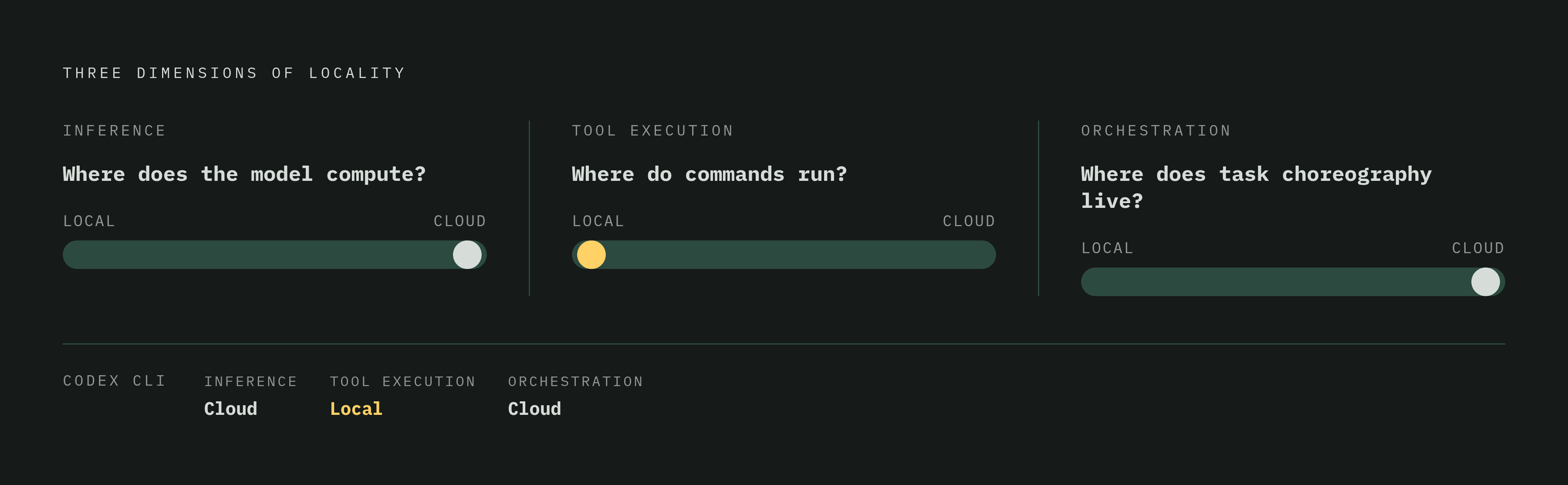
Codex CLI is the cleanest illustration available of why the three-part taxonomy from the opening section earns its keep. It runs in the terminal, reads and edits files sitting on the local disk, and executes local commands directly. None of that changes the fact that the actual inference, the part where the model does its thinking, happens on OpenAI's servers. Local tool execution and local inference are separate dials, and Codex CLI has one turned one way and the other turned the opposite way.
OpenAI released Codex CLI on April 16, 2025, as an open-source, Apache 2.0-licensed coding agent built for the terminal. It connects OpenAI's models to local code and command-line tasks, covering writing and editing code, running commands, and working with files through a lightweight interface. By March 2026, the broader Codex platform had grown to millions of weekly active users, with a desktop app for Windows and macOS, IDE integrations for VS Code, JetBrains, and Xcode, and a unified App Server architecture keeping sessions consistent no matter which interface someone opens. On July 9, 2026, OpenAI folded the Codex desktop app into the ChatGPT desktop app, part of a broader consolidation of its developer-facing products. That same March, OpenAI shipped GPT-5.4 for Codex and introduced Codex Security, an agent built specifically to find and fix application vulnerabilities.
For a team that wants terminal-native agent behavior and local file execution, and isn't worried about where the model's thinking happens, Codex CLI is a solid fit. For a team where inference privacy is the whole point, it isn't the right tool, and a different setup is called for.
Enterprise self-hosted deployment: Tabnine and the air-gapped tier
Everything so far assumes a developer with some say over their own machine. Regulated industries, government agencies, and defense contractors operate under a different constraint entirely: no code can touch an external server, period, not even briefly, not even for a model that claims to delete the data afterward. At that tier, "local execution" means fully self-hosted infrastructure with network behavior that can be audited and proven. That's a different category of tool, built for organizations whose compliance requirements treat an unverified outbound connection as a finding, not a footnote. The stakes also change shape: a missed API bill is an inconvenience, but an undisclosed data path out of an air-gapped network is the kind of thing that ends up in front of a regulator. For organizations operating under that bar, the question is which deployment can prove, on paper and in practice, that nothing leaves the building.